
Posts tagged remote work

Independent workforce climbs as U.S. women leave traditional jobs
May 17, 2023 // The independent professionals in the report are defined as not employing others and working in the following industries: • Professional services, such as legal, accounting and marketing • Skilled technical services, including architecture and computers • Creative services, such as artists and video producers Here's a breakdown of independent professionals and their typical revenue in 2022, based on the study's survey: • Professional, 3.4 million people, with average earnings per hour of $103 • Technical, 1.9 million people, with average earnings per hour of $90 • Creative, 1.4 million people, with average earnings per hour of $71 Despite mounting concerns over the economy, most independent professionals feel financially secure, according to the survey. More than eight in 10 reckon that having multiple sources of income provides a greater level of security than relying on a single employer.
After OMB’s updated telework guidance, federal unions emphasize role of collective bargaining
May 12, 2023 // To try to get more feedback from employees on engagement and satisfaction, HUD created a small-scale “stay survey” for employees leaving the agency. It received 65% positive ratings from respondents. The pilot was primarily a way to assess the value of the questions and make changes before rolling out the survey on a larger scale, HUD Deputy Press Secretary De’Marcus Finnell said in an email to Federal News Network. HUD plans to use upcoming focus groups on the survey to make additional changes to the final version. But Viola took issue with the way the survey was conducted, saying that the lack of questions about attrition, and asking why employees were choosing to leave, made the survey a limited resource to understand the root of the problem.
NY union wants more remote work for state employees
March 17, 2023 // Spence called for New York to do more on remote work flexibility and go beyond what was proposed in Gov. Kathy Hochul’s budget for the Empire State. Hochul’s budget would not only consider more flexibility for public employees to work remotely, but it allocated over $18 million to address worker shortage issues. Yet it was not enough for Spence, who has been pushing for public employees to remain as remote workers on a long-term basis and has clashed with state lawmakers over the remote work issue during the past year. The union president asserted that New York public employees are leaving New York for other states that offer more remote work flexibility and have a lower cost-of-living. Neither PEF nor Spence outlined specifics about flexible remote work and which incentives could lead to higher retention rates of employees.
Which States Are Best for Remote Workers?
March 2, 2023 // Remote work has proliferated as a work arrangement since the COVID-19 pandemic began in 2020. While its popularity has declined since its Spring 2020 peak, remote work remains far more common today than it was before the pandemic (see Figure 1). Research from Nicholas Bloom and others found that last month, nearly 13 percent of workers were fully remote, and an additional 28 percent worked in a hybrid arrangement.
Op-ed: Why Employers Forcing a Return to Office is Leading to More Worker Power and Unionization
February 23, 2023 // It's important to recognize that this turn to worker power is happening in the context of massive layoffs by tech companies, which are becoming less willing to offer perks like remote work to their workforce. In fact, there's evidence that some companies such as Twitter are using return-to-office mandates to get workers to quit voluntarily, to avoid paying severance. Employers are increasingly getting the upper hand, as workers who feel anxious about the economy are reluctant to make demands for more remote work. However, such strategies may well backfire against employers in the long term if they spur increases in labor union organizing; even though individual employees might be anxious about their jobs, together they can press their case, especially given an unemployment rate of 3.4%, the lowest in over 50 years. And even tech workers are finding new jobs in three months or so, pointing to the strength of the labor market despite some shift toward employer power.
Oregon senators want taxpayers to stop paying long-distance commuting costs of remote workers. Union leader says think again
February 13, 2023 // Oregon lawmakers are wrestling with whether to continue paying state workers who’ve chosen to live in far-flung states including Hawaii to travel back to the state for periodic in-person check-ins. Before the pandemic, it was not unusual for a small segment of state workers to live just outside Oregon’s borders, in Washington, Idaho, California and Nevada. But they were expected to show up at state workplaces on their own dime.

OPM Tells Agencies to Review Exclusions from Bargaining Units
February 1, 2023 // It added: “OPM acknowledges agencies undertaking a comprehensive review of bargaining unit coverage may conclude existing bargaining unit employees who encumber positions should be excluded from bargaining unit coverage under the Statute. Such matters will be resolved by the FLRA.” The memo is the latest in a series of steps from the Biden administration favorable to unions in the federal workplace. Among those are guidance encouraging agencies to create labor-management forums and involve unions in more decisions outside the bargaining context; to provide job candidates and newly hired employees information about union rights, including allowing unions to be involved in new employee orientation; and to promptly process employee requests to have dues withheld.
Opinion: Liberate markets to help workers succeed
January 10, 2023 // From educational services and child care to transportation, housing, and health care, the Cato team offers sensible reforms that either eliminate barriers to opportunity or make it easier for individuals to spend public dollars in the way most likely to meet their particular needs. As Lincicome observes in the book’s conclusion, our political debate is filled with supposedly “pro-worker” proposals that are based on faulty assumptions about the past, present, and future of the American workplace. Far too many politicians think of workers as “helpless and in need of government protection from cradle to grave, despite the long‐term harms that such policies inflict on these very same workers and the economy more broadly,” he writes. “By contrast, pro‐market policies that respect the individual agency and ability of all workers would allow them to pursue their unique hopes and dreams in a more dynamic, diverse, and high‐wage economy—and to adjust to whatever comes next.”
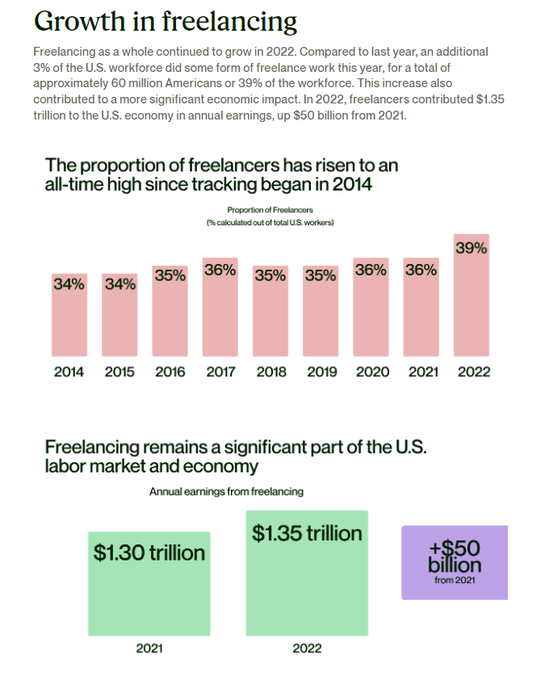
Freelance Forward 2022
December 29, 2022 // Upwork's 2022 Freelance Forward survey, a representative study of 3,000 professionals, reveals a staggering 39% of the U.S. workforce, or 60 million Americans, performed freelance work in the past year, an increase from the year prior. At a time of economic and labor market uncertainty, Upwork’s study found American freelancers contributed approximately $1.35 trillion in annual earnings to the U.S. economy, $50 billion more than in 2021. This growth was driven in large part to professionals seeking alternatives to the traditional model of a full time, 9-to-5 job. The data shows that increasingly, professionals are exploring the benefits of freelancing, whether for extra income, autonomy or as a way to find more meaningful work.
More than 1,000 New York Times union employees plan walkout over wages
December 5, 2022 // More than 1,000 union employees at the New York Times Co (NYT.N) have pledged to walk out if the news publisher does not agree to a "complete and equitable contract" by Dec. 8, according to a tweet by the union on Friday. The NYT NewsGuild has sought wages that "keep up with inflation" as well as to preserve and enhance health insurance and retirement benefits that were promised during hiring, according to a letter signed by 1,036 members.