
Posts tagged federal unions
Backgrounder: Executive Order: Exclusions from Federal Labor-Management Relations Programs
March 31, 2025 // The practice of “official time” is when unionized federal employees perform union-related activities, rather than their actual public service duties, while being paid by taxpayers. The Federal Unions EO requires that agencies, upon termination of an applicable collective bargaining agreement, reassign any workers who performed “official time” to positions where they perform solely agency business. It also contains language regarding existing grievance proceedings and allows for the head of each agency to submit a report to the President within 30 days highlighting any agency subdivisions that were not covered but should have been covered under the Federal Unions EO.

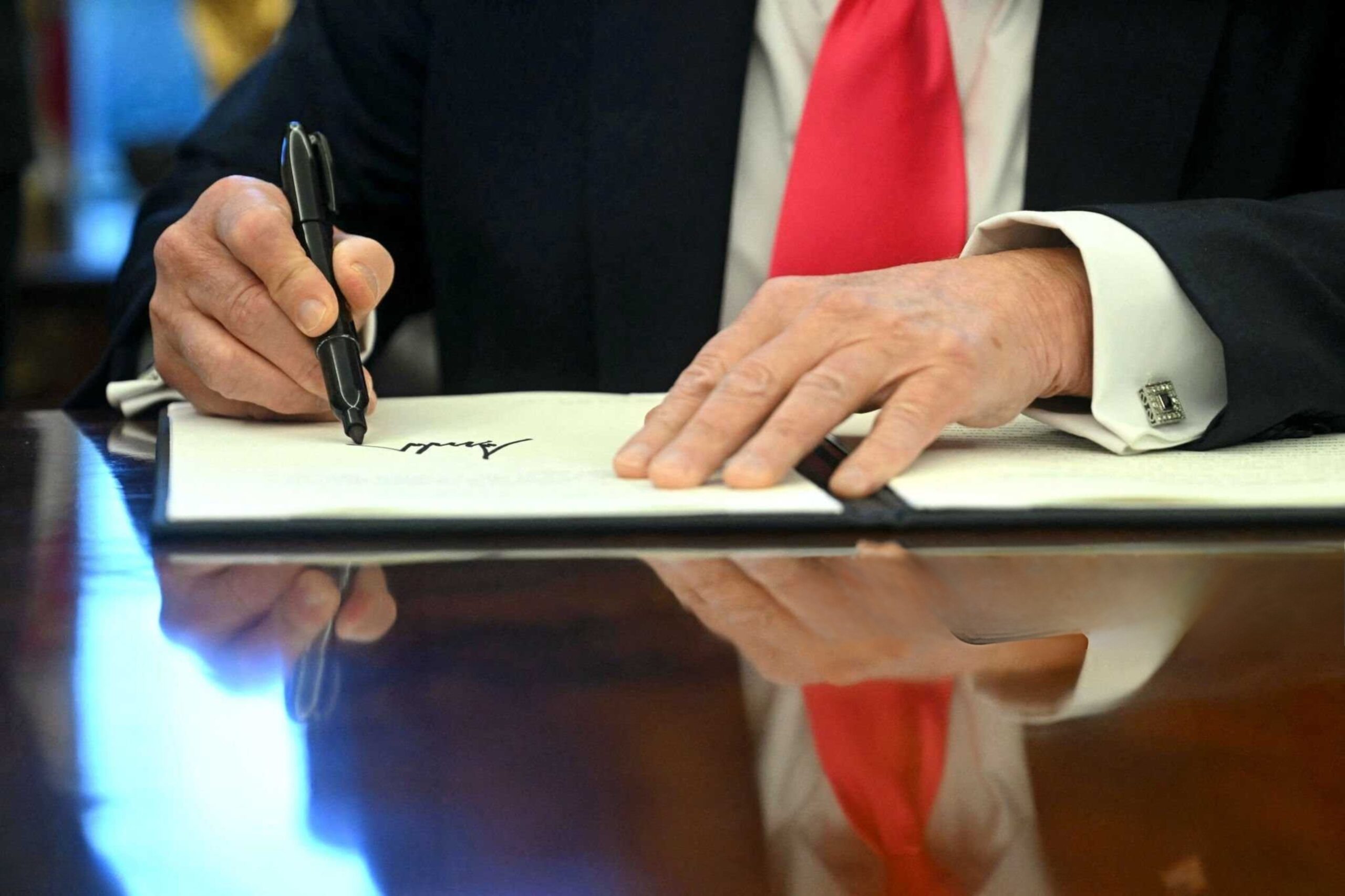
Trump signs executive order to end collective bargaining at agencies involved with national security
March 27, 2025 // President Donald Trump moved Thursday to end collective bargaining with federal labor unions in agencies with national security missions across the federal government, citing authority granted him under a 1978 law. The order, signed without public fanfare and announced late Thursday, appears to touch most of the federal government. Affected agencies include the Departments of State, Defense, Veterans Affairs, Energy, Health and Human Services, Treasury, Justice and Commerce and the part of Homeland Security responsible for border security.
White House seeks data on federal staffers’ union work, raising alarms
March 4, 2025 // Legislation passed by Congress in 1978 grants federal government employees designated paid time during work hours — known as “official time” — to engage in certain union matters related to labor-management activities, such as bargaining contracts, filing grievance proceedings and holding workplace safety trainings. A federal worker, for example, may be allowed to use paid work time to represent an employee who is getting disciplined or fired. Official time is not allocated for union-specific business, such as union drives or elections.

Unions Sue DOGE, Calling It ‘Unbalanced’ For Excluding Opponents Of Efficiency
January 20, 2025 // The lawsuit said AFGE’s president, Everett Kelley, requested that a representative of the federal employees union be appointed to the cost-cutting panel because AFGE “has a deep knowledge of the federal government.” It complains that Norm Eisen, a far-left lawyer and lawfare practitioner who has tried to thwart Trump, also applied, only to be told that “we have no room in our administration for Democrats.” The lawsuit claims that DOGE is an advisory committee that should be subject to the Federal Advisory Committee Act (FACA), which would require it to have members with balanced views, and meetings and materials open to the public. It said the Grace Commission, a Reagan-era cost-cutting panel, was structured under FACA.
Op-Ed: Many federal public union employees remain AWOL
May 28, 2024 // "I'll get these people back to work if I have to send in troops to get them." – Joe Biden In response to Biden's plans to end "federal work at home offices" last week, the White House Office of Management issued a time sensitive guidance for agencies to “substantially increase productive in-person work at Federal offices, particularly at headquarters and their equivalents.” Biden's mandate went over like a lead balloon with federal unionized employees who were told that Biden's harsh decree to return to work possibly violated their union contract.

COMMENTARY: White House Swells Federal Union Ranks – But at What Cost
May 18, 2023 // Using the estimated dues of the largest federal employee union as an example, the new union members for which the Biden administration is taking credit could represent between $37 million and $46 million in annual dues revenue. And as these employees are ushered through the union door, union officials and government agencies appear determined to slam it behind them. For employees who feel this arrangement violates their rights, litigation may be the only way out. In the past year, the Fairness Center, the public interest law firm of which I am president, has filed 36 matters on behalf of federal employees involving 16 unions and eight federal agencies.
Which agencies are the biggest potential targets for union growth?
August 24, 2022 // f…

Federal unions have a way to locate unrepresented employees, OPM says
August 22, 2022 // The Office of Personnel Management has offered some extra help to federal unions looking to add eligible employees to their membership rosters. Federal unions have tools available in FedScope, OPM’s online federal employee database, to identify which agencies have the largest amounts of unrepresented workers, said Tim Curry, OPM’s deputy associate director for accountability and workforce relations, in an email obtained by Federal News Network. On the other hand, the departments of Education, Energy, Labor, State and Treasury, as well as the Department of Housing and Urban Development, were among the agencies with the lowest numbers of unrepresented workers. The most recent data available in FedScope is from March 2022. NFFE National President Randy Erwin,
OPM, NTEU offer recommendations to improve relationships between agencies, unions
July 22, 2022 // Earlier this year, the White House Task Force on Worker Organizing and Empowerment made 70 recommendations to enhance federal unions, including providing information on unions to federal employees and improving transparency. labor-management relations, Tony Reardon, Tim Curry, Federal Mediation and Conciliation Service, Obama and Clinton administrations, Frontline employees

FLRA Control Returns to Democrats After Senate Confirms Biden Nominee
May 16, 2022 // With the addition of another Democrat at the FLRA with a background of working for unions, federal agencies can anticipate a change in the direction from that which emerged under the Trump administration. The approach will be to expand bargaining and the role of unions in agencies rather than focusing on the prior approach of seeking to limit the role of unions and emphasizing “efficient government”.