
Posts tagged freelance
California Independent Contractor Law Faces Withering Attacks
June 16, 2023 //
San Diego Gompers Preparatory Academy Charter School Educators Vote Out SDEA Union
June 9, 2023 // Even worse, shortly after the PERB’s ruling halting the original decertification effort, Chiscano and another Gompers educator filed charges maintaining that SDEA agents targeted them on social media for opposing the union hierarchy. California law makes it illegal for union officials to intimidate or retaliate against employees who exercise their right to refrain from union membership. Union boss-aligned state legislators even chimed in to pressure Gompers management to give in to union demands. In a letter to Gompers management, then-Assemblywoman Lorena Gonzalez (now an AFL-CIO president) attacked the National Right to Work Foundation for simply providing legal aid to Gompers educators as they sought to exercise their right to hold a decertification election. Gonzalez was best known during her tenure for authoring AB5, a California law that drastically reduced opportunities for freelance workers and independent contractors across the state.
Julie Su Pining for Labor Secretary
June 1, 2023 // The National Education Association, one of the largest unions in the nation, began placing ads in states with senators who have yet to commit to voting for Su if – and when – her nomination comes before the full Senate. Ads like these are running in Alaska (Murkowski, R), Arizona (Kelly, D, and Sinema I-ish), West Virginia (Manchin, D). None – along with Angus King (I) of Maine and John Tester (D) of Montana – have said for sure they will vote Su for sure. The NEA came out in favor of Su even before she was nominated, and unusual thing to do for the union, a union that – like its counterpart the AFT led by the egregious Randi Weingarten – pushed strongly to keep schools closed across the country during the pandemic.
Su Squeaks Past Committee on Party Line Vote
April 27, 2023 // According to the California State Auditor, “(D)espite repeated warnings, EDD (under Su) did not bolster its fraud detection efforts until months into the pandemic…(including allowing) claimants to collect benefits even though they were using suspicious addresses—in one case, more than 1,700 claims were coming from a single address.” As to the rate of fraud, California actually realized a rate of about 22% and, while having only about 12% of the nation’s workers, processed 21% of all unemployment claims which, one would assume, should have been seen as a red flag to the EDD.
Biden Wants To Restrict Work and Flexibility for Freelancers
February 20, 2023 // Beyond these misunderstandings, there is a key question that PRO Act proponents have failed to directly answer: Over a dozen surveys—including the Bureau of Labor Statistics' Contingent Worker Supplement—have found that a majority of independent contractors would prefer their current arrangements over an employment arrangement. Workers cite dependent care obligations, personal circumstances, or a strong preference for job flexibility (over job stability) as the primary reasons. Beyond surveys, in a recent study published by the Journal of Political Economy, economists estimated that UberX drivers would require almost twice as much pay to accept the inflexibility that comes from adopting a taxi-style schedule. And for the top 10 percent of DoorDash drivers, losing flexibility is equivalent to a 15 percent pay cut. Sens. Mark Warner (D–Va.), Todd Young (R–Ind.), and Rep. Suzan DelBene (D–Wash.)
A third of Americans contribute to the $1.3T freelance economy. Now what?
January 24, 2023 // Nearly 40% of Americans performed freelance work in 2022. That’s up nearly 10% from 2021, and a third of them make freelance their full-time work.

How To Empower Millions of Independent Workers
January 3, 2023 // Given millions of Americans' clear preference for independent work, and given the economic benefits of these arrangements, state and federal legislators should reduce the regulatory and tax burdens on both independent workers and gig platforms.
Freelance Forward 2022
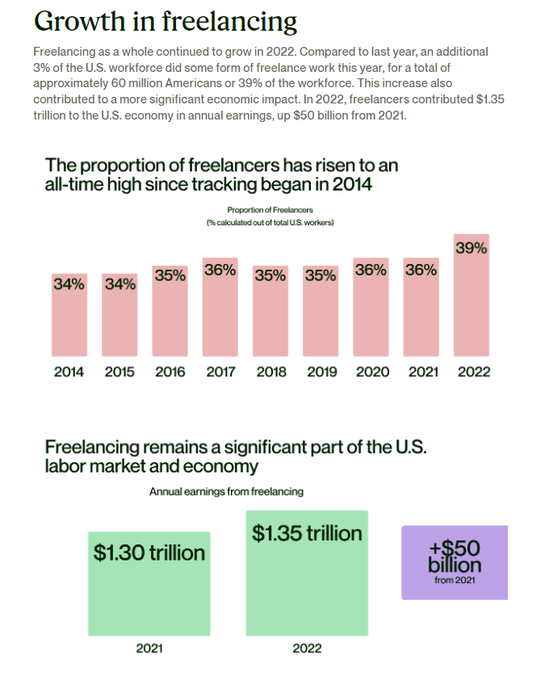
December 29, 2022 // Upwork's 2022 Freelance Forward survey, a representative study of 3,000 professionals, reveals a staggering 39% of the U.S. workforce, or 60 million Americans, performed freelance work in the past year, an increase from the year prior. At a time of economic and labor market uncertainty, Upwork’s study found American freelancers contributed approximately $1.35 trillion in annual earnings to the U.S. economy, $50 billion more than in 2021. This growth was driven in large part to professionals seeking alternatives to the traditional model of a full time, 9-to-5 job. The data shows that increasingly, professionals are exploring the benefits of freelancing, whether for extra income, autonomy or as a way to find more meaningful work.

Sens. Braun, Burr, Thune, and Rep. Foxx Lead Republican Colleagues in Urging Department of Labor to Protect Independent Contractor Classification
December 19, 2022 // Senators Braun, Burr and Thune are leading a bicameral letter with Rep. Foxx (R-N.C.) urging the Department of Labor (DOL) not to move forward with its proposed rule for determining independent contractor classification due to the negative impact on workers and business, the test’s lack of clarity and the devastating consequences for the U.S. economy. They are joined by Sens. Hagerty, Romney, T. Scott, Cramer, Johnson, Barrasso, Cassidy, Lankford, Marshall, Hoeven, Blackburn, Boozman, Tuberville, Young, Lummis, Lee, R. Scott, Inhofe, Graham, Fischer, Ernst, Shelby, and Rounds as well as Reps. Wilson, Thompson, Walberg, Grothman, Stefanik, Allen, Banks, Comer, Fulcher, Keller, Miller-Meeks, Owens, Good, McClain, Harshbarger, Miller, Spartz, Fitzgerald, Steel, and Pete Sessions.

Op-ed: FTC on the Gig Economy: The Glass is Almost Empty
October 12, 2022 // The FTC does, of course, have a legitimate role to play in challenging unfair methods of competition and unfair acts or practices that undermine consumer welfare wherever they arise, including in the gig economy. But it does a disservice by focusing merely on supposed negative aspects of the gig economy and conjuring up a gig-specific “parade of horribles” worthy of close commission scrutiny and enforcement action. Many of the “horribles” cited may not even be “bads,” and many of them are, in any event, beyond the proper legal scope of FTC inquiry. There are other federal agencies (for example, the National Labor Relations Board) whose statutes may prove applicable to certain problems noted in the gig statement. In other cases, statutory changes may be required to address certain problems noted in the statement (assuming they actually are problems). The FTC, and its fellow enforcement agencies, should keep in mind, of course, that they are not Congress, and wishing for legal authority to deal with problems does not create it (something the federal judiciary fully understands). In short, the negative atmospherics that permeate the gig statement are unnecessary and counterproductive; if anything, they are likely to convince at least some judges that the FTC is not the dispassionate finder of fact and enforcer of law that it claims to be. In particular, the judiciary is unlikely to be impressed by the FTC’s apparent effort to insert itself into questions that lie far beyond its statutory mandate.