Posts tagged East Palestine

Editorial: Why are some Republicans pushing price-hiking, pro-union bills in Congress?
June 15, 2026 // Democrats have long pushed pro-union measures sure to boost prices, even as they pretend to care about “affordability.” But why are Republicans now joining them? On Tuesday, a full 20 GOPers crossed the aisle to pass the Faster Labor Contracts Act, 230-193. The bill, lifted from Dems’ PRO Act, aims to boost unionization by forcing employers to agree to labor contracts within 90 days after a newly formed labor group calls for talks.
Goldwater Institute: Embracing the Future: Say No to Driver-in Mandates
June 4, 2026 // If an autonomous truck cannot operate safely, it should not be on the road. But if it can operate safely without a human driver, requiring one anyway does not improve safety. It simply raises costs, slows deployment, and forces consumers to pay more. The United States has never prospered by forcing new technology to imitate the old system it improves upon. Policymakers should allow autonomous vehicles and trucking to develop under clear, evidence-based safety rules. They should not revive the logic of railroad featherbedding for the age of artificial intelligence. Autonomous vehicles should be judged by their safety and performance, not by whether they preserve the labor arrangements of the past. The future of freight should be faster, safer, and less expensive. Policymakers should let it arrive.
GOP’s populists flex muscles with wins on Capitol Hill
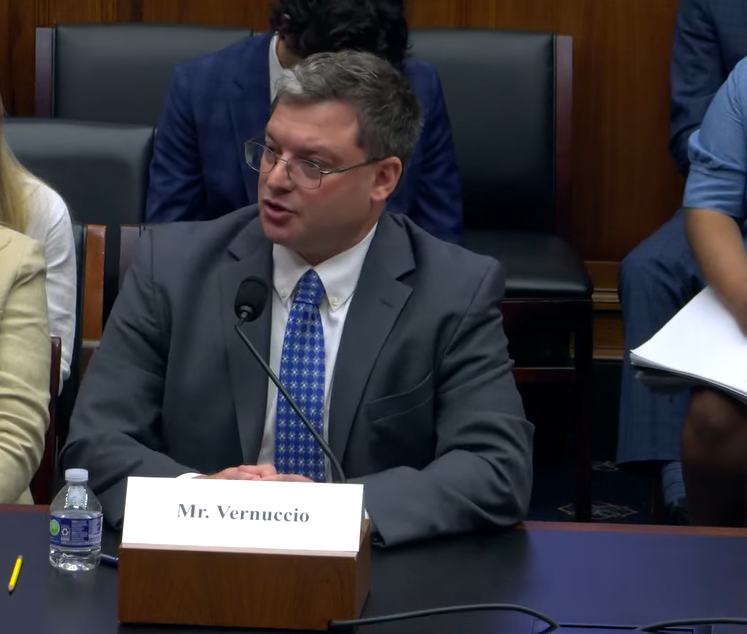
May 29, 2026 // F. Vincent Vernuccio, president of the Institute for the American Worker think tank, which has argued against the bill, pointed to hesitation that one union official expressed about that format in a Senate hearing last year, calling it undemocratic. “It takes away the whole point of a union because it takes away the vote from workers, and that’s exactly what the Faster Labor Contracts Act would do,” Vernuccio told The Hill. “If the union and the employer can’t come to an agreement within 120 days, this arbitration panel that’s appointed by government bureaucrats would write everything in that contract.”
Railway Safety Act in the balance
May 21, 2026 // Today, the House Transportation and Infrastructure (T&I) Committee is marking up the BUILD America Act — the surface transportation reauthorization bill. Among the amendments under consideration is the Railway Safety Act (RSA), a pro-union measure that has consistently failed to advance as a standalone bill but has suddenly gained new life with President Trump’s endorsement. The RSA purports to be aimed at ensuring an accident like the East Palestine, Ohio disaster does not happen again. Indeed, that is the president’s stated rationale for supporting the measure. However, as so often happens after a disaster, on hearing a cry that “something must be done,” opportunistic forces advance a policy wish list saying, “this is something, so let’s do this.” That is certainly the case with the RSA, which advances a long-held rail union position that two-person crews are necessary for safety. This is untrue. Research has shown that modern trains can operate safely with one-person crews. As T&I Committee Chairman Sam Graves (R-MO) said opposing the amendment,
Op-ed: Reject The Rail Crew Mandate And Embrace Deregulation
June 24, 2025 // This destructive, union-backed rule undermines voluntary labor-management agreements that already govern crew sizes in a more flexible and effective manner. The Center for Transportation Advancement points out that rigid staffing mandates override productive negotiations and mimic the failed "full crew" laws of the early 1900s—laws long since repealed because they served union interests, not public safety.

J. D. Vance’s One-Track Mind for Railroad Regulation
August 17, 2024 // Ohio senator and GOP vice-presidential nominee J. D. Vance has something of a soft spot for unions, as evidenced by his co-sponsorship of the 2023 version of the Railway Safety Act. The legislation would mandate minimum two-member crews on freight trains, a requirement unions have long sought. Such a mandate wouldn’t make trains any safer but would damage the ability of the rail industry to pursue automation.
Opinion: Unions, Washington Lackeys Exploit Ohio Rail Tragedy to Fatten Coffers
June 7, 2023 // the unionistas are pushing for a permanent requirement that all carriers use a minimum of two-person crews. This, despite the fact that the ill-fated Norfolk-Southern train itself had not two but three crew members. Mandating two on a crew would have done nothing to avert the disaster. It’s not responsive to the challenge at hand. Moreover, the make-work provisions will not affect Norfolk-Southern-sized railroads. It will primarily hurt the smaller regional and short-line railroads, which are more likely to use a one-man crew.