Posts tagged Brian Fitzpatrick
House-Passed Faster Labor Contracts Act Is a Disgrace to Free Enterprise
June 18, 2026 // Setting a dangerous precedent, House Democrats and a few unprincipled Republicans today voted to pass the Faster Labor Contracts Act,” said ABC President and CEO Michael Bellaman. “The FLCA imposes arbitrary and unrealistic deadlines on employers to finalize negotiations with newly elected unions or face ‘binding interest arbitration of first contracts.’ In practice, this means, for the first time in American history, a federal government bureaucrat will appoint an individual to dictate exactly what is included in a contract between two private negotiating parties.

These Republicans keep undermining Trump. This week proves it
June 11, 2026 // Specifically, the Faster Labor Contracts Act would empower a federal agency that Trump has called to eliminate. It could then impose a collective bargaining agreement on workers if the union and employer don’t reach an agreement within three months. But the workers wouldn’t even get a vote, fundamentally gutting workplace democracy. As Trump’s administration said in 2020, “Involuntary contracts that do not work for employees or their employers could force layoffs or even bankruptcies — ultimately, harming workers.” This bill is one of the Democrats’ top priorities. It should never be a priority for any Republican. Several of these Republicans pulled a similar stunt in January, when they killed House leadership’s plan to vote on the Save Local Business Act. The bill would have prevented a heavy-handed mandate from the Obama and Biden years that put many franchises, subcontractors, and small businesses at risk of layoffs or even closure. Yet LaLota said that he and his colleagues would only support a watered-down version. Trump has proposed a regulation that’s similar in intent to the legislation that was killed, yet by refusing to support the bill, these Republicans are all but ensuring that a future Democrat president will overturn this necessary reform.
Why Would Any Republican Support Forced Unionism?
June 9, 2026 // What makes this even more shocking is that President Trump has proposed completely eliminating the Federal Mediation and Conciliation Service, which the bill would supercharge. The president understands that contracts imposed by government bureaucrats are more likely to be based on political than economic logic, and that negotiations are better left to the private parties. Ironically, government-imposed contracts are likely to harm the workers whose union bosses are pushing this idea. Because when economics don’t add up, it’s the workers who pay in layoffs, reduced hours and the diversion of capital investments that would have raised productivity. This risks broader economic disruption by creating a threat perception that, at any time, a single union request could trigger a government-enforced contract clock. That perception would tend to chill hiring and investing, especially by smaller businesses that can’t afford to fight out an arbitration battle.
Republicans’ Latest Pro-Union Move Has Some Conservatives Sounding The Alarm
June 4, 2026 // Vinnie Vernuccio, the president of the Institute for the American Worker, also said that it would give “unprecedented power” to federal bureaucrats. He said that his organization was “proud to stand for union democracy by joining the larger coalition and sounding the alarm on this harmful legislation.” The Senate version of the proposal was introduced by Senator Josh Hawley (R-MO) and Senator Cory Booker (D-NJ) and also supported by Republican Senators Roger Marshall (Kansas) and Bernie Moreno (Ohio) and 12 other Democrats.
The Faster Labor Contracts Act disempowers workers
June 1, 2026 // The bill’s most obvious defect is its egregious misnaming. Whatever is produced by statutorily compelled arbitration cannot be correctly characterized as a contract at all. A contract results from parties negotiating, compromising, and voluntarily agreeing to terms each can accept. That process is precisely what gives contracts legitimacy and durability. The Faster Labor Contracts Act abandons that principle. Under its framework, if the parties fail to reach agreement within the prescribed period, federal arbitrators impose terms neither side may actually want. This is not a contract; it is coercive government regulation.
GOP’s populists flex muscles with wins on Capitol Hill
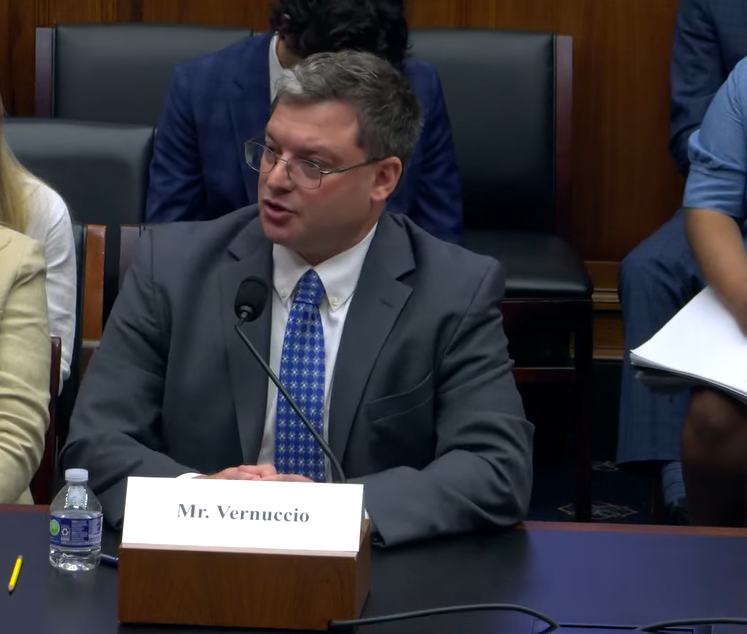
May 29, 2026 // F. Vincent Vernuccio, president of the Institute for the American Worker think tank, which has argued against the bill, pointed to hesitation that one union official expressed about that format in a Senate hearing last year, calling it undemocratic. “It takes away the whole point of a union because it takes away the vote from workers, and that’s exactly what the Faster Labor Contracts Act would do,” Vernuccio told The Hill. “If the union and the employer can’t come to an agreement within 120 days, this arbitration panel that’s appointed by government bureaucrats would write everything in that contract.”

Op-ed: The New Big Labor GOP
May 26, 2026 // The FLCA is a plank in the Big Labor PRO Act that failed to pass Congress in the Biden years. The bill is now likely to pass the House. The GOP Senate could kill it, but Josh Hawley (R., Mo.) is sponsoring the corresponding legislation there. The pro-union Republicans fancy themselves as tribunes for the common man, but they’re really rubber stamps for labor bosses who are allies of the Democratic Party.
Why Are Republicans Looking To Pass Obama-Era Forced Unionization Bill?
May 20, 2026 // Instead of contract bargaining, there would be “binding arbitration.” For 90 days, unions and employers would come to the table as normal and work toward an agreement. After that, the Federal Mediation and Conciliation Service could be called in to “mediate” the talks for an additional 30 days. If no agreement was reached, the agency gained the power to convene an arbitration panel that would write up a contract that bound both the union and the employer for two years. EFCA made unionization faster, but only by taking away checks that workers and employers had on union bosses. Today, unions are still pushing for the “binding arbitration” half of EFCA. It’s on the smorgasbord of provisions in the so-called PRO Act, a union-backed bill supported by all but a few congressional Democrats, and it’s central to the Faster Labor Contracts Act.
AFP Mobilizes Grassroots in Key Districts to Oppose the Faster Labor Contracts Act
May 18, 2026 // “This bill puts a 100-day stopwatch on one of the most consequential decisions a workplace ever makes — and then hands the final call to a stranger who has never set foot inside the building. That isn’t fairness, and it isn’t faster bargaining. It’s rushed bargaining, with an outside arbitrator deciding pay, schedules, and working conditions for people whose jobs and businesses they don’t know,” said Austen Bannan, labor policy fellow at Americans for Prosperity. “Workers deserve a contract they can actually live with — not one written under an artificial clock that benefits union leadership the moment the ink dries, because that’s when dues start flowing. AFP activists are showing up in Nebraska and Pennsylvania this week to tell Reps. Bacon, Bresnahan, and Fitzpatrick what real workers in their districts are saying: oppose this bill, and don’t sign the discharge petition,” Bannan continued.
Commentary: Josh Hawley’s Pro-Union Bill Would Let Washington Write Your Contract
May 16, 2026 // A Hawley-backed bill, known as the Faster Labor Contracts Act (FLCA), seems to be picking up steam and may soon pass the House of Representatives. Unfortunately, the FLCA is a trifecta of bad public policy: It suffers from constitutional infirmities, revives a corrupt government agency, and takes away the voice of both businesses and workers. Earlier this Congress, Hawley introduced the FLCA in the Senate, alongside one other Republican senator and three Democratic senators; he has since picked up another Republican and 10 more Democrats. Companion legislation in the House has 99 cosponsors, 17 of which are Republican.