Posts tagged Josh Hawley
Reed Larson built a movement for the long fight
September 24, 2026 // As union membership continues a decadeslong decline, nearing historic lows, union officials are spending billions on politics every election cycle. Traditionally, Democrats have been the main recipients of union political funding. However, major unions, notably the Teamsters, have begun to turn toward populist Republicans to advance their legislative agenda. Teamsters head Sean O’Brien has taken up with Republicans such as Sen. Josh Hawley (MO), who, along with union-label Democrats, introduced the Teamsters-endorsed FLCA into the Senate.

Commentary: Are Unions Rising from the Political Grave?
September 21, 2026 // Here again, however, there may be less than meets the eye. Despite its surprising bipartisan support, the FLCA would raise significant constitutional questions if enacted. By relying on a government-mandated arbitration panel to resolve labor disputes, the law effectively empowers the state to impose contractual terms on private parties—a form of what constitutional lawyers call “state action.” As attorneys Alex MacDonald and Vinnie Vernuccio observe: “[S]tate action opens the door to a slew of constitutional requirements and restrictions, notably to protect rights of free speech and association.”
Op-ed: Right-to-Work States Attract Family Breadwinners
September 10, 2026 // The disconnect between rank-and-file workers and pro-union Republicans such as Josh Hawley of Missouri and Bernie Moreno of Ohio is especially disturbing. Such politicians’ avowed goal is to reconstitute the Republican Party, which is today overwhelmingly supportive of Right to Work, into a party that largely agrees with Democratic politicians’ support for labor special privileges over the individual freedom of the employee. If Hawley, Moreno and Co. get their way, pro-Right to Work citizens will routinely be denied a meaningful choice at the ballot box. The reality is, when they have a choice, working-age people prefer not to live in forced-unionism states. Census data make that very clear.

Op-ed: How ‘pro-union conservatism’ is a win for the radical Left
August 14, 2026 // The AFL-CIO has funneled over $107 million to “Working America,” a voter canvassing operation affiliated with the union. Since 2015, the Service Employees International Union has sent nearly $39 million to “The Fairness Project,” a progressive ballot initiative operation that is currently working to defeat a proposed abortion ban in Hawley’s home state of Missouri. Union operatives see “organizing” a workplace to form a union as just another kind of political organizing that a professional left-wing activist would do, which is why, once they take control of workplaces and begin negotiating a contract with the employer, unions push their political objectives, not just workplace conditions.

Trucking groups challenge bill that expands labor arbitration
August 7, 2026 // Representing American Trucking Associations as president, Chris Spear described the bill as government-mandated contracting instead of collective bargaining. He said if passed, the changes would eliminate employees from voting to approve an arbitration-imposed contract.
Bipartisan Bill to Accelerate Labor Contracts Roils Employers
August 6, 2026 // “The notion that I’m going to bargain a fresh contract and think of all the terms and conditions of employment that get woven into a contract, a contract that on the light side might be 10 or 15 pages single space and on the long side 50 pages, that’s just ridiculous,” he said. “People that have never bargained wrote this law.” The bill could also exacerbate timelines instead of accelerating them, as arbitrators and mediators become increasingly overwhelmed with an influx of contract disputes. That could be especially aggravated by ongoing staffing challenges at the Federal Mediation and Conciliation Service, said Steven M. Bernstein, regional managing partner and Labor Relations Group co-chair at Fisher & Phillips LLC.

Opinion: Big Labor, DEI and the GOP
July 6, 2026 // These Republicans are promoting much more than the FLCA’s mandated arbitration after 120 days of collective bargaining. The bill gives the whip hand to unions in negotiating labor contracts, and along with that comes the left-wing cultural agenda that unions like the Teamsters and the SEIU have adopted. Take DEI—diversity, equity and inclusion—which unions have made part of their social-justice mission and collective-bargaining agreements. The General Teamsters Local Union No. 174 made DEI a feature of its negotiation with the Port of Seattle. The Writers Guild of America, East, included DEI targets for the hiring process and a formal diversity committee in its bargaining with Vox Media.
Op-ed: To High Praise and Hallelujahs, Trump Nominates Keith Sonderling for Secretary of Labor
June 30, 2026 // As Acting Secretary, Sonderling has strongly advocated for Trump's pro-business and pro-worker agenda, touting the manufacturing jobs that have been returned to the U.S., and has worked tirelessly to beef up and expand apprenticeships through the U.S. Department of Labor for small businesses and private-sector concerns. Under Biden's DOL, apprenticeships were issued through the major labor unions like the AFL-CIO and SEIU, effectively cutting out any private sector opportunities. Sonderling has also long been a champion for defined benefit pension plan sponsors to be able to use group annuities to protect pension benefits through pension risk transfers, and to allow employers to incorporate retirement plan options like cryptocurrency assets and private credit funds. But most pivotal, Sonderling is working hand-in-hand with the Fraud Task Force to eradicate the rampant unemployment insurance fraud.
Republicans And Union Allies Could Force Abortion On Christian Employers, Critics Warn
June 28, 2026 // The Senate version of the bill is sponsored by outspoken social conservative Senator Josh Hawley (R-MO) who says that the bill will help workers assert their rights against woke corporations. But according to the Christian Employers Alliance, the bill could have significant ramifications for religious workers and employees.
Commentary: The House Sides With Unions Over Workers
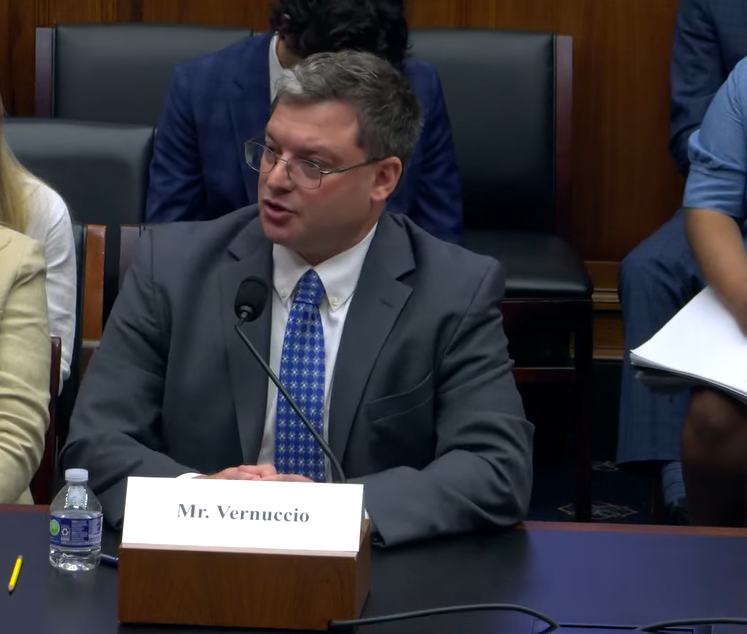
June 26, 2026 // Last year, I participated in a Senate hearing in which a union shop steward was asked about government-appointed arbitrators unilaterally imposing contracts. He said that would be “removing the democracy from the workplace.” He said such democracy “is the whole point of the union” because it gives workers a say. The shop steward’s own union was in the process of voting down several contract proposals, further emphasizing the importance of letting workers vote.