Posts tagged discharge petition

Commentary: Are Unions Rising from the Political Grave?
September 21, 2026 // Here again, however, there may be less than meets the eye. Despite its surprising bipartisan support, the FLCA would raise significant constitutional questions if enacted. By relying on a government-mandated arbitration panel to resolve labor disputes, the law effectively empowers the state to impose contractual terms on private parties—a form of what constitutional lawyers call “state action.” As attorneys Alex MacDonald and Vinnie Vernuccio observe: “[S]tate action opens the door to a slew of constitutional requirements and restrictions, notably to protect rights of free speech and association.”

Op-ed: Republicans should stop helping Democrats empower union bosses
July 29, 2026 // Policies built on employee choice, such as right-to-work protections, reflect what American workers actually want. The partisan legislation now moving through Congress reflects only what union leadership wants. Pro-worker legislation is not synonymous with pro-union legislation; in fact, they often are opposites. It is time for Congress to wake up and realize this.
Faster is Not Always Better: House Passes Bill Seeking Radical Change in First Contract Bargaining
June 17, 2026 // The bill also raises questions about the lawfulness of strikes and lockouts during these first contract negotiations. Typically, where parties agree to interest arbitration (or where it exists in the public sector) it is premised on a mutual commitment of labor peace, i.e., the union will not go on strike, and the employer will not lock employees out while negotiations are ongoing and the arbitration is pending. However, in the private sector and in the absence of such a mutual commitment, both such economic weapons may be used offensively in furtherance of a party’s bargaining demand. The FLCA does not explain if or how a party may exercise such an economic weapon in furtherance of their bargaining position if the dispute will be submitted to an FMCS panel for binding interest arbitration. Equally troubling is the FLCA’s potential impact on unilateral implementation. Unilateral implementation upon reaching a good-faith bargaining impasse has long been a vital bargaining tool for employers. The possibility of implementing terms when negotiations stall has been an effective tool to encourage the parties to continue making movement towards the other. Eliminating this option will alter bargaining leverage and strategies particularly in successor contracts where the FLCA’s temporal framework does not apply.
Faster Labor Contracts Act passes House after GOP rebels join Democrats
June 10, 2026 // The bill, though, exposed a trend of more populist Republicans bucking House leadership and free-market conservative groups that had been traditional allies of the GOP. Steven Bernstein, co-chair of the Fisher Phillips law firm’s labor relations practice group, said in a statement ahead of the vote that the legislation if enacted would “lead to a sea change in the country’s well-established labor dynamic by taking away the rights of employers and unions to decide for themselves what goes into their initial collective bargaining agreements.”
Workers for Opportunity joins the fight against the Faster Labor Contracts Act
June 8, 2026 // Vincent Vernuccio, a senior fellow with Workers for Opportunity and president of Institute for the American Worker, recently recapped a Senate hearing where he testified. An unwitting union official opposed the Faster Labor Contracts Act idea of forced arbitration. Vernuccio wrote: [U.S. Senator and Chair of the federal labor committee Sen. Bill] Cassidy explained this policy in real-world terms, saying that it would “take workers out of the process by removing the need to ratify a contract.” He put a finer point on it by saying that if the government mandated arbitration, workers “cannot reject” the resulting agreement, even though it would be binding on them. “What would happen,” he asked, “if workers lost that ability to ratify a contract?” The union official didn’t mince words: “That would be removing the democracy from the workplace.” Then he doubled down: Such democracy “is the whole point of the union,” he said, because it gives workers “a say.”
Faster Labor Contracts Act Bad for Workers and Small Businesses
June 4, 2026 // The supporters on the right also argue that pandering to a piece of legislation championed by Big Labor and the whole Democratic Party will save Republican seats in Congress. Kishi further argues that “the Republican Party today draws its strength not from boardrooms and donor retreats, but from working-class Americans.” Working-class Americans voted for President Donald J. Trump and put Republicans in charge of Congress because they reject the anti-family, woke agenda of a far left that has captured the agenda of the Democratic Party. Arguing that Republicans should adopt Democrat-lite policies to win over votes ignores the fact that voters can just vote for Democrats if they want big government and anti-business policies.
JD Vance Courts Sean O’Brien and the Teamsters
June 1, 2026 // Mr. O’Brien is desperate for a win in Washington to sell to his 1.3 million members as he runs for re-election. Some Republicans in Congress seem eager to give him one—maybe two—as they seek to burnish their bona fides as defenders of the working class. These Republicans are doing more to help Democrats—the primary beneficiaries of Teamster campaign donations—than workers. The Teamsters’ membership has shrunk by nearly half since the 1970s amid a broader decline in organized labor. Technology has improved productivity. At the same time, jobs have migrated to states with right-to-work laws, which prohibit unions and employers from making union membership a condition of employment. The Teamsters have also lost rank-and-file support. Between 2016 and 2025, members filed 373 petitions to decertify the Teamsters, according to Reason magazine. Some 60% of the decertification elections succeeded. You can’t blame union members for wearying of paying dues that bankroll Democratic candidates and lavish lifestyles of union leaders. In the 2023-24 election cycle, 92% of Teamsters PAC donations to federal candidates went to Democrats, as did 91% of the union’s contributions to party committees.
GOP’s populists flex muscles with wins on Capitol Hill
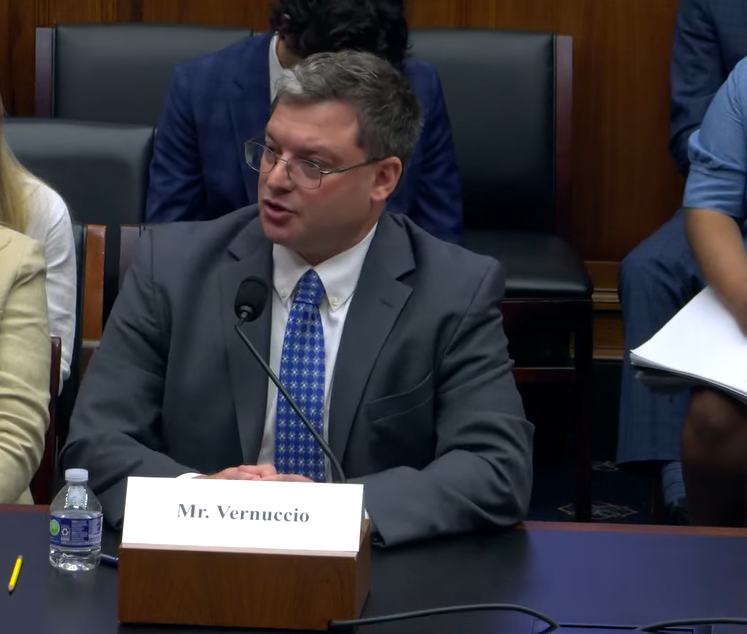
May 29, 2026 // F. Vincent Vernuccio, president of the Institute for the American Worker think tank, which has argued against the bill, pointed to hesitation that one union official expressed about that format in a Senate hearing last year, calling it undemocratic. “It takes away the whole point of a union because it takes away the vote from workers, and that’s exactly what the Faster Labor Contracts Act would do,” Vernuccio told The Hill. “If the union and the employer can’t come to an agreement within 120 days, this arbitration panel that’s appointed by government bureaucrats would write everything in that contract.”

Faster Labor Contracts Act would silence workers’ voices and empower bureaucrats
May 28, 2026 // While forced arbitration for union contracts would be new in the private sector, there is a corollary in the public sector called “interest arbitration” that some states most frequently apply to police and firefighter labor disputes. It’s not entirely analogous because a government that imposes forced arbitration is also the employer and thus part of the contract negotiations. Moreover, governments aren’t subject to the same bottom line as private sector companies because, unlike businesses, states generally can’t go bankrupt. Nevertheless, interest arbitration contracts have burdened state and local governments, arguably contributing to rising property tax rates in New Jersey, unfunded pensions in Chicago, and even municipal bankruptcy in Detroit.
Why Are Republicans Looking To Pass Obama-Era Forced Unionization Bill?
May 20, 2026 // Instead of contract bargaining, there would be “binding arbitration.” For 90 days, unions and employers would come to the table as normal and work toward an agreement. After that, the Federal Mediation and Conciliation Service could be called in to “mediate” the talks for an additional 30 days. If no agreement was reached, the agency gained the power to convene an arbitration panel that would write up a contract that bound both the union and the employer for two years. EFCA made unionization faster, but only by taking away checks that workers and employers had on union bosses. Today, unions are still pushing for the “binding arbitration” half of EFCA. It’s on the smorgasbord of provisions in the so-called PRO Act, a union-backed bill supported by all but a few congressional Democrats, and it’s central to the Faster Labor Contracts Act.