Posts tagged Pro-union
Bipartisan Bill to Accelerate Labor Contracts Roils Employers
August 6, 2026 // “The notion that I’m going to bargain a fresh contract and think of all the terms and conditions of employment that get woven into a contract, a contract that on the light side might be 10 or 15 pages single space and on the long side 50 pages, that’s just ridiculous,” he said. “People that have never bargained wrote this law.” The bill could also exacerbate timelines instead of accelerating them, as arbitrators and mediators become increasingly overwhelmed with an influx of contract disputes. That could be especially aggravated by ongoing staffing challenges at the Federal Mediation and Conciliation Service, said Steven M. Bernstein, regional managing partner and Labor Relations Group co-chair at Fisher & Phillips LLC.
COLUMN: It’s a mistake to support Faster Labor Contracts Act
July 1, 2026 // The Club for Growth, one of the most influential conservative scorecards in Washington, has issued a formal “Key Vote Alert” urging all representatives and senators to vote no on the FLCA and announced the vote will be included in its 2026 congressional scorecard. For the seven House Republicans who signed the discharge petition — Riley Moore, of West Virginia; Nick LaLota and Mike Lawler, of New York; Don Bacon, of Nebraska; Max Miller, of Ohio; and Rob Bresnahan and Brian Fitzpatrick, of Pennsylvania — a vote for this bill is now on permanent record as a vote against economic freedom. The Wall Street Journal editorial board was blunt in its assessment, calling these members “rubber stamps for labor bosses who are allies of the Democratic Party” and describing their support as the latest sign of Republican midterm panic.
Republicans And Union Allies Could Force Abortion On Christian Employers, Critics Warn
June 28, 2026 // The Senate version of the bill is sponsored by outspoken social conservative Senator Josh Hawley (R-MO) who says that the bill will help workers assert their rights against woke corporations. But according to the Christian Employers Alliance, the bill could have significant ramifications for religious workers and employees.
NTEU sues IRS over destruction of employees’ pro-union decorations
June 18, 2026 // The Internal Revenue Service last month issued a directive barring employees from posting flyers and other decorations related to the National Treasury Employees Union, which the union says violates the First Amendment.

Editorial: Why are some Republicans pushing price-hiking, pro-union bills in Congress?
June 15, 2026 // Democrats have long pushed pro-union measures sure to boost prices, even as they pretend to care about “affordability.” But why are Republicans now joining them? On Tuesday, a full 20 GOPers crossed the aisle to pass the Faster Labor Contracts Act, 230-193. The bill, lifted from Dems’ PRO Act, aims to boost unionization by forcing employers to agree to labor contracts within 90 days after a newly formed labor group calls for talks.
USC faculty groups vote to unionize and university vows to challenge it
June 7, 2026 // Not all eligible USC faculty have been supportive. The effort drew opposition from full-time non-tenure faculty at the Gould School of Law, who said in spring that they were “unanimously opposed to the effort to include us.” The group cited American Bar Assn. accreditation standards that it said already provided workers with protections “reasonably similar to tenure” and encouraged law faculty to remain out of university unions. Some professors in pharmacy, engineering and education schools also publicly opposed unionizing.

Republicans’ Latest Pro-Union Move Has Some Conservatives Sounding The Alarm
June 4, 2026 // Vinnie Vernuccio, the president of the Institute for the American Worker, also said that it would give “unprecedented power” to federal bureaucrats. He said that his organization was “proud to stand for union democracy by joining the larger coalition and sounding the alarm on this harmful legislation.” The Senate version of the proposal was introduced by Senator Josh Hawley (R-MO) and Senator Cory Booker (D-NJ) and also supported by Republican Senators Roger Marshall (Kansas) and Bernie Moreno (Ohio) and 12 other Democrats.

Shrinking unions grasp hold of power through ESG activism
May 11, 2026 // Under the ESG pretense, unions are pushing shareholder resolutions that would ditch secret-ballot elections at companies. That’s a key labor demand because it enables unions to harass and intimidate workers into publicly signing cards in favor of unionization. Unions also push shareholder resolutions ordering companies to adopt “non-interference policies,” ensuring a business can’t talk to its employees about the downsides of unionization. Practically, unions promote these policies in two significant ways. The simplest approach is to use their own pension funds, which invest hundreds of billions of dollars, to demand that the businesses they invest in adopt pro-union policies. Union officials are also appointed to pension boards, where they directly support activist investment strategies based on ESG. Public pension plans have great clout thanks to the trillions of dollars at their disposal, enough to take significant ownership stakes in banks or investment funds. Either approach lets organized labor push shareholder proposals that tilt the scales in unions’ favor.
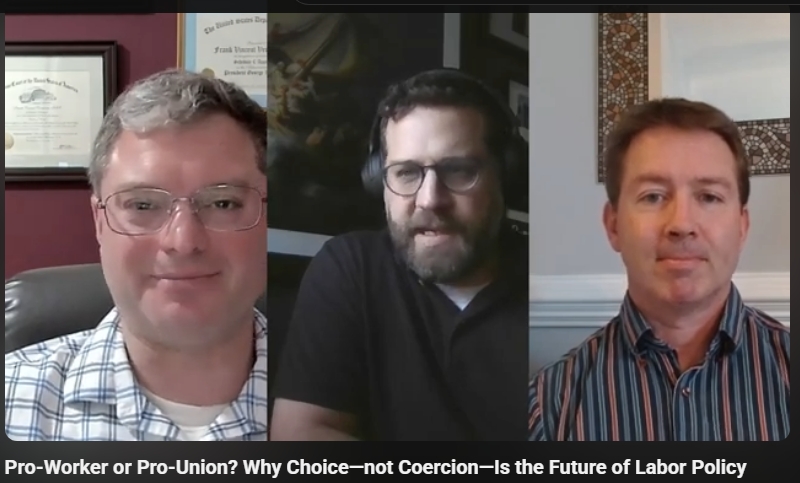
Pro-Worker or Pro-Union? Why Choice—not Coercion—Is the Future of Labor Policy, Disunion: The Government Union Report; Commonwealth Foundation
December 18, 2025 // This week on Disunion, host David Osborne is joined by Austen Bannan of Americans for Prosperity and Vincent Vernuccio, president of the Institute for the American Worker, to break down a sweeping new report: How to Empower Workers: Embracing a Pro-Worker Agenda Built on Choice. With Congress rolling out a flurry of labor bills—from right-to-work reforms and secret ballot protections to proposals backed by unions and even some Republicans—this episode cuts through the noise. The panel explains why many so-called “pro-worker” policies actually empower union bosses and government regulators, not workers themselves.
RELEASE: Gen Z Men Are the Most Pro-Union Generation in History
December 4, 2025 // A new analysis from the Center for American Progress finds that Gen Z men show stronger support for unions than do people of any other age or gender. The findings show that this historic support is closely tied to the substantial wage gains, benefits, and financial stability unions deliver for young workers. “Gen Z men are navigating high costs, uncertain job prospects, and delayed financial independence,”