Posts tagged union rate

Report: The Battle for Worker Freedom: Grading State Public Sector Labor Laws
September 10, 2026 // Union executives are prioritizing recruitment. The fastest-growing category of public sector labor legislation expands collective bargaining into new workplaces. On the strength of these new laws, union executives are slowly replacing their membership losses since 2018. From 2018 to 2025, the country’s four largest government unions report a net decline in membership of 87,919, or 1.3 percent. However, they also report a collective gain of 232,502 members, or 3.5 percent since 2024. This report awards full letter-grade increases to Idaho (now A) and Louisiana (now B) due to their adoption of pro-worker labor reforms this past legislative session. However, the drops in grades—Nebraska (D), Nevada (D), and Rhode Island (F)—are the result of these states prioritizing union executives over workers and enacting laws helping unions recruit, politick, organize, and strike. Thirteen states now have an “A” or “A+” grade—up from twelve in the previous edition of this report—while six states earned an “F”—up from five over the same time period. Overall, the research finds 25 states fall below a “C.”
NJ remains one of nation’s most unionized states, Rutgers report finds
September 9, 2026 // The researchers estimate New Jersey has about 22,000 more union members than in a previous Rutgers study. But the share of workers belonging to unions slipped slightly because nonunion employment grew faster. New Jersey's average unionization rate was 15.47% from 2023 through 2025, ranking sixth-highest among the 50 states and well above the national rate of about 10%.
UC Doctors Seek to Unionize 10,000 Colleagues in Massive Campaign
July 28, 2026 // About $24 billion, nearly 40% of the university’s total revenue last year, came from its six academic health centers, serving 2.5 million Californians. UC is the state’s second largest employer. Labor experts said it’s unlikely that university executives would welcome a new large doctors’ union. If the UC Doctors United organizing campaign is successful, it could inspire doctors elsewhere to seek a collective voice on the job, according to John Logan, director of labor and employment studies at San Francisco State University. “People who run the university undoubtedly will not want 10,000 doctors at the UC system to unionize and to have to bargain collectively over things that they can unilaterally decide at the moment,” Logan said.
Unions’ Capital Activism Harms Members
July 16, 2026 // A new Mackinac Center study, “Unions and ESG: From Worker Representation to Shareholder Activism,” shows how activist investing by organized labor slows the economy, weakens the financial system, and directly harms union members. The most common vehicle is ESG investing, in which shareholders pressure publicly traded companies to enact certain environmental, social and governance policies. While ESG advocates often present the movement as a benign effort to make companies more socially responsible, unions use it to advance their political and organizational self-interest.
Here’s how much money Shawn Fain, other UAW leaders made in 2025
May 15, 2026 // April Verrett, president of the Service Employees International Union, made $322,045. Sean O'Brien, the president of the International Brotherhood of Teamsters, made $443,539. Fain's compensation for the year was the highest of his tenure by about two thousand dollars. In 2023, filings show Fain made $228,872. In 2024, Fain was paid $274,407.
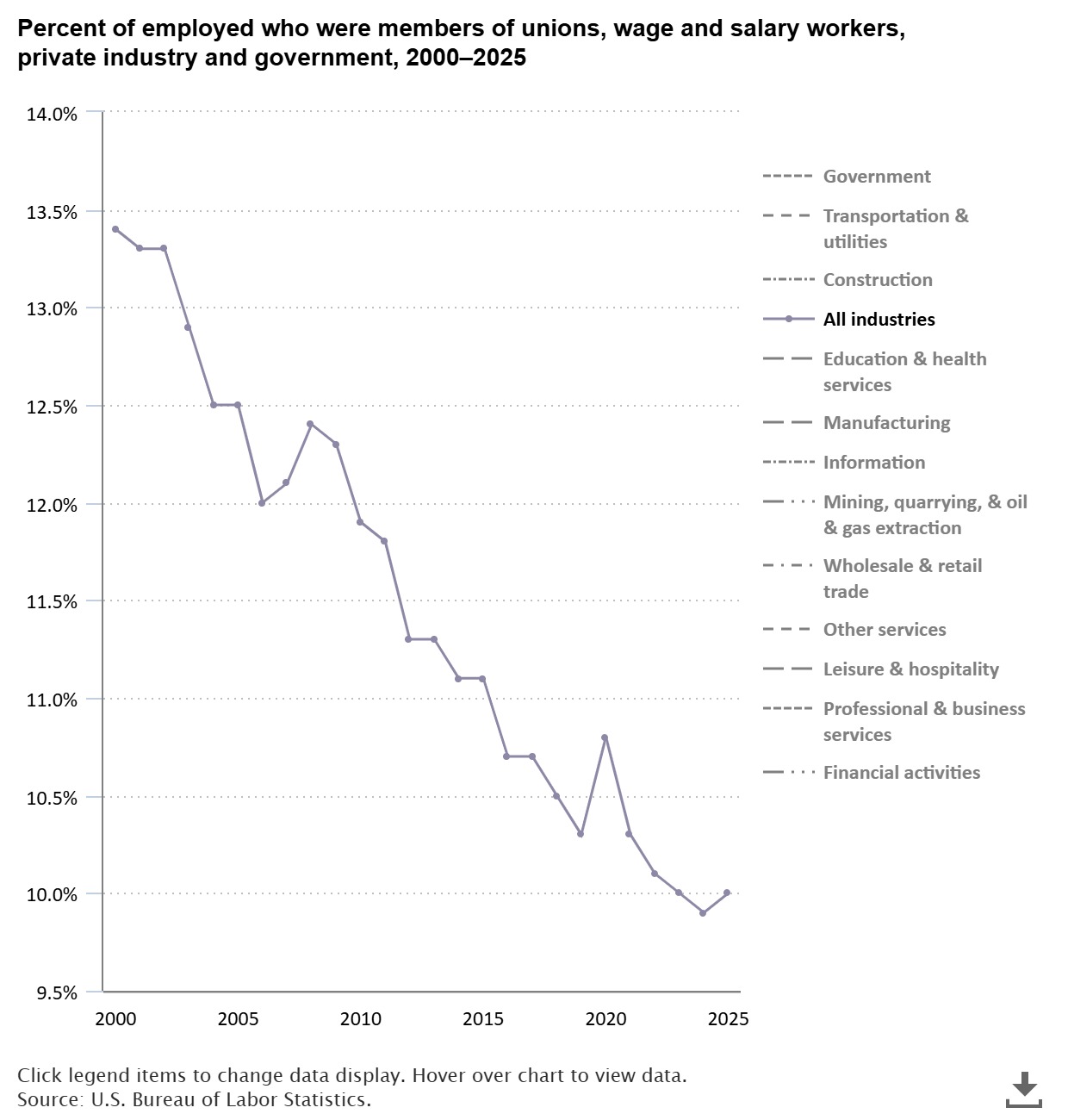
Union membership rate 10.0 percent in 2025
April 26, 2026 // The union membership rate of public-sector (government) workers, 32.9 percent in 2025, continued to be more than five times higher than the rate of private-sector workers. The public-sector union membership rate increased by 0.7 percentage point over the year. The union membership rate continued to be highest in local government, which employs many workers in heavily unionized occupations. The union membership rate in the private sector (5.9 percent across all industries) was unchanged over the year. Industries with some of the highest unionization rates in 2025 included transportation and utilities, 14.3 percent, and construction, 11.1 percent. Among the lowest unionization rates were financial activities, 1.5 percent, professional and business services, 2.1 percent, and leisure and hospitality (which includes food services and drinking places), 3.0 percent.
Opinion– Editorial Board: Why the Republican-union alliance never works
April 22, 2026 // "The new acting secretary, Keith Sonderling, is a more conventional Republican choice for the job. Respected by conservatives, he would sail through the Senate confirmation process if nominated. He has already been competently running the department as deputy secretary, as it has advanced deregulation and protected independent contractor status for 11.9 million workers"

How CA state worker unions have fared since landmark SCOTUS decision reshaped membership
March 17, 2026 // According to eight years of data obtained from the State Controller’s Office on the number of dues-paying state workers, some unions have slowly bled members since the Janus decision. For other bargaining units, the membership level has dropped 20% over that period. Labor groups representing peace officers and prison staff, however, hardly saw a change pre- and post-Janus. And still other units have increased the percentage of workers who pay monthly membership dues, the data revealed. Nearly 10 years before the Janus decision, the public’s approval of unions hit a historic low. In 2009, Americans’ approval ratings dipped below 50% for the first and only time since the public opinion polling company Gallup began assessing ratings of labor unions in 1936. In the years since, the public’s opinion of labor unions has improved substantially. Last year, 68% of Americans reported approval of unions.
Modeling the Impact of Sectoral Bargaining for U.S. Workers
March 5, 2026 // New statistical modeling suggests that sectoral bargaining could more than double collective bargaining coverage in the United States and generate big gains in union density.
Opinion: Workers say ‘I like unions, I just don’t like my union’ — here’s what they’re discovering
February 28, 2026 // "I like unions. I just don’t like my union." Time and time again, I hear this sentiment from employees nationwide. Most will express frustration with their union officials, who’ve disappointed or even mistreated them and other members. Some tell me how they tried and failed to improve their own union from within. They imagine there’s a better union out there — one where union officials actively improve the workplace and help employees achieve some measure of personal freedom.