Posts tagged private-sector workers
Editorial Board: Americans approve of unions. They just don’t want to join one.
September 9, 2026 // Gallup says 71 percent of Americans approve of labor unions, near a record high. The Bureau of Labor Statistics says 10 percent of American workers are in labor unions, near a record low. What gives? The first issue is that Gallup wasn’t asking whether respondents wanted to join a union themselves. In 2022, Gallup found that unions had the same approval rating as they do this year, but it also asked nonunion workers how interested they were in joining.
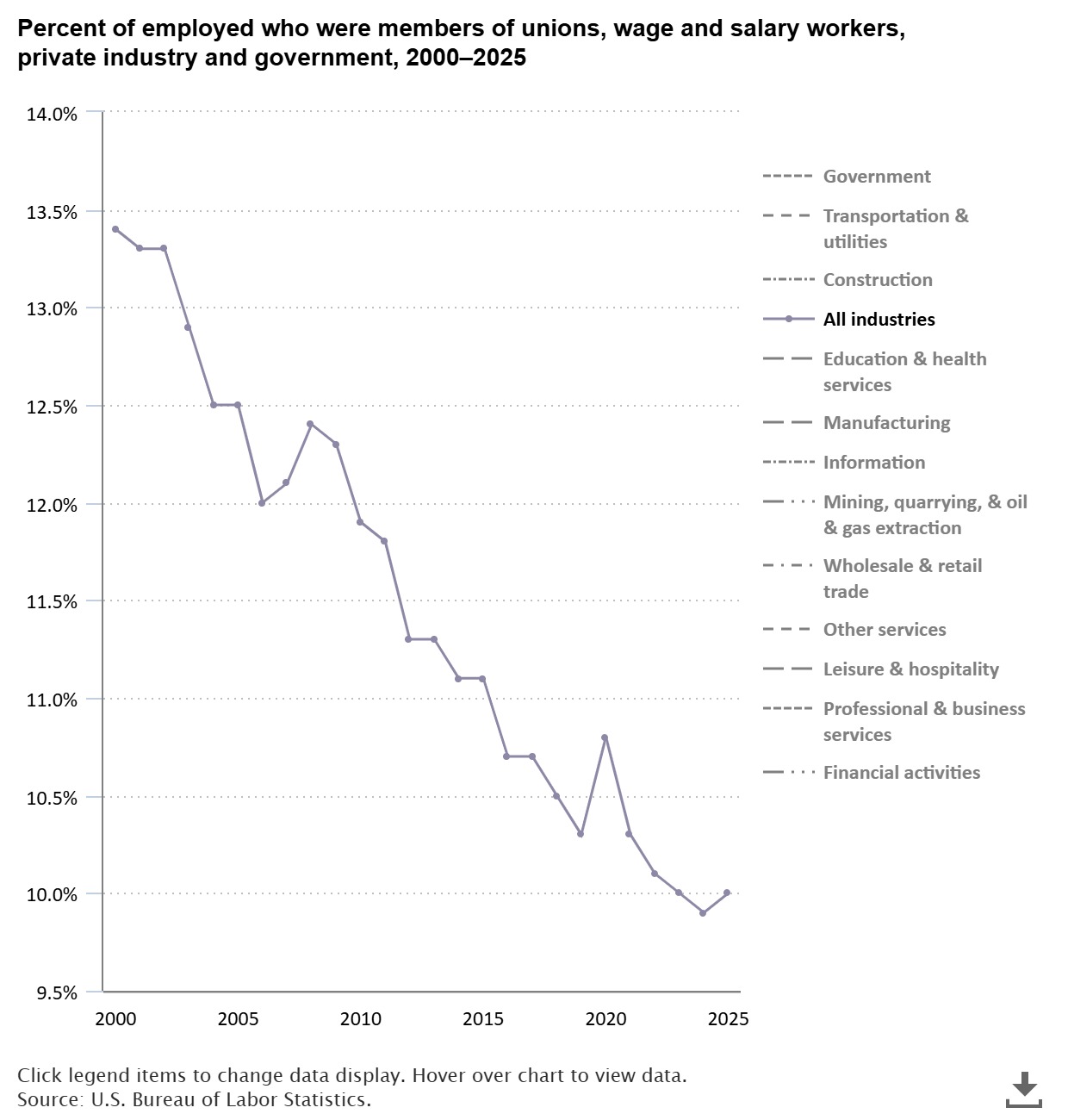
Union membership rate 10.0 percent in 2025
April 26, 2026 // The union membership rate of public-sector (government) workers, 32.9 percent in 2025, continued to be more than five times higher than the rate of private-sector workers. The public-sector union membership rate increased by 0.7 percentage point over the year. The union membership rate continued to be highest in local government, which employs many workers in heavily unionized occupations. The union membership rate in the private sector (5.9 percent across all industries) was unchanged over the year. Industries with some of the highest unionization rates in 2025 included transportation and utilities, 14.3 percent, and construction, 11.1 percent. Among the lowest unionization rates were financial activities, 1.5 percent, professional and business services, 2.1 percent, and leisure and hospitality (which includes food services and drinking places), 3.0 percent.
Opinion– Editorial Board: Why the Republican-union alliance never works
April 22, 2026 // "The new acting secretary, Keith Sonderling, is a more conventional Republican choice for the job. Respected by conservatives, he would sail through the Senate confirmation process if nominated. He has already been competently running the department as deputy secretary, as it has advanced deregulation and protected independent contractor status for 11.9 million workers"
Opinion GOP’s fatal attraction to unions is the start of a bad romance
April 21, 2026 // Instead of offering flowers and chocolates, they aim to impress labor by slicing up the PRO Act and feeding it piecemeal to the rest of the GOP. The Faster Labor Contracts Act, sponsored by Hawley and Rep. Donald Norcross (D-NJ), is the first portion. It would allow federal mediators to essentially write union contracts for newly organized workplaces, if businesses and unions can’t agree on terms within four months of a union’s workplace-election win.
Opinion: Workers say ‘I like unions, I just don’t like my union’ — here’s what they’re discovering
February 28, 2026 // "I like unions. I just don’t like my union." Time and time again, I hear this sentiment from employees nationwide. Most will express frustration with their union officials, who’ve disappointed or even mistreated them and other members. Some tell me how they tried and failed to improve their own union from within. They imagine there’s a better union out there — one where union officials actively improve the workplace and help employees achieve some measure of personal freedom.

Opinion: Did Biden save unions? Now we have numbers.
February 23, 2026 // Local government employs more union workers than any other industry, by a lot. State government is the next largest employer. The category education and health services comes next, and even though it’s counted as a private industry, most of those jobs are closely connected to government programs. The federal government has more union members than the entire manufacturing sector.
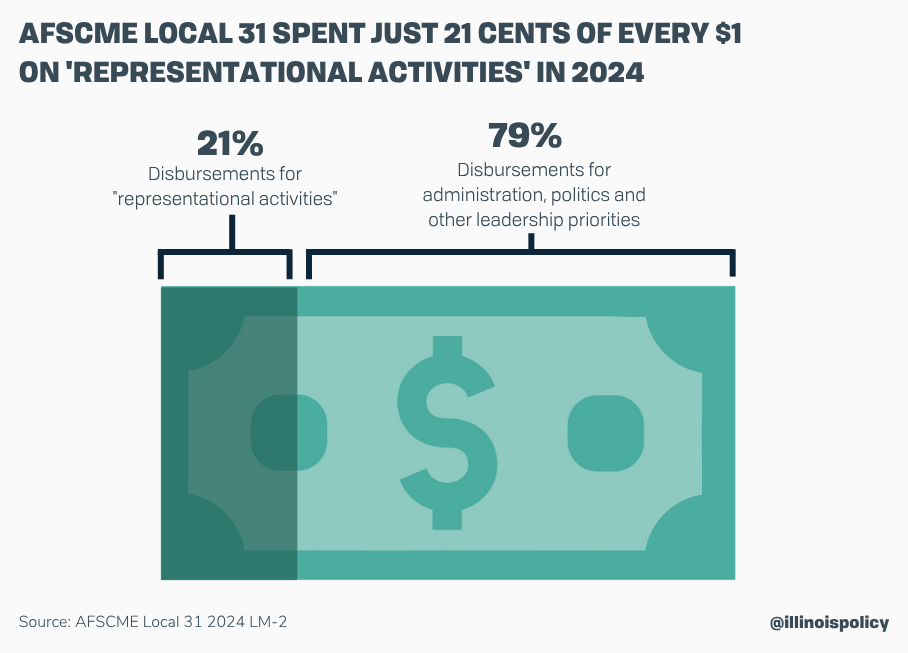
Illinois at near record-low union membership in 2025
February 23, 2026 // Just 13.1% of workers in Illinois were union members in 2025. Thousands of government workers have rejected union membership. Union membership in Illinois was at a near-record low in 2025, according to a release from the U.S. Bureau of Labor Statistics Feb. 18.
Denver Public Library workers move to unionize in 2026
January 5, 2026 // The action came just a day after a new law took effect, allowing thousands of city employees to join unions and engage in collective bargaining.
Union Bosses Admit They Spent $1.8 Billion on Politics in the 2024 Election Cycle — The Real Number is Likely Over $28 Billion
December 19, 2025 // It is nearly impossible to produce perfectly accurate figures from the LM-2 because subsidiary unions file separate forms from the larger national unions they fall under, and transactions between these unions could be listed multiple times in the data. This only worsens the problems of inconsistent and potentially inaccurate reporting mentioned above. The LM-2 does not lend itself to a precise analysis of union boss spending, but it does give a sense of its scale. When sympathetic media outlets report unions’ political influence in the tens or even hundreds of millions of dollars that is a dramatic underrepresentation.

Education and Workforce Committee Passes 3 Bills to Expand Flexibility, Boost Earnings, and Hasten Back Pay
November 25, 2025 // On Thursday, the House Education and Workforce Committee passed three bills to boost flexibility, wages, and efficiency for workers. These three bills would modernize the 1938 Fair Labor Standards Act to provide flexibility for workers, simplicity for tipped employees, and more efficient resolutions to payroll errors. Importantly, none of these provisions will cost taxpayers a single dime because they simply remove unnecessary barriers to flexibility and higher pay. In fact, at least one of the bills would likely save taxpayers from unnecessary administrative costs.