Posts tagged union rate
Report: Interest in unionization on the rise in Kentucky
September 5, 2024 // But speaking of the auto industry, Kentucky’s largest auto-related project — the Ford BlueOval SK plant — will not be unionized. That’s part of an agreement between Ford and United Auto Workers. Recent data show less than 10% of workers in most of the south have union coverage, but proponents say they’re seeing renewed momentum they haven’t seen in decades.

Labor unions lose 63,000 members under new state law
September 5, 2024 // The largest losses of union representation in Florida due to SB 256 come from those employed by the state government — more than 43,000 state employees have lost their unions. The second largest loss of union representation comes from university and college professors, specifically unions that represent adjunct and part-time faculty. Municipal employees from cities large and small follow. WLRN is using public records to maintain a database that shows the full extent of the fallout of the law.
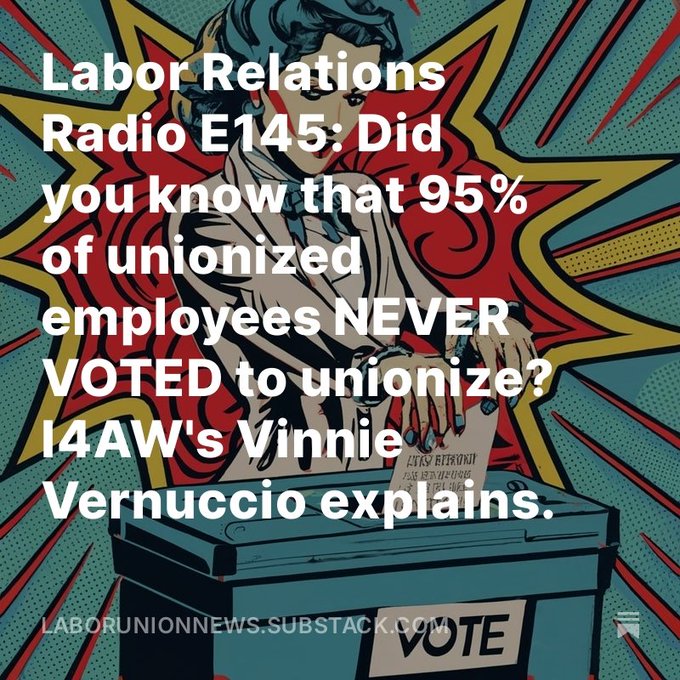
Labor Relations Radio E145: Did you know that 95% of unionized employees NEVER VOTED to unionize? I4AW’s Vinnie Vernuccio explains.
September 4, 2024 // As Americans, every two, four, or six years, we head to polls to cast our ballots for who we want to represent us. For unionized workers in the private sector, the vast majority never voted to unionize. According to a new study [in PDF] by the Institute for the American Worker (I4AW), 95 percent of private sector union workers under the National Labor Relations Act (NLRA) are represented by a union they have never voted for.

OPINION STAR PARKER: Unions and Republicans
August 16, 2024 // According to a recent survey from Pew Research, 39 percent of union members are Republicans. Furthermore, when we examine the polling data, we see a disconnect between what voters think about unions and what workers are actually doing. Regarding the latter, the data is clear that fewer and fewer workers are joining unions.
State of the unions: 8 facts you need to know about unions in Colorado
August 8, 2024 // Colorado is a modified “right to work” state because, under the state’s Labor Peace Act, workplaces with unions may hold a second election to become an all-union workplace. If at least 75% of eligible workers approve its Labor Peace Act election, the workplace becomes all-union, meaning every worker must join the union and pay dues. The act was passed in 1943 as a compromise between unions and business owners. In 2023 and 2024 to date, nine Labor Peace Act elections have been held — six won and three lost, according to the Colorado Fiscal Institute.

‘All-of-government’ approach undermines workers’ free choice
February 15, 2024 // As punishment for the “offense” of simply not being organized by a union, these employers face particular hostility from the supposed arbiter of private-sector labor relations, the National Labor Relations Board. Now packed with pro-union Biden appointees, the Board continues to issue decisions that appear singularly focused on increasing union power without regard to their impact on workers or businesses.
5 States That Have America’s Strongest Unions
February 15, 2024 //
Workers at an employee-owned Utah grocery vote to unionize, citing ‘unsustainable’ conditions
February 14, 2024 // A bill moving through the Utah Legislature would add requirements for public unions and prohibit them from using public money or public property for union activities, including organizing and paying for union leave hours. HB285, authored by State Rep. Jordan Teuscher, R-South Jordan, passed to the House floor on an 8-4 vote in late January after a two-hour hearing where most public comment was against the bill. The federal statistics on union membership do not differentiate between public-sector workers and private-sector employees.

Opinion: Unions’ deceptive ‘salting’ loophole leaves a bad taste
November 3, 2023 // Workers United — a Service Employees International Union affiliate — hired labor organizers who got jobs at Starbucks, then pushed for unionization on the coffee company’s dime — while also collecting a union paycheck. These “salts” start by building trust with workers. As one Starbucks salt told a group of fellow organizers, it’s best to do “thankless chores” that gain the appreciation of peers and “make the company less suspicious of you.”

Op-ed: With fewer workers choosing unions, administration turns to taxpayer dollars to boost union ranks
September 19, 2023 // First, some solicitations for grants, such as under the Environmental Protection Agency’s “Clean School Bus” program, ask whether applicants will recognize card check certifications. Card check is a process where workers are denied the chance to vote for or against a union by private ballot. Instead, union organizers are allowed to repeatedly pressure them to sign cards, in public. Both the text of the National Labor Relations Act and numerous court rulings (including by the Supreme Court) have recognized that private ballots are far superior to signature cards in determining workers’ true feelings about unionizing. Apparently, the administration thinks “free and fair” means a free and fair chance for organizers to pressure workers into saying “yes.” Second, many grant solicitations, such as those under the Department of Energy’s “Home Energy Efficiency Contractor Training,” “encourage” applicants to remain neutral in organizing campaigns. What this means is that employers are being asked to waive their statutory right to discuss the potential negatives of unionizing with workers. Instead, workers will get just one side of the story — that of the union. With no other source of information, workers might just decide to say yes, especially when being pressured to sign a card. Third, some applications, such as those published by the National Telecommunications and Information Agency to build broadband, ask applicants to sign labor peace agreements. Labor peace certainly sounds desirable, but here’s what it means in practice. Let’s say a union decides it wants to represent the workers of a particular grantee. Upon notice of that intent, the grantee would have to get the union to sign a labor peace agreement, which typically includes a “no-strike” pledge among other provisions. The catch is that if the union doesn’t sign, you don’t get your grant. This gives the union tremendous leverage to demand organizing concessions, most notably things like card check and neutrality.