Posts tagged government workers
Opinion Shameful: Republicans help SEIU defy Gavin Newsom’s return to work order
September 1, 2026 // Enter Assembly Bill 1729. Authored by Democratic Assemblyman Alex Lee and coauthored by Republican Assemblyman Josh Hoover, the bill throws a statutory obstacle in Newsom’s way. Existing law already requires agencies to maintain telework plans where teleworking is “both practical and beneficial.”
Op-ed: California doubles down on pension debt — and dares Congress to bail it out
July 23, 2026 // On July 1, California’s Assembly Appropriations Committee advanced AB 1383, a bill that guts the pension reform Sacramento passed in 2013 to keep its own promises honest. It would drop the public safety retirement age from 57 to 55, invent a new 3%-at-55 benefit formula, and let cities bargain away the cost-sharing rules that reform required. CalPERS already carries more than $179 billion in unfunded liabilities. California’s total state and local pension debt tops $200 billion. Sacramento’s answer, apparently, is to promise more.
Op-ed: 8 years after Janus, unions are still trying to keep workers in the dark
July 6, 2026 // The National Education Association’s headquarters dues revenue fell from $370 million in fiscal 2017 to an inflation-adjusted $310 million five years later — a decline in real terms of about 16 percent. Nationally, Bureau of Labor Statistics data show public-sector union density slid from 33.9 percent in 2018 to 32.2 percent in 2024, before edging back up to 32.9 percent last year. States that gave workers more direct control over their own dues saw the effect even more clearly. After Florida ended government payroll deduction of union dues in 2023, the Florida Education Association lost more than 20,000 members in a single school year. When workers must actively choose to pay, rather than having dues quietly deducted by default, a meaningful share of them chooses not to.
California state workers union warns of mass exodus with Newsom’s return to office order
June 22, 2026 // From an economic perspective, the return-to-office mandate could benefit local businesses, according to Robert Heidt, president of the Sacramento Metro Chamber. “There is a lot of value in bringing people back to the office. The ebb and flow. The next generation of workforce. There is a value in experiencing by observation. Even me as the CEO, if I wasn't here every day, there are things I wouldn't notice or pick up or see in the office,” Heidt said. “I can't imagine that we can sustain an acceptable level of business and commerce with everyone remote. It just doesn't make sense,” he added.
Trump strips civil service protections from thousands of workers
June 8, 2026 // The reclassification is part of a wider campaign by Trump to downsize the civil service and realign it toward his policy goals. The administration has developed rules to have federal employees sign nondisclosure agreements, extend suitability standards, end certain layoff protections, cap performance ratings and weaken safeguards for probationary workers. Office of Personnel Management Director Scott Kupor told reporters the administration needs people in policy-making positions willing to carry out the president’s directives. It doesn’t matter what political views those federal employees may have, he said. “But if you allow those views to basically interfere with your willingness to actually carry out lawful orders and policy directives of the administration, then this provides a mechanism, obviously, for people in those agencies to be able to be removed effectively at will,” Kupor said.
Op-ed: The right’s growing crackup over organized labor
May 14, 2026 // In the face of its growing crackup over organized labor, the Right is badly in need of developing a labor policy that is pro-worker without being pro-union. The best bet would be to coalesce around a flexible work agenda that empowers workers to achieve autonomy and agency in their employment arrangements. This policy agenda could take many different forms, but it might include championing the independent contracting status of gig workers while simultaneously expanding so-called portable benefit models that provide these workers with funds to access workplace benefits. This provides a more nimble, nuanced alternative to reclassifying them as employees or unionizing them. Or right-leaning politicians could seek to address issues like just-in-time scheduling, a common sore spot for workers in many industries, by striking a grand bargain with the business community regarding overtime averaging. By focusing on flexibility rather than cribbing the union political playbook, the Right can take a pro-worker stance without needing to fully repudiate its pro-business instincts.
Unions Leverage Retirement Funds for Political Agendas
May 5, 2026 // The new report “Unions and ESG: From Worker Representation to Shareholder Activism,” explains how organized labor backs Environmental, Social and Governance (ESG) investing principles. Under ESG principles, fund managers no longer make investment decisions based solely on financial returns for their clients, instead considering unrelated environmental and social issues such as climate policies and corporate diversity efforts.
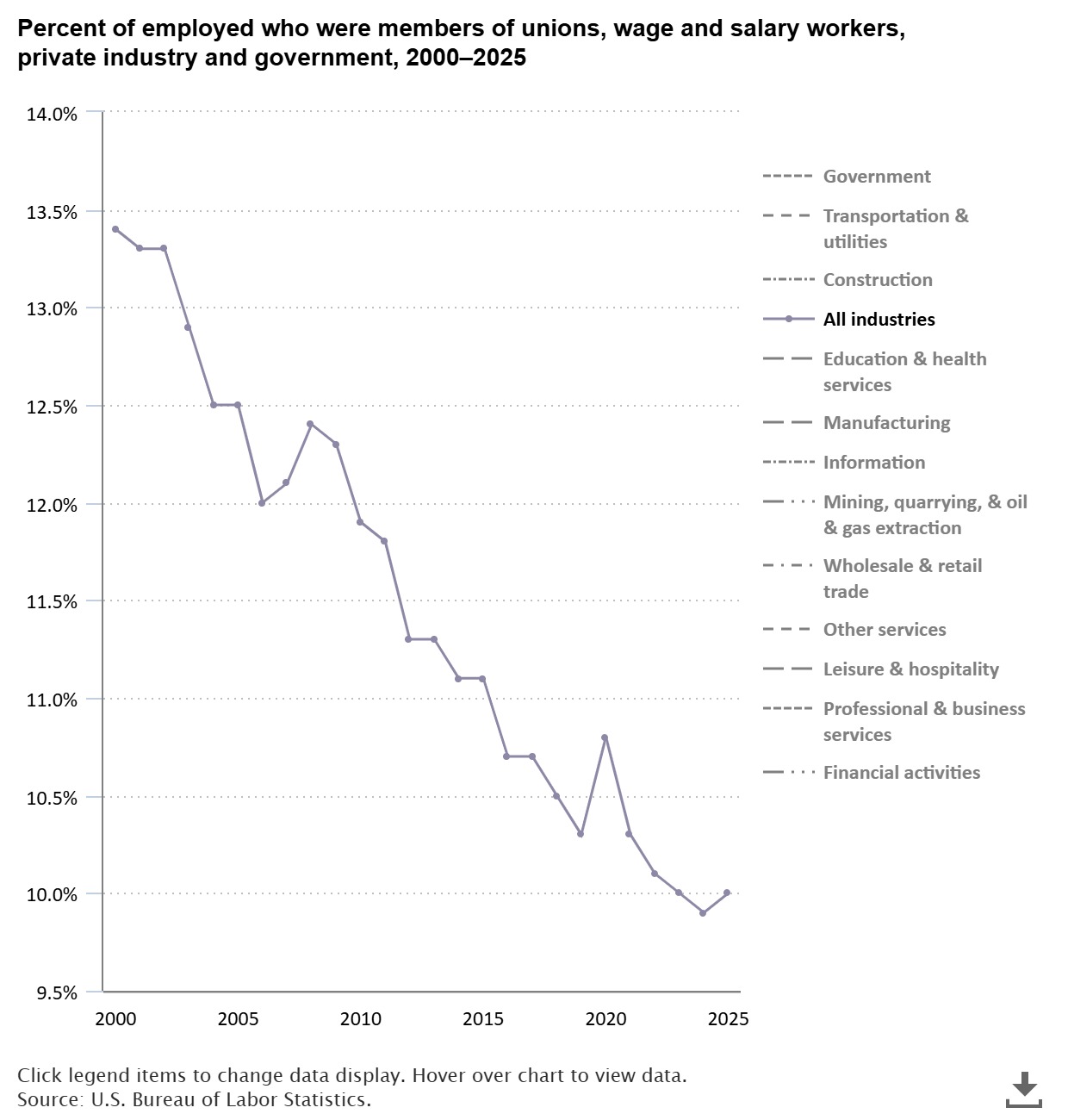
Union membership rate 10.0 percent in 2025
April 26, 2026 // The union membership rate of public-sector (government) workers, 32.9 percent in 2025, continued to be more than five times higher than the rate of private-sector workers. The public-sector union membership rate increased by 0.7 percentage point over the year. The union membership rate continued to be highest in local government, which employs many workers in heavily unionized occupations. The union membership rate in the private sector (5.9 percent across all industries) was unchanged over the year. Industries with some of the highest unionization rates in 2025 included transportation and utilities, 14.3 percent, and construction, 11.1 percent. Among the lowest unionization rates were financial activities, 1.5 percent, professional and business services, 2.1 percent, and leisure and hospitality (which includes food services and drinking places), 3.0 percent.
Unions heighten calls for a bigger federal pay boost next year
April 15, 2026 //
Unleash Prosperity Hotline: Unions Are SOOO Yesterday
April 14, 2026 // We all want higher wages for workers, but we wince when the Bernie Sanders Dems and the NatCons say the way to reach that goal is to expand union power. That can’t work today because, as Rachel Greszler of Advancing American Freedom notes in her latest policy brief, only one in 16 private workers is in a union. And that percentage keeps drifting down.