Posts tagged Public Sector Workers
Op-ed: Unions still haven’t accepted Janus
June 29, 2026 // Public employees have a First Amendment right not to join or financially support a public-sector union. Yet across the country, many workers are never clearly told that. In some states, unions have secured laws giving them mandatory access to new employees, including closed-door meetings during onboarding. But those workers may never hear the other side: That union membership is optional and that they have a constitutional right to decline. That is not informed consent. It is a one-sided sales pitch backed by political power.
UAW votes to divest from Israel bonds
June 24, 2026 // United Auto Workers delegates on Thursday voted in a narrow decision to amend their constitution prohibiting investment in Israel Bonds, a mark of a sea change in the union's politics, according to experts. The passage is expected to result in the divestment of at least $400,000 in Israel Bonds, according to the passed resolution and the Unite All for Workers for Democracy caucus within the Detroit-based union focused on "class struggle" that pushed for the resolution. Israel Bonds is the common name for Development Corp. for Israel, which is the broker-dealer that underwrites and markets debt securities issued by the State of Israel in the United States. Proceeds from the sales support Israel's government.
Labor leaders call collective bargaining veto a ‘betrayal’ by Virginia governor
May 19, 2026 // “I remain committed to continuing to work with the General Assembly, unions, localities and public servants across the Commonwealth to develop a public sector collective bargaining system that works for Virginia,” Spanberger said in a statement. “However, I believe additional amendments are needed to the enrolled bill currently before me.” During the Jim Crow era, Virginia banned public sector collective bargaining in 1948 in response to a group of Black workers organizing a union at the University of Virginia hospital. Before Virginia passed a law that permits local governments to enact their own collective bargaining system in 2021, the state was one of only three that have blanket bans on collective bargaining for public sector workers. Even after the law passed, collective bargaining for state government workers remains illegal.
‘We can shut down the city’: Lurie’s budget cuts spark a showdown with labor
May 19, 2026 // Mayor Daniel Lurie may be setting the stage for a once-in-a-generation showdown with San Francisco’s public-sector labor unions. Faced with a $643 million deficit and the threat of hundreds of millions more in federal cuts, Lurie is slashing city jobs and squeezing public services — moves that are fueling anger among the unions he’ll soon face across the bargaining table.
Penn State faculty vote to unionize in one of Pennsylvania’s largest union elections
May 16, 2026 // With the election decided, the next major step will be negotiating a first union contract between Penn State faculty and the university. Organizers say they hope the agreement will address workplace conditions, faculty voice in governance and support for the university’s academic mission. SEIU Local 668 represents about 25,000 public-sector workers across Pennsylvania’s 67 counties. This comes as the university moves forward with plans to close several branch campuses, including Penn State York and Penn State Mont Alto.
Opinion Editorial Board ‘Ha! She has been supporting the thing she despises this entire time.’
May 4, 2026 // Adding to their contempt for Carter, the union continued to fight her in court. Finally, last week, the case came to a close when Carter received almost $950,000 in damages from Southwest and the TWU. Carter was only able to afford this lawsuit because of pro bono representation by the National Right to Work Legal Defense Foundation. How many other Southwest flight attendants have had their money used for political activism they oppose by a union that hates their beliefs?
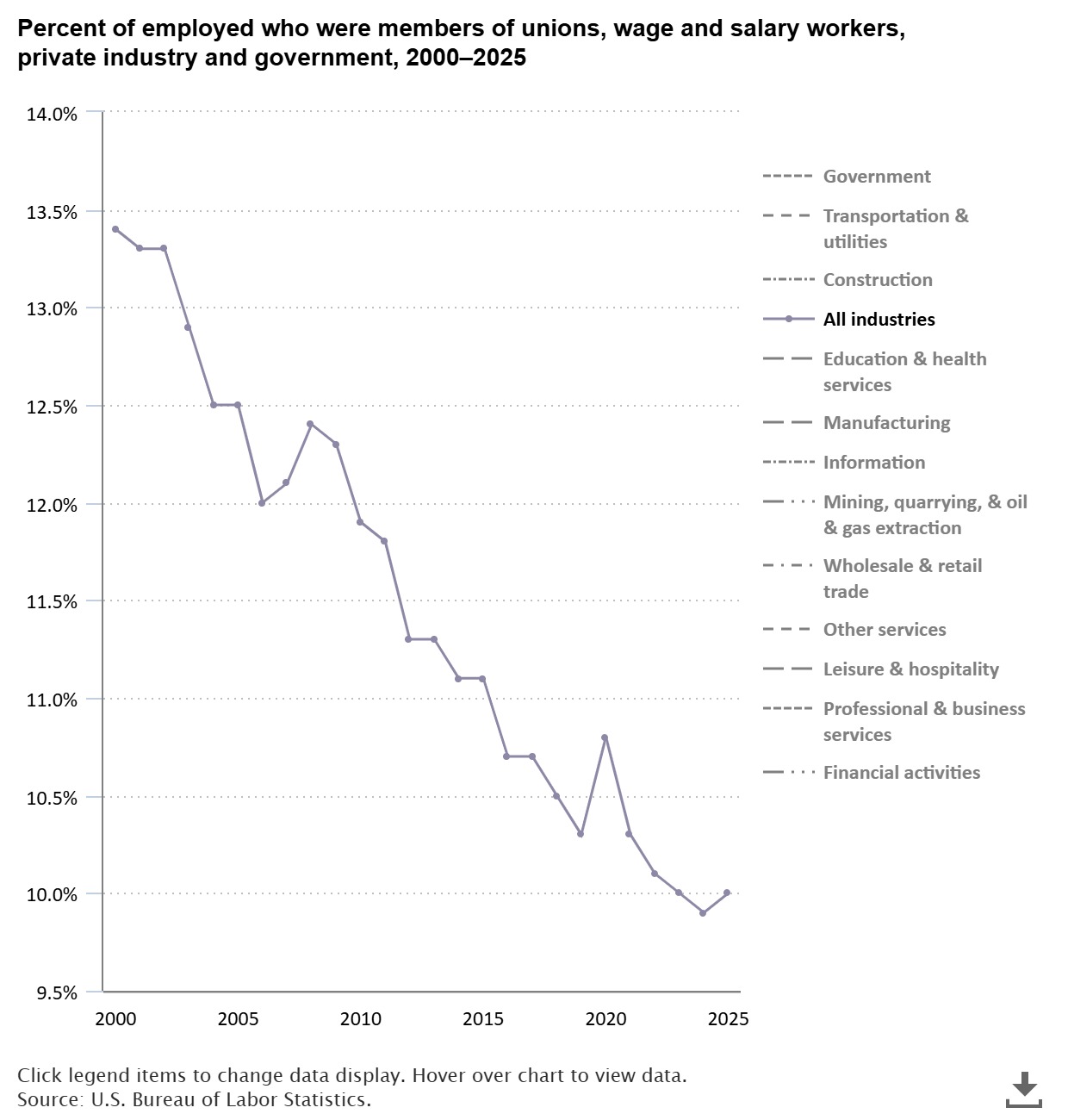
Union membership rate 10.0 percent in 2025
April 26, 2026 // The union membership rate of public-sector (government) workers, 32.9 percent in 2025, continued to be more than five times higher than the rate of private-sector workers. The public-sector union membership rate increased by 0.7 percentage point over the year. The union membership rate continued to be highest in local government, which employs many workers in heavily unionized occupations. The union membership rate in the private sector (5.9 percent across all industries) was unchanged over the year. Industries with some of the highest unionization rates in 2025 included transportation and utilities, 14.3 percent, and construction, 11.1 percent. Among the lowest unionization rates were financial activities, 1.5 percent, professional and business services, 2.1 percent, and leisure and hospitality (which includes food services and drinking places), 3.0 percent.
Teachers union flexes on New York state budget: pension boosts or bust
April 1, 2026 // The UFT and other teacher unions are focused on lowering the age when someone can retire without penalty. Under Tier IV, public employees including teachers can retire at 55 if they’ve worked for 30 years. Under Tier VI, an employee must work until 63 in order to retire without losing half of their pension award. Opponents say there’s scant evidence that pensions are contributing to recruitment and retention challenges. Tier VI required employees hired after its 2012 enactment to contribute to the cost of their retirement for the duration of their employment, instead of just the first 10 years. It also set a later retirement age — all measures that are saving state and local governments an estimated $80 billion through 2042.

How CA state worker unions have fared since landmark SCOTUS decision reshaped membership
March 17, 2026 // According to eight years of data obtained from the State Controller’s Office on the number of dues-paying state workers, some unions have slowly bled members since the Janus decision. For other bargaining units, the membership level has dropped 20% over that period. Labor groups representing peace officers and prison staff, however, hardly saw a change pre- and post-Janus. And still other units have increased the percentage of workers who pay monthly membership dues, the data revealed. Nearly 10 years before the Janus decision, the public’s approval of unions hit a historic low. In 2009, Americans’ approval ratings dipped below 50% for the first and only time since the public opinion polling company Gallup began assessing ratings of labor unions in 1936. In the years since, the public’s opinion of labor unions has improved substantially. Last year, 68% of Americans reported approval of unions.
Florida Gov. Ron DeSantis backs a new bill targeting unions; those who support him won’t be affected
March 3, 2026 // In 2023, the Florida Legislature passed Senate Bill 256, a measure designed to attack public sector unions by making it harder for them to collect dues, while simultaneously forcing them to show that at least 60% of their members were paying their dues. Any union that failed to meet that 60% threshold faced a decertification vote.