Posts tagged Department of Energy
Federal Workers Get Second Musk Buyout Offer
April 2, 2025 // The initiative bears many of the hallmarks of Musk’s “Fork in the Road” offer in January, which allowed federal workers to leave their jobs in February but continue being paid through September. This time the offers are being made agency-by-agency as part of each department’s mandate to reduce the size of its workforce. Deadlines and rules for eligibility differ by department.
Backgrounder: Executive Order: Exclusions from Federal Labor-Management Relations Programs
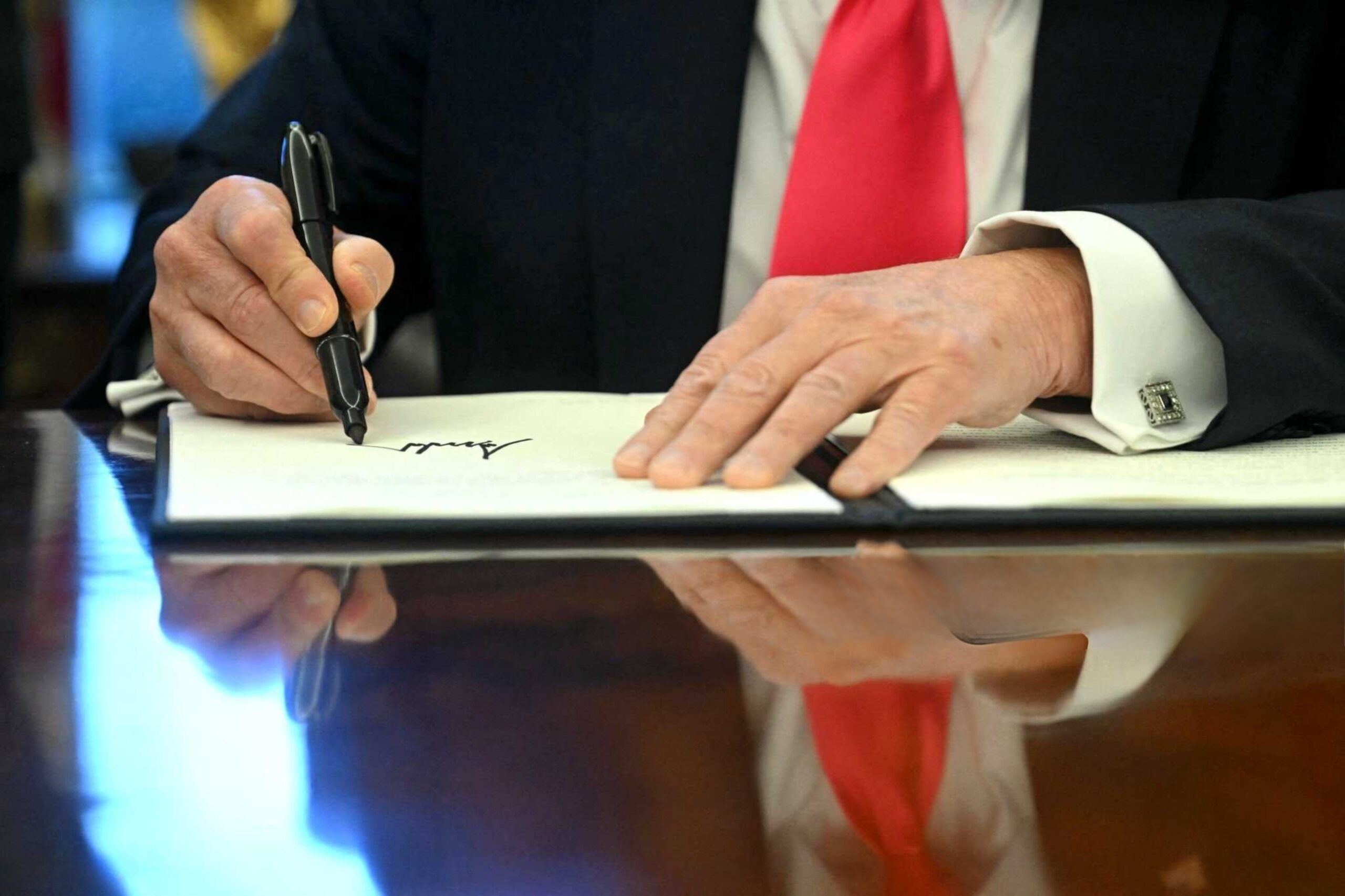
March 31, 2025 // The practice of “official time” is when unionized federal employees perform union-related activities, rather than their actual public service duties, while being paid by taxpayers. The Federal Unions EO requires that agencies, upon termination of an applicable collective bargaining agreement, reassign any workers who performed “official time” to positions where they perform solely agency business. It also contains language regarding existing grievance proceedings and allows for the head of each agency to submit a report to the President within 30 days highlighting any agency subdivisions that were not covered but should have been covered under the Federal Unions EO.

Trump signs executive order to end collective bargaining at agencies involved with national security
March 27, 2025 // President Donald Trump moved Thursday to end collective bargaining with federal labor unions in agencies with national security missions across the federal government, citing authority granted him under a 1978 law. The order, signed without public fanfare and announced late Thursday, appears to touch most of the federal government. Affected agencies include the Departments of State, Defense, Veterans Affairs, Energy, Health and Human Services, Treasury, Justice and Commerce and the part of Homeland Security responsible for border security.
This Pennsylvania battery plant just voted to unionize—here’s why it matters
September 10, 2024 // Eos Energy has received a roughly $400 million conditional loan guarantee from the Department of Energy and has also received millions of dollars from the Inflation Reduction Act’s Section 45X advanced manufacturing production tax credit, designed to incentivize production of renewable energy components such as batteries. If the company expands production as planned, Eos will be eligible for $1.98 billion in Section 45X tax credits between 2026 and 2032. Legislators framed the Inflation Reduction Act as a source of “good-paying union jobs” within the renewable energy sector. But the legislation did not require companies receiving federal funds to commit to union neutrality agreements.
Workers Say Plant Eligible for $2 Billion in Public Funds Is Union-Busting
September 4, 2024 // Eos’s Pittsburgh-area battery plant got subsidies aimed at ‘good clean jobs.’ Its workers say they’re getting fired for unionizing.
UAW workers at Stellantis could strike over Illinois plant reopening
August 20, 2024 // Last month, the U.S. Energy Department said it planned to award Stellantis $334.8 million to convert the shuttered Belvidere Assembly plant to build EVs and $250 million to convert its Indiana Transmission Plant in Kokomo to produce EV components. The UAW said since 2023 "the company has gone back on its product commitments at Belvidere, and has been unreceptive in talks with the union to stay on track." The UAW added "this glaring violation of the contract imperils all of the other investment commitments the company has made."
Whitmer joined by Granholm, Slotkin and Fain to announce EV battery training program
March 27, 2024 // “To bring together this front row here of just, I’m sorry, bad asses,” said Slotkin to laughter from the crowd. “I have to say the beauty of being a legislator is when you get to see the stuff that you vote on, actually matter in your own district, in your own state.” The stuff to which Slotkin was referring was the $5 million investment by the Department of Energy for the Battery Workforce Initiative that will, according to a release, “support up to five pilot training programs in energy and automotive communities and advance workforce partnerships between industry and labor for the domestic lithium battery supply chain.” While the $5 million is just a small fraction of the $1.2 bipartisan infrastructure bill signed by Biden in 2021, Whitmer said it was a key piece of the strategy to keep the U.S., as well as Michigan, at the forefront of electric vehicle manufacturing.
Electric Vehicle Factories Are Overwhelmingly Nonunion. The UAW Strike Could Change That.
September 20, 2023 // Nonunion companies are also getting in on the EV facility boomlet. Tesla plans to expand to a lithium refinery in Texas and produce battery cells, packs, and modules in California and Texas. Other companies investing in battery plants include BMW (South Carolina), Honda (Ohio), Hyundai (Georgia), Mercedes-Benz (Alabama), Toyota (North Carolina), Volkswagen (Ontario, Canada), and Volvo (South Carolina). The construction boom continues in nonunion plants. A variety of battery manufacturers are building new facilities, too. These include the Japanese company AESC (Tennessee, Kentucky, and South Carolina), the Chinese-owned Gotion (Michigan), South Korea’s LG Energy Solution (Arizona and Michigan) the start-up Our Next Energy (Michigan), Japanese-owned Panasonic (Kansas), South Korean SK Battery America (Georgia), and Redwood Materials, a recycling company (Nevada and South Carolina).
Op-ed: With fewer workers choosing unions, administration turns to taxpayer dollars to boost union ranks
September 19, 2023 // First, some solicitations for grants, such as under the Environmental Protection Agency’s “Clean School Bus” program, ask whether applicants will recognize card check certifications. Card check is a process where workers are denied the chance to vote for or against a union by private ballot. Instead, union organizers are allowed to repeatedly pressure them to sign cards, in public. Both the text of the National Labor Relations Act and numerous court rulings (including by the Supreme Court) have recognized that private ballots are far superior to signature cards in determining workers’ true feelings about unionizing. Apparently, the administration thinks “free and fair” means a free and fair chance for organizers to pressure workers into saying “yes.” Second, many grant solicitations, such as those under the Department of Energy’s “Home Energy Efficiency Contractor Training,” “encourage” applicants to remain neutral in organizing campaigns. What this means is that employers are being asked to waive their statutory right to discuss the potential negatives of unionizing with workers. Instead, workers will get just one side of the story — that of the union. With no other source of information, workers might just decide to say yes, especially when being pressured to sign a card. Third, some applications, such as those published by the National Telecommunications and Information Agency to build broadband, ask applicants to sign labor peace agreements. Labor peace certainly sounds desirable, but here’s what it means in practice. Let’s say a union decides it wants to represent the workers of a particular grantee. Upon notice of that intent, the grantee would have to get the union to sign a labor peace agreement, which typically includes a “no-strike” pledge among other provisions. The catch is that if the union doesn’t sign, you don’t get your grant. This gives the union tremendous leverage to demand organizing concessions, most notably things like card check and neutrality.
The United Auto Workers Meet Electrification
August 22, 2023 // LeRoy and Whiton calculated in their report that battery factory subsidies will range from $2 million to $7 million per job over the ten-year duration of the 45X program. One of their case studies is the $3.5 billion BlueOval Battery Park in Marshall, Michigan. So far, the facility has been awarded $1.7 billion in state and local government subsidies, in addition to qualifying for an expected $6.7 billion in federal 45X credits. Yet wages at the battery plant will average around $45,000 a year. The gap between the sheer amount of money on the table for manufacturers and the quality of job it translates into is the IRA’s weakest link. “The states where these facilities are located should be publicly saying that in exchange for such subsidies the company should allow for voluntary [union] recognition votes,” LeRoy suggested.