Posts tagged Secret Ballot

Commentary: Short-Term Gains, Long-Term Harm: The Real Cost of Union Monopoly Power
May 22, 2026 // The Mercatus paper's survey findings cut against the union narrative in ways that should matter to anyone who follows labor policy. When asked directly, workers say they prefer unions that cooperate with management over unions that are more powerful but adversarial. They prefer having multiple options for representation rather than one organization with legal monopoly control over their workplace. And union progressive political activity and strikes, the two things union leadership most reliably prioritizes, are the only factors that consistently make workers less favorable toward organized labor.
Why Are Republicans Looking To Pass Obama-Era Forced Unionization Bill?
May 20, 2026 // Instead of contract bargaining, there would be “binding arbitration.” For 90 days, unions and employers would come to the table as normal and work toward an agreement. After that, the Federal Mediation and Conciliation Service could be called in to “mediate” the talks for an additional 30 days. If no agreement was reached, the agency gained the power to convene an arbitration panel that would write up a contract that bound both the union and the employer for two years. EFCA made unionization faster, but only by taking away checks that workers and employers had on union bosses. Today, unions are still pushing for the “binding arbitration” half of EFCA. It’s on the smorgasbord of provisions in the so-called PRO Act, a union-backed bill supported by all but a few congressional Democrats, and it’s central to the Faster Labor Contracts Act.
Editorial Board: In defense of the secret ballot
March 15, 2026 // In the case decided by the 6th Circuit, Brown-Forman challenged the basis for the NLRB’s Cemex ruling and won. The supposedly unfair labor practice committed at its Woodford Reserve bourbon distillery was giving workers a $4-per-hour raise, expanding merit-based salary increases, offering more vacation time and providing free bottles of bourbon. The employees voted 45-14 against unionizing, but the NLRB ordered the company to bargain with that union anyway. The advantage of secret-ballot elections is that workers are free of coercion by unions or employers when deciding whether they wish to unionize. It also ensures that their decisions are anonymous, so they won’t fear retaliation or harassment by aggressive union organizers or the people who pay their salaries. A secret ballot is far more likely to reflect their true views.
Whitman College Will Not Voluntarily Recognize WCWU
March 8, 2026 // Because of this, eligible employees will be expected to vote through the NLRB’s secret ballot process before WCWU can initiate formal negotiations on campus. According to the announcement, the college has decided not to recognize the voluntary signatures which WCWU collected prior to the rally last month as a legitimate election process. Instead, administrators believe that an organized election through the NLRB will allow employees to vote in “a fair, inclusive and confidential process in which all eligible staff members have the opportunity to participate.”
Op-ed: When taxpayers incentivize jobs, the state should protect workers’ privacy in union votes
February 26, 2026 // Now, Rankin County Republican State Sen. Josh Harkins, who chairs the Senate Finance Committee, has introduced legislation to protect the investments of state and local taxpayers in economic development projects that rely on taxpayer incentives. The bill ensures that Mississippi workers are entitled to a private ballot for any unionization vote. In a recent op-ed, Harkins explained: “Senate Bill 2202 is straightforward: for companies that choose to accept future state economic development incentives, any decision about union representation should be made through a private, secret-ballot election. The bill does not prohibit employees from organizing. It does not outlaw unions. It does not interfere with an employee’s right to choose union representation if a majority wants it. It simply sets an expectation that the decision is made in a way that protects (worker) privacy.”
Majority of Lynchburg, Virginia Manufacturing Plant Workers File Petition to Oust Chemical Union Bosses
February 17, 2026 // Natera Carter, an employee of Parker O-Ring & Engineered Seals, has filed a petition with the National Labor Relations Board (NLRB) seeking a “decertification” election to remove the International Chemical Workers Union Council (ICWUC) Local 845C labor union from her workplace. The petition was filed with free legal aid from National Right to Work Foundation staff attorneys.
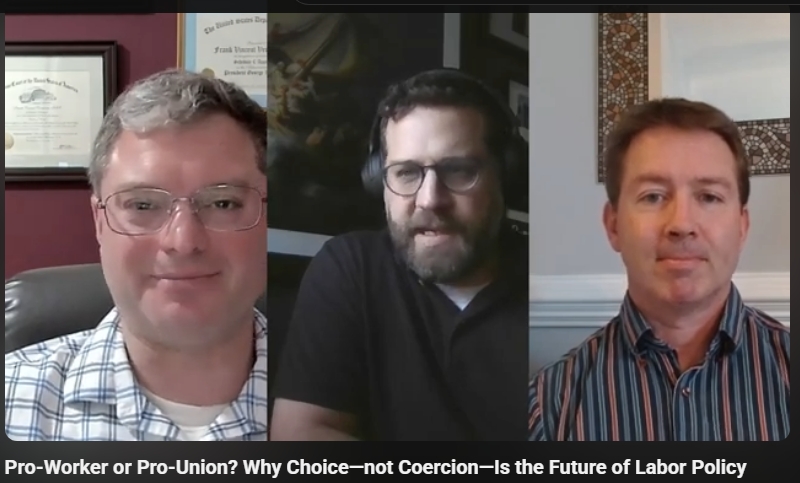
Pro-Worker or Pro-Union? Why Choice—not Coercion—Is the Future of Labor Policy, Disunion: The Government Union Report; Commonwealth Foundation
December 18, 2025 // This week on Disunion, host David Osborne is joined by Austen Bannan of Americans for Prosperity and Vincent Vernuccio, president of the Institute for the American Worker, to break down a sweeping new report: How to Empower Workers: Embracing a Pro-Worker Agenda Built on Choice. With Congress rolling out a flurry of labor bills—from right-to-work reforms and secret ballot protections to proposals backed by unions and even some Republicans—this episode cuts through the noise. The panel explains why many so-called “pro-worker” policies actually empower union bosses and government regulators, not workers themselves.
Cayuga Medical Center nurses are unionizing, pushing for hospital recognition
December 11, 2025 // The union is asking hospital management for voluntary recognition, which would mean the nurses wouldn’t need to hold an election to finish establishing the union and start bargaining their first contract. However, when reached for comment, a hospital representative did not say that Cayuga Medical Center would provide that recognition. Instead, they said Cayuga Medical Center respected nurses' rights to hold a vote on unionization. “We fully respect their right to pursue a secret ballot vote following National Labor Relations Board (NLRB) rules,” the hospital said in a statement.
Union activity at Chicago Botanic Garden heats up
December 11, 2025 // She also wrote that the garden respects employees’ rights “to support, or not support” union representation, but the nonprofit organization disagrees with the suggestion for “card check neutrality” and issued support for a secret-ballot process. “Federal labor law establishes a process for employees to exercise their rights by making their choice for or against representation in a secret ballot election administered and supervised by the National Labor Relations Board,” Franczyk wrote. “Embracing ‘card check neutrality’ would eliminate the opportunity for employees to vote in a secret election.”
Opinion: The Senate can stop the NLRB’s threats to American freedom
December 8, 2025 // Trump’s nominees will restore the balance and discipline needed to repair the NLRB’s legitimacy and credibility with American workers. They understand that the NLRB’s role is not to pick winners and losers, but to protect workers’ rights and uphold secret ballots, as well as ensure union accountability and that information is not hidden from workers. Confirming them would restore the constitutional guardrails that keep government honest and workplaces free.