
Posts tagged AFSCME
ISU workers go on strike after negotiations hit dead end
April 9, 2026 // Coplan said in addition to dining, they’ve planned for ensuring buildings are clean and grounds remain cared for. They do not anticipate disruption to other areas of operation. Most union contracts on campus have language restricting work stoppages if workers from another union go on strike. “We’re communicating with each of our other bargaining units to make sure that there’s an understanding of what that language actually speaks to,” Coplan said. That includes unionized faculty members, who cannot cancel classes, office hours, meetings or other work requirements in a show of solidarity with another union.
DIA budget hearing: About 200 employees unionize
April 4, 2026 // Proposed fiscal year 2027 budget: $0 from the City of Detroit. DIA’s current budget is $45.5 million, with revenue generated through ticket sales, fundraising and a tri-county property tax millage. The DIA functions as an independent nonprofit since the city’s bankruptcy.

As Michigan’s childcare costs rise, workers debate risks of unionizing
March 31, 2026 // Instead of childcare workers unionizing against owners, the model most commonly seen in childcare unions across the country is owners unionizing against their state, as Henderson is advocating for — specifically, childcare owners who receive state reimbursement payments for care they provide low-income families and therefore can be considered state employees. The purpose is to get more robust and permanent public dollars through contract negotiation to fund things providers say they can’t currently afford because of limits on their revenue, like higher wages, insurance benefits, and overall more stability for the struggling industry. Critics of this model say childcare providers shouldn't be considered public employees just because they receive payments from the state or put in a position where they may feel they have to pay union dues. They also say the fractured layout of the industry doesn't lend itself well to unionization and could create division among already under-resourced owners and staff.
Op-Ed: Are unions intentionally exploiting the language barrier?
March 26, 2026 // They don’t know dues are voluntary. They don’t know they can stop payments. They don’t even know they have a choice. And just as importantly — they’re too often made to feel like they shouldn’t ask.
New group of Alexandria City workers vote to unionize
March 25, 2026 // As new negotiations gear up in Alexandria, public workers and unions around the state are waiting to see what Spanberger does with the public-sector collective bargaining bill that the General Assembly passed. The bill would remove the collective bargaining ban on local government, school board, and state employees. Currently, local government and school board employees only have the right to collective bargaining if their employers pass resolutions allowing them to do so. The bill would also extend collective bargaining rights to home care providers and service workers at public universities. The bill excludes university full-time professors, adjuncts, and librarians. These workers are waiting to see if Spanberger adds them back to the bill or makes other changes.
PHILADELPHIA: Prosecutors in District Attorney Larry Krasner’s Office move to unionize
March 24, 2026 // In addition to the ADAs, more than 100 paralegals and victim witness coordinators in the office are also seeking to unionize, according to people familiar with the plans, though it was not immediately clear which union would represent them. The unionization effort could represent a major shift in the culture at the district attorney’s office, where prosecutors make up a significant portion of the 600-person staff. It could also be a flashpoint for Krasner, a three-term progressive Democrat who has cast himself as a supporter of organized labor.
Opinion Aaron Withe: Why unions love the ‘Billionaire Tax’
March 12, 2026 // It has attracted a coalition of supporters — chief among them government employee unions. That might seem like an odd pairing, but the logic becomes clear once you trace where the money is supposed to go. Sanders’ legislation would redirect the projected revenue — $4.4 trillion over a decade — into an array of new federal spending programs, including direct cash payments, a federal salary floor for public school teachers and expanded Medicare benefits. Not coincidentally, pouring money into such programs means more federal employees, more union-eligible positions and more dues flowing into union bank accounts.
Group of Springfield city workers unionize
February 24, 2026 // A group of Springfield city workers have unionized due to a “need for a collective voice in shaping policies affecting City Hall employees.” Workers in the finance department, code enforcement department and law department came together to be represented by AFSCME Local 739,
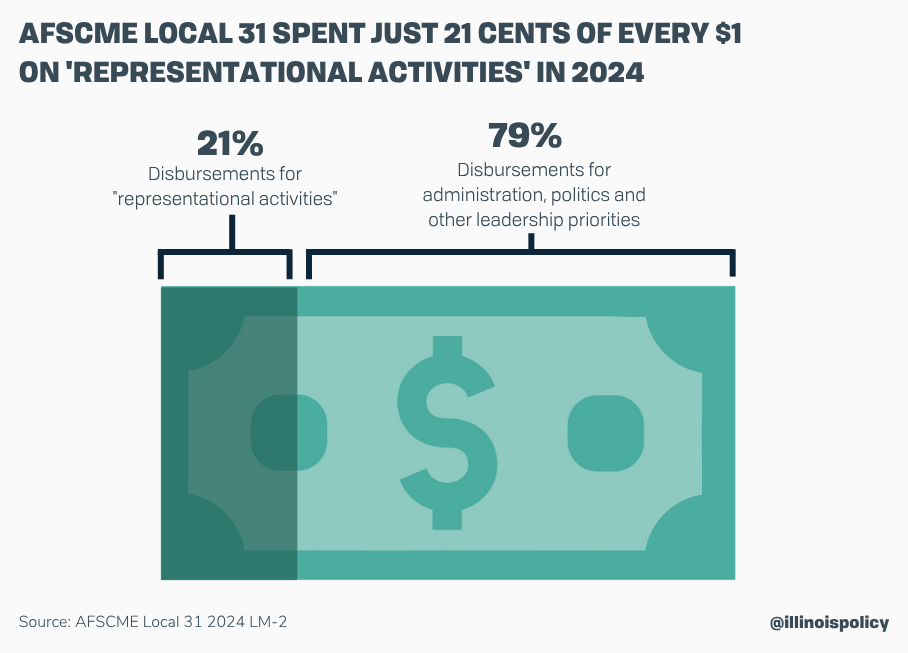
Illinois at near record-low union membership in 2025
February 23, 2026 // Just 13.1% of workers in Illinois were union members in 2025. Thousands of government workers have rejected union membership. Union membership in Illinois was at a near-record low in 2025, according to a release from the U.S. Bureau of Labor Statistics Feb. 18.
Op-ed: The $921M Special Interest Machine That Controls California
February 21, 2026 // The California Policy Center’s analysis lays it bare: California’s public sector unions collected $921 million in 2018 alone. That’s not campaign contributions—that’s annual revenue. The prize they’re protecting? According to Govern For California, state and local governments spend $240 billion per year on public employee compensation and benefits.