
Posts tagged Republicans
Why Would Any Republican Support Forced Unionism?
June 9, 2026 // What makes this even more shocking is that President Trump has proposed completely eliminating the Federal Mediation and Conciliation Service, which the bill would supercharge. The president understands that contracts imposed by government bureaucrats are more likely to be based on political than economic logic, and that negotiations are better left to the private parties. Ironically, government-imposed contracts are likely to harm the workers whose union bosses are pushing this idea. Because when economics don’t add up, it’s the workers who pay in layoffs, reduced hours and the diversion of capital investments that would have raised productivity. This risks broader economic disruption by creating a threat perception that, at any time, a single union request could trigger a government-enforced contract clock. That perception would tend to chill hiring and investing, especially by smaller businesses that can’t afford to fight out an arbitration battle.
Workers for Opportunity joins the fight against the Faster Labor Contracts Act
June 8, 2026 // Vincent Vernuccio, a senior fellow with Workers for Opportunity and president of Institute for the American Worker, recently recapped a Senate hearing where he testified. An unwitting union official opposed the Faster Labor Contracts Act idea of forced arbitration. Vernuccio wrote: [U.S. Senator and Chair of the federal labor committee Sen. Bill] Cassidy explained this policy in real-world terms, saying that it would “take workers out of the process by removing the need to ratify a contract.” He put a finer point on it by saying that if the government mandated arbitration, workers “cannot reject” the resulting agreement, even though it would be binding on them. “What would happen,” he asked, “if workers lost that ability to ratify a contract?” The union official didn’t mince words: “That would be removing the democracy from the workplace.” Then he doubled down: Such democracy “is the whole point of the union,” he said, because it gives workers “a say.”
Faster Labor Contracts Act Bad for Workers and Small Businesses
June 4, 2026 // The supporters on the right also argue that pandering to a piece of legislation championed by Big Labor and the whole Democratic Party will save Republican seats in Congress. Kishi further argues that “the Republican Party today draws its strength not from boardrooms and donor retreats, but from working-class Americans.” Working-class Americans voted for President Donald J. Trump and put Republicans in charge of Congress because they reject the anti-family, woke agenda of a far left that has captured the agenda of the Democratic Party. Arguing that Republicans should adopt Democrat-lite policies to win over votes ignores the fact that voters can just vote for Democrats if they want big government and anti-business policies.
Republicans’ Latest Pro-Union Move Has Some Conservatives Sounding The Alarm
June 4, 2026 // Vinnie Vernuccio, the president of the Institute for the American Worker, also said that it would give “unprecedented power” to federal bureaucrats. He said that his organization was “proud to stand for union democracy by joining the larger coalition and sounding the alarm on this harmful legislation.” The Senate version of the proposal was introduced by Senator Josh Hawley (R-MO) and Senator Cory Booker (D-NJ) and also supported by Republican Senators Roger Marshall (Kansas) and Bernie Moreno (Ohio) and 12 other Democrats.
Ruben Gallego, Flirting With 2028 Bid, Backs Key Demands of Labor Unions
June 3, 2026 // Sectoral bargaining “stops employers from trying to attract top talent by outbidding their competition,” argued the Institute for the American Worker, a right-leaning think tank, in a paper. “This would be a huge problem as American employees typically see larger raises by switching jobs rather than simply waiting for a salary increase at their current workplace.”
Op-ed: When Labor Policy Leaves Its Workers Behind
June 2, 2026 // The Faster Labor Contracts Act empowers unions at workers’ expense. Some Republicans failed to see this charade in the House, but hopefully the Senate will have more common sense.
JD Vance Courts Sean O’Brien and the Teamsters
June 1, 2026 // Mr. O’Brien is desperate for a win in Washington to sell to his 1.3 million members as he runs for re-election. Some Republicans in Congress seem eager to give him one—maybe two—as they seek to burnish their bona fides as defenders of the working class. These Republicans are doing more to help Democrats—the primary beneficiaries of Teamster campaign donations—than workers. The Teamsters’ membership has shrunk by nearly half since the 1970s amid a broader decline in organized labor. Technology has improved productivity. At the same time, jobs have migrated to states with right-to-work laws, which prohibit unions and employers from making union membership a condition of employment. The Teamsters have also lost rank-and-file support. Between 2016 and 2025, members filed 373 petitions to decertify the Teamsters, according to Reason magazine. Some 60% of the decertification elections succeeded. You can’t blame union members for wearying of paying dues that bankroll Democratic candidates and lavish lifestyles of union leaders. In the 2023-24 election cycle, 92% of Teamsters PAC donations to federal candidates went to Democrats, as did 91% of the union’s contributions to party committees.

More transparency for the largest unions
May 31, 2026 // A new rule from the Labor Department will recalibrate the disclosure reports that labor unions are required to file. It’s a welcome update to ensure that union members know how their money is being spent. What will happen in the 2026 midterms? Sign up for Margin of Victory The reason unions have government-mandated disclosure requirements is that they are government-backed monopolies. Labor relations law gives unions exclusive power as the sole bargaining agent for the entire workplace.
Colorado governor vetoes union dues bill — again
May 31, 2026 // Gov. Jared Polis on May 29 again vetoed legislation that would have made it easier for labor organizations to impose dues on non-union members, a decision long expected after the legislature approved the measure without securing the buy-in of businesses. Polis rejected a similar proposal last year, and cited the same reason: that, if enacted, the bill would allow a simple majority of employees who choose to unionize to “also determine that dues could be mandatorily taken from all workers.”
GOP’s populists flex muscles with wins on Capitol Hill
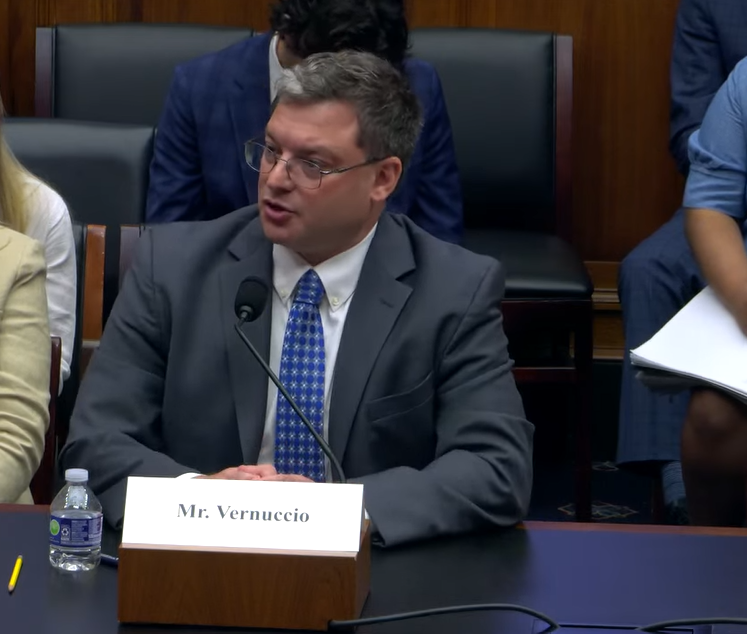
May 29, 2026 // F. Vincent Vernuccio, president of the Institute for the American Worker think tank, which has argued against the bill, pointed to hesitation that one union official expressed about that format in a Senate hearing last year, calling it undemocratic. “It takes away the whole point of a union because it takes away the vote from workers, and that’s exactly what the Faster Labor Contracts Act would do,” Vernuccio told The Hill. “If the union and the employer can’t come to an agreement within 120 days, this arbitration panel that’s appointed by government bureaucrats would write everything in that contract.”