Posts tagged Forced unionization
Why Would Any Republican Support Forced Unionism?
June 9, 2026 // What makes this even more shocking is that President Trump has proposed completely eliminating the Federal Mediation and Conciliation Service, which the bill would supercharge. The president understands that contracts imposed by government bureaucrats are more likely to be based on political than economic logic, and that negotiations are better left to the private parties. Ironically, government-imposed contracts are likely to harm the workers whose union bosses are pushing this idea. Because when economics don’t add up, it’s the workers who pay in layoffs, reduced hours and the diversion of capital investments that would have raised productivity. This risks broader economic disruption by creating a threat perception that, at any time, a single union request could trigger a government-enforced contract clock. That perception would tend to chill hiring and investing, especially by smaller businesses that can’t afford to fight out an arbitration battle.
Why Are Republicans Looking To Pass Obama-Era Forced Unionization Bill?
May 20, 2026 // Instead of contract bargaining, there would be “binding arbitration.” For 90 days, unions and employers would come to the table as normal and work toward an agreement. After that, the Federal Mediation and Conciliation Service could be called in to “mediate” the talks for an additional 30 days. If no agreement was reached, the agency gained the power to convene an arbitration panel that would write up a contract that bound both the union and the employer for two years. EFCA made unionization faster, but only by taking away checks that workers and employers had on union bosses. Today, unions are still pushing for the “binding arbitration” half of EFCA. It’s on the smorgasbord of provisions in the so-called PRO Act, a union-backed bill supported by all but a few congressional Democrats, and it’s central to the Faster Labor Contracts Act.
Contractors Sue New Jersey Over Forced Unionization and Race-Based Quotas
May 8, 2026 // WILL Deputy Counsel, Lucas Vebber, stated, “New Jersey is telling Earle Asphalt, a family company that’s been in business for over 60 years, how to do what they do best – build. Forcing a family business to hire union and then use racial quotas isn’t just unconstitutional; it’s an example of government intervention contributing to rising costs. We hope our lawsuit marks a new milestone in the fight for true merit and equality under the law.”
Op-ed: The Case Against Public-Sector Unions
April 9, 2026 // The reforms are commonsense: make re-enrollment annual and affirmative — if a worker wants to belong, they sign up every year end automatic payroll deductions so dues are a visible, conscious transaction require unions to disclose political spending the same way corporations have to These are exactly the kinds of reforms Oregon, New York and Hawaii are working to prevent — not by defeating them in debate, but by making it illegal to tell workers such options exist.
William F. Buckley’s Forgotten Contribution to the War Against Union Oppression
February 17, 2026 // In his 1970 lawsuit, Buckley noted that he joined AFTRA when the show was launched in 1966 because union membership and dues were a condition of employment imposed by New York’s WOR-TV, where the show was produced, and its parent company, RKO General, Inc. Later, he came to resent having to support an organization whose values clashed with his own and sought to opt out — just as hundreds of thousands of public employees have since Janus v. AFSCME affirmed their First Amendment right to do so in 2018.
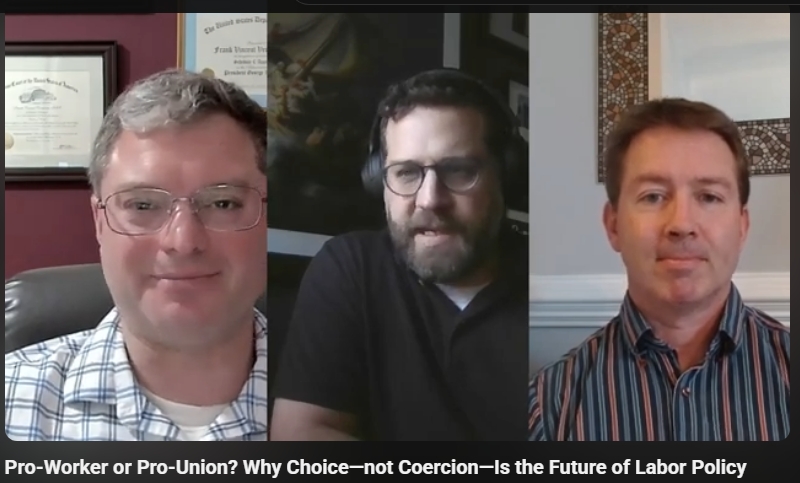
Pro-Worker or Pro-Union? Why Choice—not Coercion—Is the Future of Labor Policy, Disunion: The Government Union Report; Commonwealth Foundation
December 18, 2025 // This week on Disunion, host David Osborne is joined by Austen Bannan of Americans for Prosperity and Vincent Vernuccio, president of the Institute for the American Worker, to break down a sweeping new report: How to Empower Workers: Embracing a Pro-Worker Agenda Built on Choice. With Congress rolling out a flurry of labor bills—from right-to-work reforms and secret ballot protections to proposals backed by unions and even some Republicans—this episode cuts through the noise. The panel explains why many so-called “pro-worker” policies actually empower union bosses and government regulators, not workers themselves.
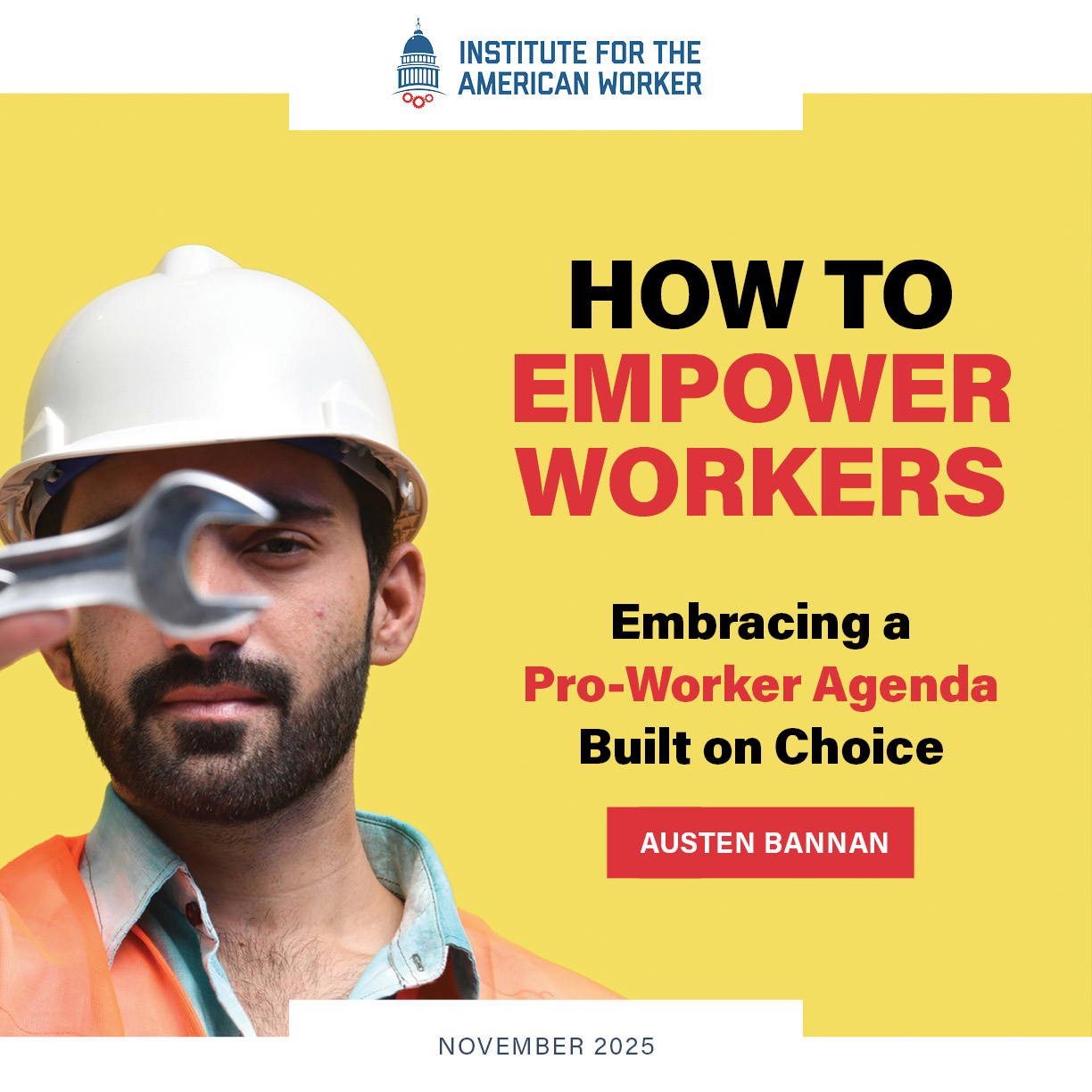
Report: How to Empower Workers: Embracing a Pro-Worker Agenda Built on Choice
November 14, 2025 // “Today’s workers want flexibility and individuality, they need an agenda that puts them first and recognizes the dignity found in all pathways of work instead of one size fits all solutions,” said F. Vincent Vernuccio, president of Institute for the American Worker. “Austen Bannan’s ‘How to Empower Workers’ report will serve as a one stop shop for how to help workers and create modern labor policy for a modern workforce.”
Commentary: Massachusetts Voters Support Unions for Uber Drivers
October 31, 2025 // The numbers needed to unionize the rideshare drivers are shockingly low. According to Axios, just 5% of all drivers need to sign on, and then 25% of so-called “active drivers” must support forming a bargaining unit, i.e., a group of employees who negotiate with management. After that threshold is met, the state recognizes a union that will represent all drivers—whether they supported it or not. In other words, if you’re an independent rideshare driver in Massachusetts, you don’t get a choice. The union chooses for you. Moreover, if 5% of workers want to form a union, every rideshare company must provide every driver’s contact information to union officials. Nationwide, the threshold for forming a bargaining unit is a majority vote. Massachusetts is now proposing to impose compulsory unionization with far less support—and with sectoral bargaining that extends far beyond one workplace and into the cars of rideshare drivers across the Bay State.
We’re Suing to Stop Unions from Stealing from Home Caregivers
August 4, 2025 // This isn’t the first time that Michigan caregivers have been targeted by unions seeking to skim dues off their stipends. Democrats put in place the same unjust policy in 2005, and the Service Employees International Union went on to take an estimated $34 million from home caregivers in just six years, before Republicans repealed it. But this time, caregivers like Tammy hopefully won’t have to wait for a change in power. The courts can protect them.
Op-ed: A right-to-work repeal warning from Michigan
February 29, 2024 // Yet Michigan should be a warning, not a beacon for other states. Evidence shows that reversing right-to-work is bad for workers, businesses, local economies, and even unions themselves. Michigan has already lost out on two major new plants from General Motors and Stellantis (Chrysler’s parent), which recently chose to invest across the state line in right-to-work Indiana. Michigan’s pain is Indiana’s gain. Approximately 150,000 Michigan employees have voluntarily left their unions since 2013. They will now be forced to pay their unions around $1,000 in annual dues, an especially painful tax given the current cost-of-living crisis.