Posts tagged private-sector unions
This Labor Day, ask yourself: Are unions living up to their promises?
September 4, 2023 // Good people across the country may believe that handing more power to public sector union executives will fix teacher shortages or improve ineffective government programs. Instead, these good people should reflect this Labor Day and ask themselves whether public sector unions have lived up to these promises over the past 50 years. They should also ask how we can hold union executives accountable and improve how public sector unions work. Unfortunately, anyone trying to advance ideas to improve public sector unions soon discovers union executives aren’t interested. Public sector union executives will go to war to ensure they keep their power — even at the expense of the employees they purportedly represent.
Quin Hillyer: New Orleans should not put public-sector union power into law
May 22, 2023 // Credit Sarah Harbison, general counsel for the Pelican Institute, for flagging the well-intentioned but misguided proposal by Council Vice President Helena Moreno. “Collective bargaining agreements (CBAs) are typically negotiated in secret and remain in effect for years at a time,” Harbison wrote May 11. “They generally govern pay, working conditions, and establish a reduction in force protocol that typically retains workers based on seniority rather than merit.” Union CBAs can be fine things in many instances in private enterprise, but even famously liberal President Franklin D. Roosevelt and longtime AFL-CIO union leader George Meany fiercely argued that unionizing should be anathema for public bureaucracies. Meany said that it is “impossible to bargain collectively with the government,” and Roosevelt explained that “the process of collective bargaining … cannot be transplanted into public service.”
The Problem(s) With Public Sector Unions
March 29, 2023 // Regardless of this contract outcome and which sides can claim victory, serious questions arise regarding the advisability of having public sector unions such as the SEIU, UTLA, et. al. in existence at all and their ability to collectively bargain and launch strikes against essentially the taxpayers of any given public jurisdiction. In the case of the recent LAUSD strike, 420,000 students and their families were held hostage by public sector unions in a school district already beset by financial and other woes. According to LAUSD superintendent Alberto Carvalho, what the union sought would have put the school district on the brink of insolvency. Also, the strike itself precluded many disadvantaged students from receiving necessary daily meals that their families count on. Most importantly, a school district still reeling from the effects of a Covid-induced school lockdown just could not afford three more days of non-instruction. Arguably, the LAUSD is already a floundering if not failing district with ever-increasing taxpayer spending in spite of withering enrollment and diminishing student performance. It is to be noted that the demographics of the American union have changed dramatically over the years. While at one time the predominance of union membership was mostly among private sector blue collar workers, the ratios have flip-flopped where now the greatest numbers are not only in the public sector but are also associated with white collar employees. It should be further noted that public sector unions were once illegal in the United States.
Pennsylvania Government Union Political Spending Skyrockets Even as Membership Declines
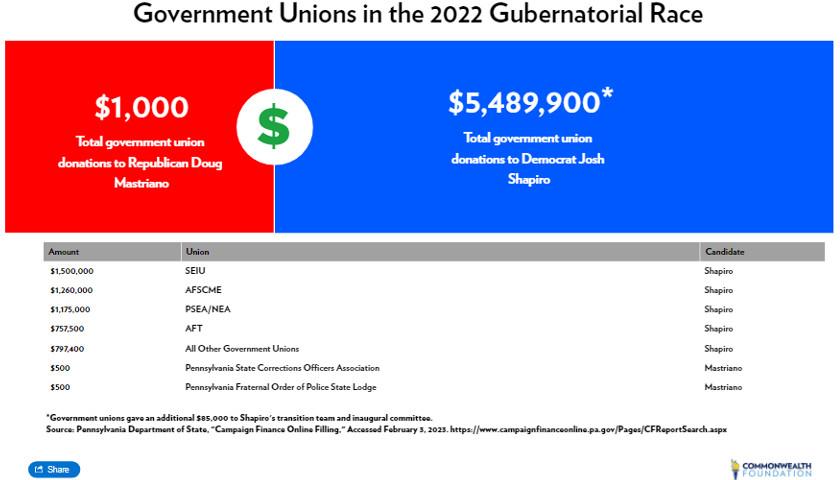
March 23, 2023 // “At a time when government unions are losing membership due to partisan political spending, government union executives have really decided to double down on the partisan political spending,” CF policy analyst Andrew Holman told The Pennsylvania Daily Star. “The recent data shows this. They’re using millions of dollars collected with taxpayer resources to fund these political-advocacy activities and I think that, really, members of government unions need to be aware of where their money is going and what their unions are advocating for.” Democratic Governor Josh Shapiro is a prime example of a Pennsylvania pol enjoying overwhelming advantage in this political-spending category. Government unions bestowed over $5.5 million on his 2022 campaign while state Senator Doug Mastriano (R-Gettysburg) garnered a mere $1,000 from these associations while running against him. Public-sector labor money was only slightly less lopsided between the candidates for lieutenant governor: Democrat Austin Davis raised $77,000 from these groups while his GOP state House colleague Carrie Lewis Delrosso got only $1,550 from them.

Unionized Public Education is Destroying California
March 13, 2023 // The teachers’ union in California supported a ballot initiative that guarantees at least 38 percent of the state general fund is spent on K-14 public education. This guarantees that any new government program – such as last year’s single payer healthcare proposal that would have added hundreds of billions to the state budget – will pour more money into public education. This creates an incentive for California’s teachers’ unions to push for huge increases to the size of the state government, because they’ll get 38 percent of the pie no matter how big it gets. Because California’s public schools receive state funds based on attendance, the teachers’ union is also incentivized to support anything that will increase the student age population. Hence they have an incentive to support anything that will facilitate mass immigration, whether or not that puts a strain on housing and other services. If those students are from low-income households or don’t speak English as their first language, the per student allocations are increased.
Right-to-work resurfaces at the Montana Legislature, as do dozens of pro-union opponents
February 22, 2023 // The bill, Buffalo Republican Rep. James Bergstrom’s House Bill 448, would prohibit private sector union contracts that require employees to join a union or otherwise pay fees for their representation. It’s the latest legislative swing at unions in Montana, a state with a deep history of labor activism that has repeatedly resisted right-to-work legislation even as national union density has declined and neighboring states have passed similar laws. “Blood has been spilled on the streets of my district for the rights we have today,” Rep. Derek Harvey, D-Butte, a union firefighter, told more than 70 union workers and officials representing a wide variety of trades on the Capitol steps Friday.
Opinion: Imagine there’s no public employee unions
February 21, 2023 // But try as President Joe Biden has, it just hasn’t been enough. Automation (including not only factory machinery but also the gig economy), trade, high-profile union corruption cases, failing pension funds, and a string of adverse court rulings are among the many factors rendering private sector unions irrelevant to workers in most modern fields. This has led the unions to desperate measures, such as organizing esoteric, low-income professions, including graduate student teachers and video game testers. Yet the story is quite different for unions in the public sector. The unionization rate of public employees remains robust, at more than 33% of all government workers nationwide. Local government workers are the most likely to be unionized, at a rate of nearly 39%, and public sector union members are concentrated in states that mandate collective bargaining. The states with higher rates of unionization seem to correlate with the nation's least functional state governments: California (54.5%), Illinois (48.7%), New York (66.7%), and New Jersey (59.3%) among them. As their private sector cousins starve, public employee unions are fat and happy — a strange development, given that there was no public sector collective bargaining at all 70 years ago, when unions were at their apex.
Chicago saw a wave of new unions form in 2022. Getting to the bargaining table is the next challenge.
January 2, 2023 // But it’s not just Starbucks: In Chicago, museum workers at the Art Institute, faculty and staff members at its affiliated school and employees at the Newberry Library have all unionized this year. So have workers at Howard Brown Health, budtenders at Zen Leaf cannabis dispensaries and booksellers at Half Price Books in Niles. Baristas at four La Colombe Coffee Roaster locations filed for union elections in December. Thousands of graduate students at Northwestern and the University of Chicago filed petitions within two weeks of each other in November. For the hundreds of newly unionized workers in Chicago, the hard work has only just begun; now they must negotiate a first contract with their employers. Labor leaders see a contract as the gold standard for protecting workers’ rights and securing gains in areas like pay and benefits. But the process can take years.
Union bosses rake it in, even as their ranks shrink
November 15, 2022 // The new report, provocatively titled “Labor’s Fortress of Finance” by the pro-labor Radish Research, looks at the balance sheets of big unions since 2010, based on financial statements they must file with the Department of Labor. It finds that, over that period, unions have lost some 710,000 members, yet union membership revenues increased by one-third, to $18 billion — 85% of that from fees on members, which grew by a similar rate. By contrast, union spending increased by just 18% over that time. The money that unions expended representing workers, for instance, improved by just 13%. As a result, the surplus (the equivalent of profits at a business) that unions generated grew almost sixfold, to nearly $2.5 billion in 2021, from just $426 million in 2010. Collectively, their cash on hand more than doubled in 11 years to $11.3 billion, their investments soared nearly 150% to $17.4 billion, and their net assets rose 120%, to $31.6 billion.

Do arbitrators go easy on federal employees who challenge being fired?
October 4, 2022 // So in the federal sector, if you’re represented by a union, you have an option if your agency tries to fire you. you can appeal to the Merit Systems Protection Board what we think of as these standard civil service protections. But you can also file a grievance under your union contract, it’s an either or you can’t do both. But if you choose to, you can file a grievance under the union contract, and your union can bring that instead to an arbitrator. Generally, these are private contractors, they work with the private sector unions, with the private companies with nothing to do with unions, as well as with the the federal workforce, there’s a master roster, maintained by the Federal Mediation Conciliation Service, and the contracts pretty much all say, you’ll get a list of names from this master roster, people strike names to union agency until one guy’s left. That guy then is the arbitrator.