Posts tagged Public Sector
Connecticut: Private and Public Jobs Recovery Suffers Setback, Still Short of Pre-Pandemic Totals
July 26, 2023 // Despite the decrease, Connecticut has reportedly gained 14,100 jobs in 2023, which is “more jobs than added in the first six months of any pre-pandemic year since 2006.” But the report also revealed that ‘Finance’ has “lost more than 7,000 jobs since March 2020,” and there are nearly 90,000 jobs available in the state.
Massachusetts lawmakers propose paying striking workers
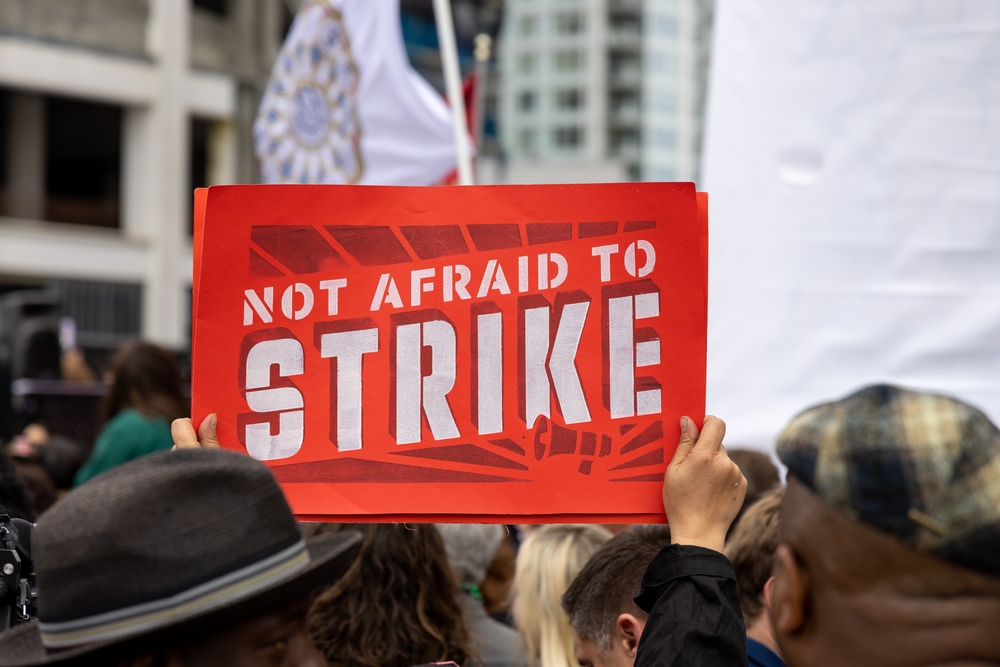
July 21, 2023 // Massachusetts State Sen. Paul Feeney recently proposed Senate Bill S1172, which would funnel unemployment benefits to striking workers after thirty days. The bill’s text states that a striking worker “shall be entitled to recover any benefits lost as a result” of going on strike for over 30 days due to a “labor dispute.” It also says that the state of Massachusetts cannot “deny benefits to an otherwise eligible individual who becomes involuntarily unemployed” and “shall receive benefits for the period of his unemployment but in no event beyond the date of the commencement of a strike.” The bill added that “no waiting period or disqualification … shall apply if the labor dispute is caused by the failure or refusal of the employer” to comply with a collective bargaining agreement or contract. Meaning, if the employer caused the strike, the striking worker receives unemployment benefits without delay and without going through a waiting period. S1172’s sponsors are Sen. Paul Feeney and Rep. Lindsay Sabadosa. Feeney proposed a similar bill last year, but it did not make it out of the state Senate’s Ways and Means Committee.

Five Years after Janus, Government Unions Are Weaker — and More Desperate
July 5, 2023 // When SEIU HCII, which operates across four states, is removed from the picture, the overall public-sector-union membership in Illinois has decreased by over 10 percent. These declines are not isolated to a single entity but spread across all public employers, with teachers’ unions such as the Illinois Education Association and Illinois Federation of Teachers losing a combined 9.4 percent of their members or fee-payers. AFSCME Council 31 — the union that represented Janus — has seen an 18.5 percent drop. A significant decrease in union membership is a sign that workers are exercising their Janus freedoms. It also means that $25 million didn’t flow into government-union coffers in 2022. This is a financial blow to a movement that’s accustomed to having huge cash reserves to fund the politicking that gets the union bosses exactly what they want. Such a dramatic shift illustrates how many government workers feel underrepresented by their unions, pushing them to distance themselves from groups now charging more and delivering less. Which points up another consequence of Janus: Government unions are in a fight for their lives. Desperation has made them even more polarizing, extreme, and political — and greedy.
CELEBRATING THE HISTORIC JANUS DECISION FIVE YEARS LATER
June 27, 2023 //

32 Knowledge Tracker How New York’s Democratic Socialists Brought Unions Around to Public Renewables
June 20, 2023 // ince they did not initially have access to state-level union leaders, the DSA organizers started by building relationships with local utilities unions across the state. Public Power New York recruited hundreds of volunteers to help steer the victories of numerous DSA-endorsed state legislators in 2020 and 2022. One successful candidate was climate organizer Sarahana Shrestha, now a state assemblymember from the Hudson Valley. She unseated her long-tenured Democratic primary opponent, in part, by highlighting his opposition to the BPRA. The bill began to move in Albany in a real way when unions outside of the utilities sector, like the New York State United Teachers, the New York State Nurses Association, and the Service Employees International Union, endorsed the bill. Once the bill passed the state Senate in the summer of 2022, the utilities unions took a more serious interest in the plan. The BPRA’s labor provisions include prevailing-wage assurances and require that all the NYPA’s renewable projects include collective-bargaining agreements for every employee, including contractors and subcontractors. These agreements must be in place before work can start on a project. The law creates a $25 million just-transition fund to retrain fossil fuel–sector workers who could lose their jobs, and specifies that union leaders must be consulted in this process. It also prioritizes hiring these retrained workers for the NYPA’s renewable projects.
Opinion: Connecticut Business Sickened by Bad LABOR BILLS
June 6, 2023 // Two pernicious bills, S.B. 6668 and S.B. 1178, mandate expanded paid sick time for employees of small businesses. If passed, the General Assembly would effectively be functioning as a labor union, completely ignoring their obligation to taxpayers. The language in both bills is almost identical, with S.B. 1178 expanding the way employees can utilize paid sick leave beyond their immediate family. The bill requires employers to allow for paid time off for employees to care for someone the employees themselves determine “whose close association with the employee is the equivalent of any such family relationship.”
‘Right to Organize’ Amendment Violates Constitution
May 19, 2023 //
Grand Rapids TerryBerry Workers Vote to Remove Unwanted Machinists Union from Workplace
May 16, 2023 // Mary Soltysiak and her coworkers at TerryBerry Company filed for a decertification vote on April 14, 2023, with free legal aid from National Right to Work Legal Defense Foundation staff attorneys. Her decertification petition contained signatures of a majority of the employees in the unit. Soltysiak has been under the protections of the Michigan Right to Work law since 2018. Under federal labor law, workers can trigger such a decertification vote with the support of 30% of workers in a unionized workplace. The NLRB should then promptly schedule a secret ballot election to determine whether a majority of workers want to end union officials’ power to impose a contract, including forced dues, on workers. The NLRB scheduled a vote for May 15, 2023. On May 15, TerryBerry employees made their position on the union clear, voting to remove the union from their workplace. Barring any objections by union officials that seek to overturn the vote, the workers will be officially free of the union in one week.

New York: Union Pressure Aims to Hit Home
May 10, 2023 // The bill (S6477) was filed last month by Senate Civil Service and Pensions committee chair Robert Jackson. It would let the unions representing government workers request each person’s home address and subject employers to penalties if they don’t turn it over. In his bill memo, Jackson falsely claims this information is “necessary to represent their members under the duty of fair representation,” under the state’s public-sector collective bargaining law, the Taylor Law. The unions, however, have no legal or other obligation to contact someone who has chosen not to pay them. Those workers, among other things, don’t get to vote on union contracts or the union officers who negotiate on their behalf. The interest here is strictly financial: New York’s largest public employee unions have shrunk since 2018 due to both a reduction in public employment and people choosing not to join after the U.S. Supreme Court held they couldn’t be forced to pay a union. The rate of union membership in state government slid from 89 percent in 2018 to 85 percent last year.
Hunter Tower: Is Pittsburgh a blueprint for other union-dominated blue cities?
May 1, 2023 // SEIU leaders now hold key posts in Gainey’s administration. Silas Russell, SEIU Healthcare executive vice president and political director, co-chaired Gainey’s transition team. Maria Montano, former SEIU Healthcare communications director, is now Gainey’s press secretary. And Lisa Frank, former SEIU vice president and director of strategic communications, is now the city of Pittsburgh’s chief operating officer. Emails uncovered through right-to-know requests by CBS Pittsburgh reveal that Russell provided the mayor with union-generated talking points ahead of a meeting last year with UPMC officials.