
Posts tagged Public Sector
The year of the strike: what’s causing this labor movement and the potential impact
October 16, 2023 // Data from the Economic Policy Institute shows the number of workers striking fell sharply in 2020 and 2021 but then jumped 50 percent last year alone. Labor historians said another factor is the victory after some of these strikes. “As workers do engage in these actions, they encourage each other, to emulate the demands and to emulate the tactics in some ways,” said Joseph McCartin, labor historian at Georgetown University.
Union-backed bills pose biggest challenges to cities
October 16, 2023 // The reasons: a tight labor market with unemployment under 4% and pro-union policies by the Biden administration. But one reason not cited is the difficulty of fighting union power in one-party, Democratic states such as California, New York and Illinois. Indeed, the SEIU’s clout was shown this month when Newsom appointed Laphonza Butler to the U.S. Senate seat vacated by the late Dianne Feinstein. Most recently the head of Emily’s List, Butler was before that president of SEIU California, representing 700,000 California workers. Through its contributions, the SEIU has a stranglehold on hundreds of local officials in the state. When Republican clout is moribund – and the party seemingly can’t get its act together, as most glaringly in California – there’s no countervailing power to union demands. Urban residents are most dependent on public services and the tourism and entertainment industries represented by these newly energized unions. Strikes always are disruptive and can paralyze an economy, damaging city finances and driving away businesses. The rusted-out remnant of Detroit, until the 1960s dubbed the Paris of the West, is a cautionary example. But one California economic sector will benefit for sure: moving companies. Better pack up before they’re unionized, too.
Opinion: Union Leaders Aren’t Fooling Anyone on Labor Day
September 6, 2023 // the Service Employees International Union (SEIU) has formed a so called “Lavender Caucus” to advocate on its behalf for pro-LGBTQ legislation; the American Federation of State, County and Municipal Employees (AFSCME) issued a resolution demanding stricter gun control laws; the National Education Association (NEA) quietly published a gender ideology resource guide, “Schools in Transition,” in 2015 that laid the groundwork for some of the craziest positions on gendered bathrooms, high school sports and pronoun usage confounding parents and teachers across the country; NEA President Becky Pringle in 2022 issued a statement on behalf of her union excoriating the U.S. Supreme Court for its ruling in Dobbs v. Jackson overturning Roe v. Wade and sending the abortion question back to the state; and, United Teachers of Los Angeles (UTLA) President Cecily Myart-Cruz in 2021 asks her union to issue a resolution condemning the state of Israel for its “war crimes” against the Palestinians.

How Unions Take Workers’ Voice and Never Give It Back
September 5, 2023 // Unfortunately, many states’ labor laws are tilted in union officials’ favor. Some unions, when faced with a decertification petition, scramble to agree to a contract — even one that favors management — to take advantage of something called a “contract bar,” which prevents a decertification election while a contract is in place. It has happened to my clients. In most states, unions never have to stand for reelection. Joan’s union, which won its certification in 1975, hasn’t had to prove that it enjoys majority support in nearly 50 years. The only way to remove it is to decertify it, and as Elizabeth and Joan would tell you, that means counter-organizing on your own time against full-time union organizers who have lots of money and lawyers on call. Few states have enacted “recertification” requirements that would impose democracy on supposedly representative unions, requiring them to periodically run for reelection.
From Strikes to New Union Contracts, Labor Day’s Organizing Roots Are Especially Strong Across the Country This Year
September 5, 2023 // The first U.S. Labor Day celebration took place in New York City on Sept. 5, 1882. Some 10,000 workers marched in a parade organized by the Central Labor Union and the Knights of Labor. A handful of cities and states began to adopt laws recognizing Labor Day in the years that followed, yet it took more than a decade before President Grover Cleveland signed a congressional act in 1894 establishing the first Monday of September as a legal holiday.
What You Need To Know About Gen Z’s Support for Unions
August 10, 2023 // Nevertheless, to sustain a lasting revival of union membership in the United States over the coming years as today’s young workers make up an increasing share of the workforce, it is imperative for lawmakers to pass measures that would help these workers exercise their right to come together in collective bargaining. Congress has a number of measures that it could pass to help workers of all generations form unions without corporate interference, such as the Protecting the Right to Organize Act, which would strengthen workers’ legal organizing protections. Young workers need policymakers who champion their right to speak up on the job.
Termination risks, collecting unemployment: A look at workers rights amid a ‘summer of strikes’
August 7, 2023 // More than 200 strikes have occurred across the U.S. so far in 2023, involving more than 320,000 workers, compared with 116 strikes and 27,000 workers over the same period in 2021, according to data by the Cornell ILR School Labor Action Tracker.
Connecticut: Private and Public Jobs Recovery Suffers Setback, Still Short of Pre-Pandemic Totals
July 26, 2023 // Despite the decrease, Connecticut has reportedly gained 14,100 jobs in 2023, which is “more jobs than added in the first six months of any pre-pandemic year since 2006.” But the report also revealed that ‘Finance’ has “lost more than 7,000 jobs since March 2020,” and there are nearly 90,000 jobs available in the state.
Massachusetts lawmakers propose paying striking workers
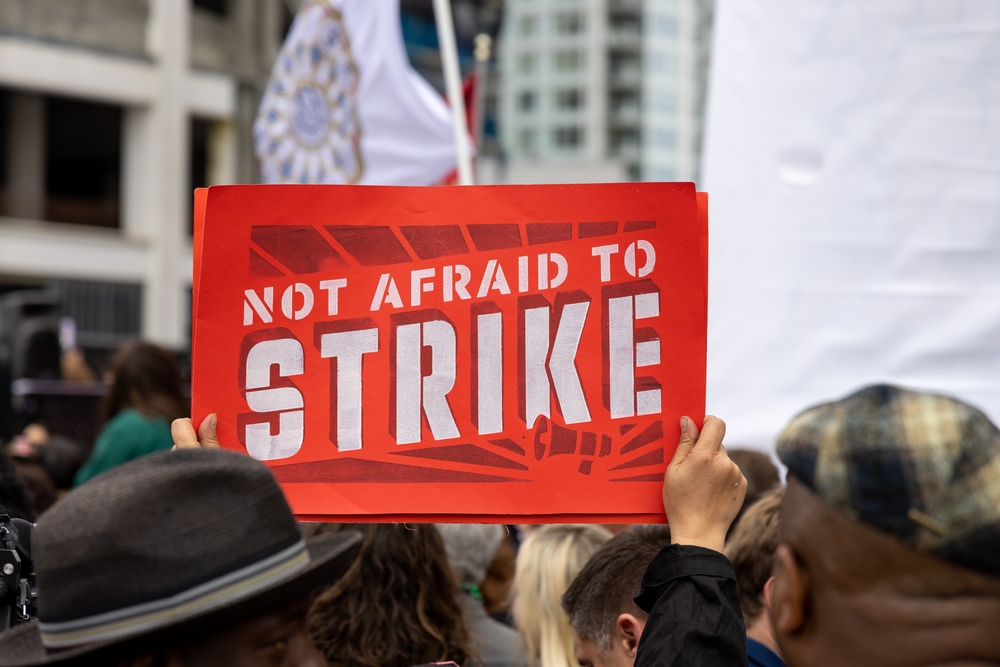
July 21, 2023 // Massachusetts State Sen. Paul Feeney recently proposed Senate Bill S1172, which would funnel unemployment benefits to striking workers after thirty days. The bill’s text states that a striking worker “shall be entitled to recover any benefits lost as a result” of going on strike for over 30 days due to a “labor dispute.” It also says that the state of Massachusetts cannot “deny benefits to an otherwise eligible individual who becomes involuntarily unemployed” and “shall receive benefits for the period of his unemployment but in no event beyond the date of the commencement of a strike.” The bill added that “no waiting period or disqualification … shall apply if the labor dispute is caused by the failure or refusal of the employer” to comply with a collective bargaining agreement or contract. Meaning, if the employer caused the strike, the striking worker receives unemployment benefits without delay and without going through a waiting period. S1172’s sponsors are Sen. Paul Feeney and Rep. Lindsay Sabadosa. Feeney proposed a similar bill last year, but it did not make it out of the state Senate’s Ways and Means Committee.

Five Years after Janus, Government Unions Are Weaker — and More Desperate
July 5, 2023 // When SEIU HCII, which operates across four states, is removed from the picture, the overall public-sector-union membership in Illinois has decreased by over 10 percent. These declines are not isolated to a single entity but spread across all public employers, with teachers’ unions such as the Illinois Education Association and Illinois Federation of Teachers losing a combined 9.4 percent of their members or fee-payers. AFSCME Council 31 — the union that represented Janus — has seen an 18.5 percent drop. A significant decrease in union membership is a sign that workers are exercising their Janus freedoms. It also means that $25 million didn’t flow into government-union coffers in 2022. This is a financial blow to a movement that’s accustomed to having huge cash reserves to fund the politicking that gets the union bosses exactly what they want. Such a dramatic shift illustrates how many government workers feel underrepresented by their unions, pushing them to distance themselves from groups now charging more and delivering less. Which points up another consequence of Janus: Government unions are in a fight for their lives. Desperation has made them even more polarizing, extreme, and political — and greedy.