Posts tagged union membership rate
Amazon workers reject union in vote at North Carolina warehouse
February 19, 2025 // Amazon workers at a facility near Raleigh, North Carolina, overwhelmingly voted against unionizing on Saturday. Of the 3,276 ballots cast, there were 2,447 votes opposing the union and 829 in favor, according to the National Labor Relations Board. There were 77 challenged ballots, a gap that’s too narrow to change the outcome of the election. The results still need to be certified by the NLRB.

Republicans Should Support Workers — Not the Failed Union Model
February 6, 2025 // Senator Hawley’s proposal would prevent workers from hearing both sides before a unionization election, which they would need to make an informed decision. Employers would be prohibited from holding meetings with workers. Unions would also be able to force ambush elections, depriving workers of time to do their own research and make up their minds. And, like the PRO Act, the proposal would even give unelected federal bureaucrats the power to force union contracts on workers, employers, and even unions.

REPORT: How government unions work against interests of private-sector unions, taxpayers
January 22, 2025 // First, there is no archetypal profit motive in the government sector. Congress passed laws promoting collective bargaining in the private sector to prevent the exploitation of workers by employers who were seeking to increase their profits through long work hours and poor working conditions.
Podcast: The State and Future of Labor Unions
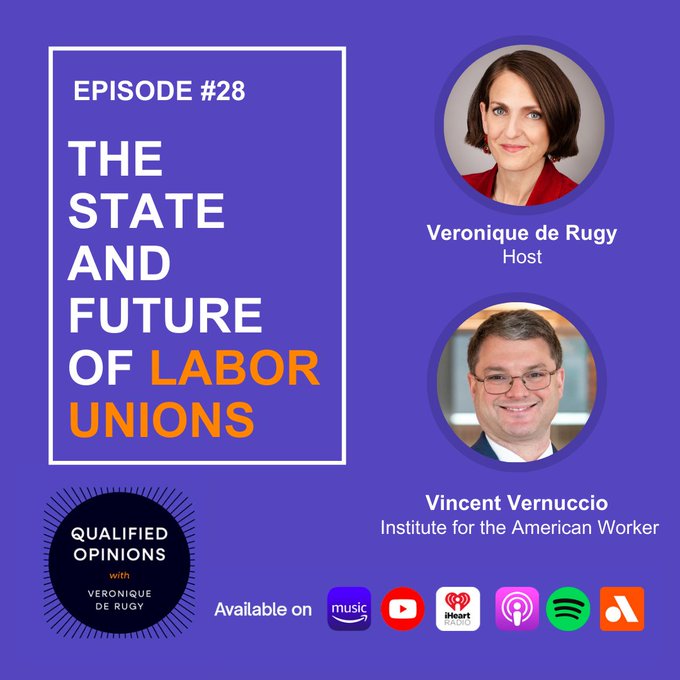
October 14, 2024 // Though there have been several union wins in recent years, union membership is at historic lows. Where do unions fit in the future of America? Will they continue to decline, or will they see a comeback? How will automation play a role? Vinnie Vernuccio joins Qualified Opinions to discuss.
Connecticut has most unionized public sector in the country
September 3, 2024 // Between 2018 and 2023, the number of public sector union members in Connecticut surged, making Connecticut the state with the highest percentage of unionized public sector workers in the country, and the fifth-highest rate of overall union membership, according to the latest numbers from Unionstats.com The figures, derived from Census data, show 15.8 percent of the state’s entire workforce is a union member, and 16.9 percent of workers are covered by a collective bargaining agreement. Those percentages have stayed relatively steady, but the actual numbers of union members have increased, even as Connecticut’s workforce has decreased.
New report shows greater interest in labor unions, especially among young workers
August 2, 2024 // he report is based on a 2022 survey from the Worker Empowerment Research Network (WERN), focusing on about 2,500 frontline workers in five specific low-wage industries post-COVID-19: health care, hospitality, retail, telecommunications and warehousing. These workers' opinions on unions are important because these sectors experienced the most upheaval during COVID and there has been major union activity within these industries. Unlike other surveys with broad national samples, this survey zeroes in on job satisfaction, workplace issues (e.g., wage theft, harassment, scheduling instability) and workers' attitudes toward unionization.
CALIFORNIA: Charter School Teachers Vote To Unionize (Commentary)
June 25, 2024 // Private sector employees have been most affected by these losses. While only 6% of these employees are represented by unions, 32.5% of their public-sector counterparts have these protections. One of the ways that right-wing politicians have tried to reduce these rates is to transfer education funds from public schools to privately run schools whose workers are not represented by unions. Since California voted not to allow school vouchers in 2000, Privatizer’s primary way has been through charter schools. This has been particularly true in Los Angeles which has more students in charter schools than any city in the country. Unions do not represent employees in most of these charter schools, but that is starting to change.
Has Pushback to Full of ‘S’ Labor Unions Finally Arrived?
June 10, 2024 // Written by I4AW’s Sam Adolphsen and F. Vincent Vernuccio, the study warns that the initial “Environmental” focus of ESG is being supplanted by labor leaders, who are focusing on the leftist acronym’s “social” component in order to intimidate companies and force membership growth: With help from the whole of Biden’s big government, Big Labor is replicating the ESG strategies used by environmentalists and other activists. These groups aim to cajole fossil fuel-producing companies and other businesses they consider socially unacceptable into abandoning profitable business ventures. The tactics of the Big Labor plan call for hijacking the shareholder resolution process through proxy voting and shareholder activism to force pro-union policies. Unlike typical shareholder proposals, those supported by Big Labor do not seek to advance shareholder value. Instead, they seek to increase union membership and strengthen Big Labor’s power.
Teamsters Memo Signals Rift Between Major Unions
June 4, 2024 // In 2013, several years after the Teamsters left the AFL-CIO, the union tried to raid bargaining units at American Airlines and then-U.S. Airways, which later merged with American. The mechanics at U.S. Airways were represented by the IAM. At the time, the IAM accused the Teamsters of “dividing already unionized employees with hollow promises.” The Teamsters and the IAM later reached a peace. They even announced in 2022 that they would work together to organize a broad swath of workers at Delta alongside the Association of Flight Attendants-CWA. The Teamsters were to represent the airline’s mechanics, the IAM Delta’s ramp and cargo workers, and the AFA Delta’s flight attendants.
Latinas, the lowest-paid group in the U.S., turn to unions for better wages, report says
May 28, 2024 // Latinas are the lowest paid demographic in the United States, one of the reasons union membership among them is increasing, bucking the national downward trend of at least four decades, according to a report released this week by the National Women's Law Center (NWLC). The document, a fact sheet on union membership analyzing relevant trends among workers from all demographics in the United States, highlights that through 2023 women made up almost half of union members (45.6%).