Posts tagged political advocacy

Op-ed: Dues & Don’ts: Unions are political — and union money is again driving opposition to initiatives
August 4, 2026 // Public unions do more than bargain over wages and working conditions. They endorse candidates and ballot measures, produce voter guides, use direct mail and other member communications to urge workers and their families who and what to support. They get into all sorts of campaign fights using treasuries built with members’ wages. The current election season displays this clearly. The Washington Education Association (WEA) opposes all three statewide measures slated for the November ballot: Initiative IL26-001, concerning parental rights in public schools, Initiative IL26-638, concerning participation in athletics at K-12 schools, and IP26-645, the initiative to repeal an income tax passed by Democratic state legislators earlier this year. (Unlike candidate contributions, which come from voluntary WEA-Political Action Committee donations, member dues may be used for ballot-initiative campaigns without separately obtaining each member’s approval for that particular campaign.)
Teachers’ Unions Are Losing One of Their Government Perks
July 22, 2026 // The question is not whether teachers unions should exist, but whether taxpayers should subsidize organizations that subsequently seek more taxpayer subsidy, often for actions the taxpayer wouldn’t otherwise support. Removing public subsidies forces unions to rely on voluntary member support, increases accountability, and keeps government resources focused on their proper purpose: educating children. The reforms in Idaho, Florida, and Arizona mark the beginning of a necessary correction.
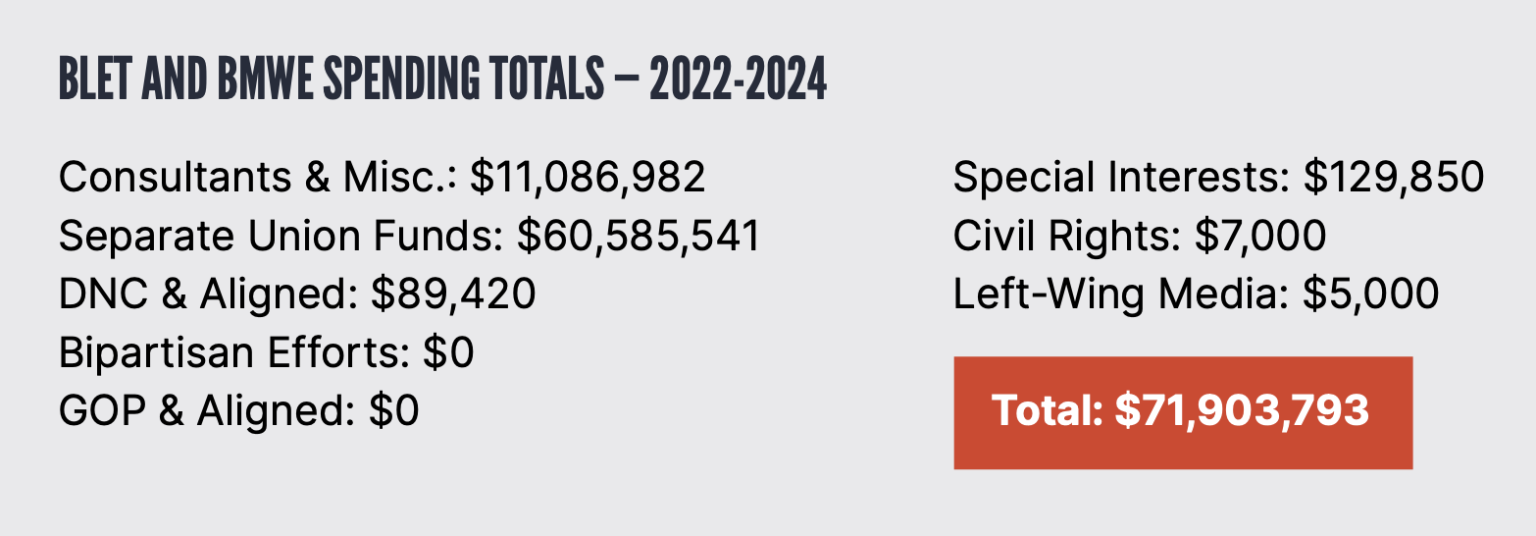
100% of Rail Union Political Advocacy Dollars Went to Left-Wing Organizations
February 3, 2026 // Special interest campaigns aligned with left-of-center policy priorities were also among the most notable recipients. These include Vote NO On 1, a campaign opposing a right-to-work ballot initiative, and the Labor Campaign for Single-Payer Health Care, an organization advocating for a Medicare-for-All system. Other examples include the International Foundation of Employee Benefit Plans, whose leaders have ties to prominent unions, the Association for Innovative Passenger Rail Operations, and the U.S. High Speed Rail Association—both of which promote transportation policies frequently supported by Democratic lawmakers and progressive coalitions. RBC & Associates, a boutique firm owned by the president of the Association for Innovative Passenger Rail Operations, also made the list. Notable left-wing media recipients include DemList, LLC, a national political column dedicated to informing the Democratic party and its allies.

100% of Rail Union Political Advocacy Dollars Went to Left-Wing Organizations
January 27, 2026 // Now, labor leaders requested a newly penned Executive Order from President Trump mandating a board mediate disputes between unions associated with the Long Island Railroad, including BLET, and the New York’s Metropolitan Transportation Authority in order to avoid a strike. “The Teamsters union and its president, Sean O’Brien, continually make a show of crossing party lines and working with the current president,” said CUF communications director Charlyce Bozzello. “Don’t let their rhetoric fool you. The Teamsters’ own political advocacy skews almost completely to the left, and now we know the same is true for its major affiliates.”
Union Bosses Admit They Spent $1.8 Billion on Politics in the 2024 Election Cycle — The Real Number is Likely Over $28 Billion
December 19, 2025 // It is nearly impossible to produce perfectly accurate figures from the LM-2 because subsidiary unions file separate forms from the larger national unions they fall under, and transactions between these unions could be listed multiple times in the data. This only worsens the problems of inconsistent and potentially inaccurate reporting mentioned above. The LM-2 does not lend itself to a precise analysis of union boss spending, but it does give a sense of its scale. When sympathetic media outlets report unions’ political influence in the tens or even hundreds of millions of dollars that is a dramatic underrepresentation.
Educator urges Illinois teachers to reject union pressure, politics and coercion
August 7, 2025 // Sarah Fletcher, a former charter school educator and now the Head of School at White Horse Academy, a private school, said her own teaching career trajectory was shaped by a desire to avoid union involvement altogether. “When we moved here to Illinois from Arizona, I had very little interest in teaching at the public school,” Fletcher said. “Part of that was because I didn’t want to be pressured into or have to be mandated to pay dues. The IEA and IFT, which are part of larger organizations like the NEA, use the majority of their funds not to represent teachers, but for political advocacy.”
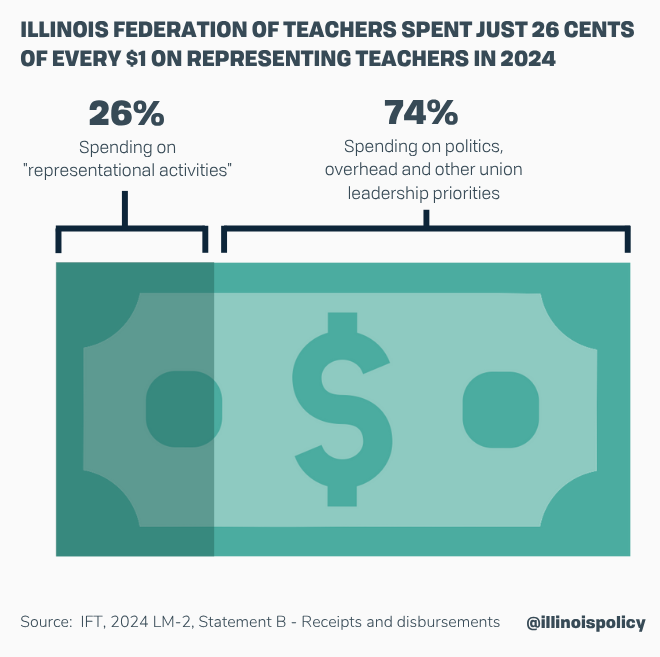
Illinois teachers can opt out of unions in August. Here’s why they should.
July 30, 2025 // Just 15% to 26% of Illinois teachers union spending was on representing teachers in 2024. But public education employees can opt out of union membership and keep their hard-earned money.

One Big Beautiful Law on American Radio Journal
July 7, 2025 // This week on American Radio Journal: Lowman Henry talks with Vincent Vernuccio from the Institute for the American Worker about the proposed Employee Rights Act of 2025;
Michael Watson: Improving Union Annual Reporting
July 3, 2025 // Especially following the 2010 Supreme Court decision in Citizens United v. FEC, which “collection” is funding what spending is important information for union members, and they deserve ready, single-site access. (Citizens United overturned a Taft-Hartley Act–derived ban on using union dues revenues for independent expenditures on behalf of candidates.) They should not need to cross-reference Federal Election Commission (FEC) reports and Labor Department reports to infer which pot of money paid for which spending. Instead, the Labor Department or Congress should revise the LM-2 form to require labor unions to specify the funding source, perhaps by adding a new schedule for expenditures to or by the “Separate Segregated Fund” (the technical name for the “second collection” pot of money) or by requiring specification of the source of funds for Schedule 16 and 17 expenditures related to politics and advocacy.
A Taft-Hartley Roundup of Recent Labor News
June 25, 2025 // For just shy of 80 years, conservative Americans and the Republican Party that provides their imperfect electoral vehicle have sought to advance a policy consensus on labor relations based on three principles: ensuring union membership and participation is voluntary, scrutinizing unions’ operations in exchange for their government-granted powers, and protecting the public from the fallout from labor disputes. As America sits by the pool at the beginning of what might prove to be a long, hot summer, what news is there about the Taft-Hartley consensus?