
Posts tagged collective bargaining rights
Op-ed: Federal correctional officers’ union targets members of congress for turning their back on law enforcement
June 3, 2025 // The billboards have been placed across the country targeting the following 10 members of Congress: Rep. Ken Calvert, R-Calif.; Sen. Shelley Moore Capito, R-W.Va.; Rep. Juan Ciscomani, R-Ariz.; Sen. Josh Hawley, R-Mo.; Rep. Clay Higgins, R-La.; Rep. Mike Johnson, R-La.; Rep. David Joyce, R-Ohio; Rep. Riley Moore, R-W.Va.; Sen. Thom Tillis, R-N.C.; and Rep. Randy Weber, R-Texas.
Kennedy Center staff to vote to unionize amid Trump changes
May 19, 2025 // After the initial wave of firings in February, broader layoffs have continued in recent weeks. The entire social impact team was let go in late March, and just this week, an international arm of the programming department was laid off, jeopardizing efforts to get talented artists from outside the United States booked for this season. "These teams are small, and they're close. We're all friends. So, it's hard to see your friends lose their jobs, and they're the ones telling us," one programming staff member admitted. "But more than that, there's uncertainty what jobs still need to be done and what is being shelved." There's been intensified concern about the fundraising efforts for the non-profit organization, which brought in an estimated $141 million in grants and donations in fiscal year 2023. The development department, which operated with about 90 employees for years previously, has been reduced to about 30 presently on staff, leaving major holes in budgeting and donor cultivation duties.
Judge blocks Trump from removing Foreign Service workers’ collective bargaining rights
May 18, 2025 // The union said Trump's order upended decades of stable labor-management relations in the Foreign Service, removing all members at the State Department and US Agency for International Development from coverage of a law that gives them the right to organise and bargain collectively. Government lawyers said Trump determined that agencies with a primary national security focus are being hamstrung by restrictive terms of collective bargaining agreements that frustrate his ability to safeguard the interests of the American people.
Commentary: VA is selectively enforcing Trump’s order stripping workers of union rights
April 22, 2025 // But the same notice, without explanation, exempts eight small labor groups within the VA from Trump’s edict, effectively allowing them to retain their collective bargaining rights. Those unions include the Laborers International Union of North America, the Western Federation of Nurses and Health Professionals, the Veterans Affairs Staff Nurse Council Local 5032 in Wisconsin, the International Association of Firefighters in Arkansas, the Teamsters Union Local 115 in Pennsylvania and the International Association of Machinists and Aerospace Workers in Hawaii. While Trump’s order exempts law enforcement and firefighter unions from losing their collective bargaining rights, that exception would apply only to the IAFF local.
Op-Ed: Question 3 Still a Question: Massachusetts’ Experiment in Sectoral Bargaining for Gig Workers
April 10, 2025 // These impracticalities explain why Question 3 embraces sectoral bargaining. Under this regime, once the drivers form a union, that union will represent all the drivers in the state, no matter what rideshare company they work for. (Rideshare companies can also team up to simplify the negotiations.) This will put the drivers in a vastly superior bargaining position than if they had to incrementally organize smaller units of drivers or even company by company, as is the norm under the NLRA. Under the NLRA, organizers would next have to get the support of 30% of drivers in a bargaining unit before being able to call an election. But how do organizers reach that 30%? For rideshare drivers, there is no workplace where everyone congregates. The closest equivalent is the airport parking lot, where many drivers wait to get a ride request. But to even encounter 30% of drivers there, much less to convince that 30%, could be a prohibitively high bar. Additionally, driver turnover is high. By the time 30% is convinced, those drivers may have moved on, a new cohort taking their place. Part-timers also pose a problem. For these reasons, Question 3 requires that the would-be union collect signatures from only 5% of Active Drivers (defined as those that have completed more than the median number of rides in the last six months). That is a much more plausible bar to clear, given that rideshare drivers are quite literally a moving target, in time and in space.
Sen. Mike Lee spearheads efforts to block government workers from union activities while on the clock
April 9, 2025 // “Federal government unions are heavily involved in party politics,” National Right to Work Committee President Mark Mix said in a statement. “They stage massive political protests, and contribute large amounts of money and manpower to influence elections. Employees of these unions should not have their salaries paid by American taxpayers.” Lee cited a 2016 report by the Office of Personnel Management that showed federal employees spent 3.6 million hours on union-related businesses, costing taxpayers more than $177 million. That number dropped to 2.6 million hours, costing $134.9 million, during the first Trump administration, according to Lee.
Pro-labor Republicans push Trump to rescind order busting most federal unions
April 3, 2025 // “This executive order, which ruthlessly strips collective bargaining agreements for over 1 million federal workers, is the most recent attack your administration has levied against our merit-based civil service in the effort to cut the workforce and replace them with political cronies,” they wrote. “While the CSRA does give the president the authority to limit collective bargaining agreements due to national security concerns, the executive order’s direction to terminate mass swaths of federal employee collective bargaining agreements is clearly intended to broadly dismantle the CSRA, which is specifically designed to grant federal employees the right to collective bargaining as a means to resolve workplace issues while maintaining the smooth functioning of government operations.”
Unions prepare to fight Ohio bill that bans university faculty from striking
March 24, 2025 // The bill that would ban most mandatory diversity training in higher education is headed back to that chamber to approve changes the House made before passing it mostly along party lines. Republicans have said Senate Bill 1 would combat what they see as liberal indoctrination at public universities. But labor unions are ready to fight it. "This is really the the most significant undercutting of collective bargaining since that was attempted with Senate Bill 5 back in 2011," said Scott DiMauro, president of the Ohio Education Association, the state's largest teachers' union which represents K-12 teachers as well as some higher education faculty. Senate Bill 5 sought to restrict collective bargaining rights for 400,000 Ohioans in public sector unions, including teachers and law enforcement. Unions came out in force against it and then mounted a campaign to repeal the law, submitting a record 1.3 million signatures to put it on the fall 2011 ballot. Nearly two-thirds of voters approved overturning it.
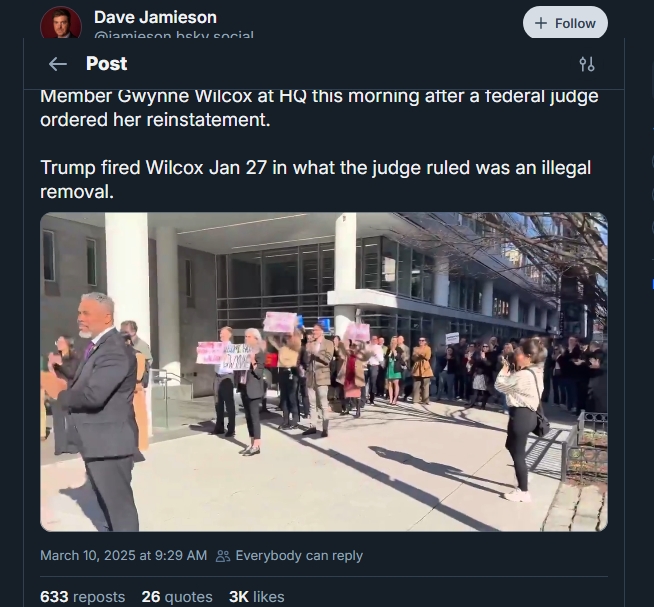
Official Fired By Trump Returns To Work To Cheers After Judge Orders Reinstatement
March 11, 2025 // Wilcox filed a lawsuit seeking reinstatement, arguing her removal was unlawful. Judge Beryl A. Howell agreed with Wilcox, issuing an order last Thursday ensuring her temporary return to the agency as the underlying case moves forward. In a stinging opinion, Howell wrote that Trump failed to grasp the Constitution’s limits on executive power.
Ohio GOP brings back ‘Right to Work,’ unions prepare to fight: Capitol Letter
February 25, 2025 // Unions and Democrats worry that the lesson Republicans learned from the defeat of Senate Bill 5 back in 2011 was to pass labor reforms in pieces. Anna Staver reports on how three bills and one section of the governor’s budget would combine to transform Ohio’s collective bargaining laws. Republicans say it’s coincidence not coordination and a total overhaul of union rights aren’t on their agendas.