
Posts tagged Republicans

As Michigan’s childcare costs rise, workers debate risks of unionizing
March 31, 2026 // Instead of childcare workers unionizing against owners, the model most commonly seen in childcare unions across the country is owners unionizing against their state, as Henderson is advocating for — specifically, childcare owners who receive state reimbursement payments for care they provide low-income families and therefore can be considered state employees. The purpose is to get more robust and permanent public dollars through contract negotiation to fund things providers say they can’t currently afford because of limits on their revenue, like higher wages, insurance benefits, and overall more stability for the struggling industry. Critics of this model say childcare providers shouldn't be considered public employees just because they receive payments from the state or put in a position where they may feel they have to pay union dues. They also say the fractured layout of the industry doesn't lend itself well to unionization and could create division among already under-resourced owners and staff.
Harris County becomes first in Texas to allow employees to organize with new ‘consultation policy’
March 19, 2026 // Harris County commissioners voted 3-1 Thursday to let many county workers choose a labor organization to advocate for workplace policy changes, elevate grievances and make recommendations to Commissioners Court. The "employee consultation policy" does not permit employees to engage in collective bargaining, which state law blocks most government employees in Texas from doing. Government employees in Texas cannot strike.
NJBIZ Exclusive: NJ voters support gig workers as independent contractors
March 12, 2026 // 75% of New Jersey voters back rideshare, delivery drivers keeping independent contractor status 72% support portable benefits, allowing workers to earn health, dental, vision, retirement benefits while staying independent Support spans Democrats (76%), Independents (71%), Republicans (69%); 84% of app-based workers in favor Poll shows broad understanding of gig economy; preference for flexible, hybrid work models
US court nixes NLRB ruling allowing for unionizing without elections
March 10, 2026 // A U.S. appeals court has ruled that the National Labor Relations Board overstepped its powers when it issued a major ruling requiring employers that violate labor laws during union organizing drives to bargain with unions even when workers vote against joining them. The Cincinnati-based 6th U.S. Circuit Court of Appeals in a 2-1 ruling, opens new tab on Friday called the board's 2023 decision in Cemex Construction Materials Pacific "rulemaking under the guise of an adjudication" that went far beyond the NLRB's authority to issue fact-based rulings and specific remedies in individual cases.

Commentary: Freelancers want to be free
February 26, 2026 // The latest evidence for this comes courtesy of a Politico poll on the subject. The survey found that 88 percent of app-based workers wanted to remain as independent contractors – that is, freelancers – rather than be treated as traditional employees. The workers themselves aren’t buying the argument that they’re being exploited. The general public feels largely the same, if not quite so strongly. The same poll found that 76 percent thought that app-based workers should continue to be treated as independent contractors “if their employers are required to provide them with access to portable benefits.”
Congress guarantees furloughed feds’ back pay despite continued White House maneuvering
February 3, 2026 // The Office of Personnel Management removed citations of the 2019 Federal Employee Fair Treatment Act from its shutdown guidance last month, as the Trump administration continues to insist that the law guaranteeing all federal employees back pay after a shutdown doesn’t.
Op-ed: Senators should ignore this anti-Trump bill
January 11, 2026 // Taxpayers spent over $200 million in 2024 alone on official time, despite the fact that unions are overtly political organizations that almost exclusively support the Democratic party and its priorities. By taking on union bosses’ time-wasting “bargaining” activities, Trump’s executive orders are helping the government operate more efficiently.
Texas cracked down on teachers for posts about Charlie Kirk, union lawsuit says
January 8, 2026 // The lawsuit says a Texas agency has received more than 350 complaints about individual educators.
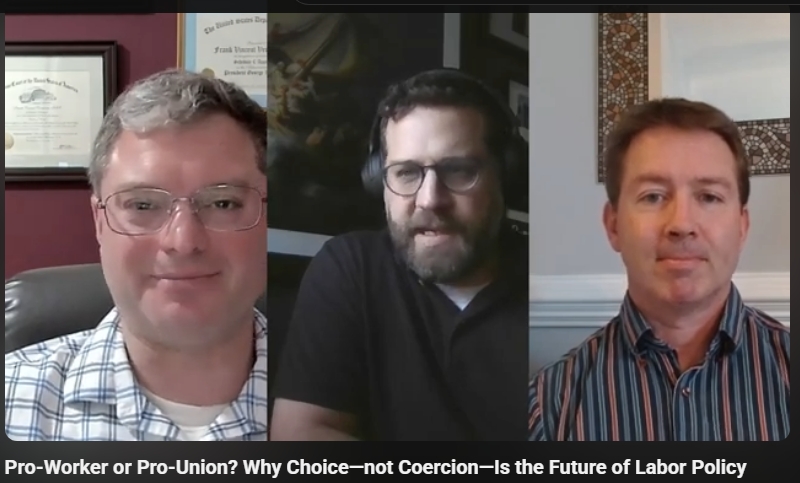
Pro-Worker or Pro-Union? Why Choice—not Coercion—Is the Future of Labor Policy, Disunion: The Government Union Report; Commonwealth Foundation
December 18, 2025 // This week on Disunion, host David Osborne is joined by Austen Bannan of Americans for Prosperity and Vincent Vernuccio, president of the Institute for the American Worker, to break down a sweeping new report: How to Empower Workers: Embracing a Pro-Worker Agenda Built on Choice. With Congress rolling out a flurry of labor bills—from right-to-work reforms and secret ballot protections to proposals backed by unions and even some Republicans—this episode cuts through the noise. The panel explains why many so-called “pro-worker” policies actually empower union bosses and government regulators, not workers themselves.

WSJ Op-ed: Republicans for Federal Worker Collective Bargaining
December 15, 2025 // The 20 GOP union abettors are Don Bacon (Neb.), Mike Bost (Ill.); Brian Fitzpatrick, Robert Bresnahan and Ryan Mackenzie (Pa.); Gabe Evans (Colo.); Andrew Garbarino, Nick LaLota, Michael Lawler, Nicole Malliotakis (N.Y.); David Joyce and Michael Turner (Ohio); Thomas Kean Jr., Christopher Smith and Jefferson Van Drew (N.J.); Mariannette Miller-Meeks and Zachary Nunn (Iowa); Pete Stauber (Minn.); David Valadao (Calif.) and Derrick Van Orden (Wis.). Many of these Republicans represent swing districts, but making government less efficient and responsive to the American people is unlikely to help them win re-election.