Posts tagged Labor Law
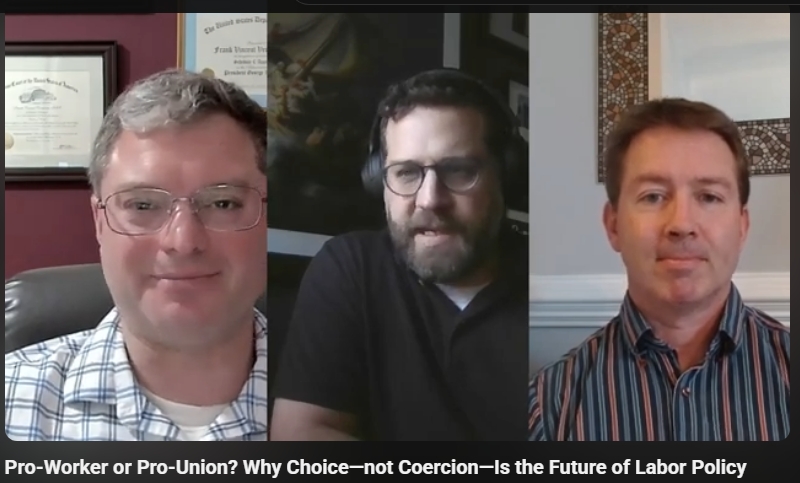
Pro-Worker or Pro-Union? Why Choice—not Coercion—Is the Future of Labor Policy, Disunion: The Government Union Report; Commonwealth Foundation
December 18, 2025 // This week on Disunion, host David Osborne is joined by Austen Bannan of Americans for Prosperity and Vincent Vernuccio, president of the Institute for the American Worker, to break down a sweeping new report: How to Empower Workers: Embracing a Pro-Worker Agenda Built on Choice. With Congress rolling out a flurry of labor bills—from right-to-work reforms and secret ballot protections to proposals backed by unions and even some Republicans—this episode cuts through the noise. The panel explains why many so-called “pro-worker” policies actually empower union bosses and government regulators, not workers themselves.

Trump’s Cuts to U.S. Labor Board Leave Festering Disputes and a Power Struggle
December 17, 2025 // “There is no room for parallel or complementary state legislation,” said William B. Cowen, the labor board’s acting general counsel. Mr. Cowen said the agency remained effective despite the lack of a sitting board, because the vast majority of cases are resolved in earlier stages. In the 2024 fiscal year, according to the board’s data, regional offices settled 96 percent of cases that advanced past filing. “I’m not saying that what the board does is unimportant. It’s very important. They decide the most important, the most contentious issues,” Mr. Cowen said. “It is a very small percentage.”
Starbucks to pay $38.9 million settlement after it violated New York’s labor laws
December 2, 2025 // According to the settlement made public on Monday, Starbucks will pay $35.5 million to the 15,000 current and former employees who worked at the company's stores between July 2021 and July 2024. The settlement will give each of these workers $50 each week to resolve the alleged violations of the city's Fair Workweek ordinance. “With this landmark settlement, we’ll put tens of millions of dollars back into the pockets of hard-working New Yorkers and reinforce every New Yorker’s right to a reliable schedule, full hours, and basic dignity,” Adams said in a statement. Additionally, Starbucks will shell out $3.4 million in civil penalties and fees, and the settlement guarantees employees laid off during recent store closings will get a chance to get reinstated at other company locations, according to the announcement.
Judge Grants Amazon Request to Block New York Labor Board Law
December 1, 2025 // Amazon won a court order temporarily blocking enforcement of New York’s statute attempting to claim jurisdiction over private-sector union disputes, which the retailer argues is preempted by federal labor law. The state law likely runs afoul of the National Labor Relations Act and should be enjoined while the legal challenge against it proceeds, the US District Court for the Eastern District of New York found.
Congress Can Empower Workers Through Choice—Not Coercion
November 24, 2025 // A case in point is the legislative package that Sen. Bill Cassidy (R-La.) introduced on Nov. 10, joined by others including Sens. Tommy Tuberville (R-Ala.) and Tim Scott (R-S.C). They’d protect workers’ paychecks by requiring unions to get approval before spending dues money on politics. They’d also protect workers’ privacy by letting them choose what contact information unions get during the organizing process. And they’d protect workplace democracy by requiring that at least two-thirds of workers participate in union elections — preventing a minority of people from determining the fate of every employee. Another praiseworthy reform is the Employee Rights Act, which Scott introduced in the shutdown’s early days after Rep. Rick Allen (R-Ga.) previously introduced it in the House. Among its many good ideas, the Employee Rights Act guarantees the secret ballot and protects workers from intimidation and harassment. It also gives unionized workers in the 26 right-to-work states the freedom to negotiate their own contract with their employer, so they can better address their individual needs. And the Employee Rights Act guarantees that self-employed workers have maximum flexibility to design their jobs to fit their lives.
California Clears Path for Gig Unions
November 23, 2025 // It's also clear that the political left will not be content to merely stop at unionization. Progressives like former California assemblymember (and sponsor of A.B. 5) Lorena Gonzalez (D–San Diego) have described unionization as "a step forward" but not "the limit of what's possible." Teamster President Sean O'Brien—whose GOP-convention speech highlighted Republicans' shift toward unions—has dismissed a similar Massachusetts unionization effort for gig workers, saying it supports "greedy corporations that want to deny full employment rights to workers."

Institute for the American Worker (I4AW) Releases “How To Empower Workers” Report
November 19, 2025 // “Workers who are equipped with an updated labor policy framework won’t need to rely on the decisions of Washington politicians or union leaders. Instead, workers will be empowered to associate with the businesses and institutions that help them lead productive and fulfilling lives in the modern economy. Through giving Americans and their families choice and flexibility, we will create the best outcomes so that everyone can chase the American Dream—without needing anyone’s permission but their own.”
RADIO: Vincent Vernuccio- Pro-Worker Labor Legislation That Promotes Worker Freedom
November 17, 2025 // Senator Bill Cassidy announced a swath of pro-worker labor legislation that promotes worker freedom and curbs undue influence and abuse by unions
Union panel rules Baltimore IG interfered in election, orders new vote
October 29, 2025 // A union election will be overturned and rerun as a result of social media posts from Baltimore Inspector General Isabel Mercedes Cumming that interfered with the process, a judicial panel for the union ruled this week. The 10-member panel, which oversees the American Federation of State, County, and Municipal Employees on an international basis, found that Cumming’s tweets, some of which were sent just days before the Aug. 23 officer election for Local 44, constituted “an act of interference” and an endorsement, regardless of the intent behind them.

America Doesn’t Have Enough Weapons for a Major Conflict. These Workers Know Why.
October 28, 2025 // Historically, in the fight against their bosses, unions have had only one real weapon to wield: their numbers. The primary goal of a labor strike is to blockade production and inflict pain on the company so that it will negotiate better terms. But in Orlando, it was hard for the union to enlist enough workers for the fight. Florida is a “right to work” state, meaning that union membership is optional. Workers in an organized factory are free to return to their stations and get back to work, leaving everyone else on the picket line to fight for a contract that would eventually apply to everyone.