
Posts tagged secret ballot elections

Potential Falsehoods by the Teamsters Create Opening for Reliable Union Elections
March 30, 2026 // Because in later testimony, BTS employees testified that the lead organizer who claims he was on site soliciting cards on April 23 was never there. Nor, workers testified, were any cards at all signed that day. In addition, there were only 40 drivers on hand that morning, not 46. And finally, BTS employed more than 91 drivers and dispatchers, meaning that, even if 46 cards had been signed, that would not constitute a majority. Therefore, if the workers’ testimony is correct, the majority needed to form a union did not exist.

Letter to NLRB General Counsel Crystal Carey: Refocusing Federal Labor Policy on Worker Choice and Due Process
March 11, 2026 // The Coalition to Protect American Workers (CPAW) and the Institute for the American Worker (I4AW) today sent a joint letter to NLRB General Counsel Crystal Carey urging swift action to reverse Biden-era labor policies that erode worker choice, restrict employer free speech, and weaponize procedural tools to block workers from voting on their own representation. The letter urges General Counsel Carey to prioritize three reforms: cementing secret-ballot elections as the foundation of representation decisions; restoring Employer Meetings on Unionization so workers hear both sides before they vote; and ending blocking charges that freeze elections while investigations proceed.
United Farm Workers has unionized eight farms under 2023 CA law. Here’s where
January 2, 2026 // The 2023 law made it easier for farmworkers to vote for union representation by signing authorization cards, a process referred to as a “majority support petition” or “card check.” Previously, under the Agricultural Labor Relations Act, farmworkers could only vote for union representation in secret ballot elections conducted on their employer’s property.
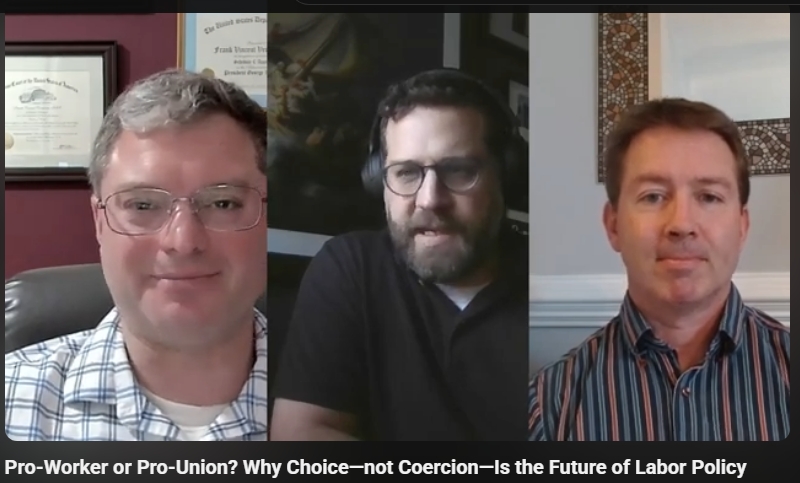
Pro-Worker or Pro-Union? Why Choice—not Coercion—Is the Future of Labor Policy, Disunion: The Government Union Report; Commonwealth Foundation
December 18, 2025 // This week on Disunion, host David Osborne is joined by Austen Bannan of Americans for Prosperity and Vincent Vernuccio, president of the Institute for the American Worker, to break down a sweeping new report: How to Empower Workers: Embracing a Pro-Worker Agenda Built on Choice. With Congress rolling out a flurry of labor bills—from right-to-work reforms and secret ballot protections to proposals backed by unions and even some Republicans—this episode cuts through the noise. The panel explains why many so-called “pro-worker” policies actually empower union bosses and government regulators, not workers themselves.
Wonderful vows to fight pro-union ‘card check’ law after court rules lawsuit improper
December 9, 2025 // Cooper said the decision does not explicitly address the merits of Wonderful Nurseries constitutional challenge, which a lower court has already concluded has merit, he said. Also, the decision does not interfere with a separate lawsuit filed in federal court by nearly two dozen workers represented by the Right to Work Foundation, he said. “And nothing in the ruling prevents the Superior Court from deciding that the Card Check law indeed violates the California and federal Constitutions, a decision we look forward to,” he said.

Union members like me need these reforms from Congress
December 2, 2025 // Three years ago, I was forced into a union against my will. While my coworkers and I tried to free ourselves, we were stifled every step of the way. We needed better federal labor laws — such as the bills introduced in both the House and Senate in recent days. Leaders such as Sen. Bill Cassidy (R-LA) and Reps. Virginia Foxx (R-NC) and Randy Fine (R-FL) have recently written some of the most pro-worker legislation in decades. My own experience with unionization shows how necessary these reforms are.
AFP Backs Transformative Labor Reform Package from Chairman Cassidy (LA) Senate HELP Committee Members
November 10, 2025 // “Americans for Prosperity thanks Senators Cassidy, Scott, and Tuberville, as well as the Senate HELP Committee, for advancing a package of reforms that will help us lead the global economy in the 21st century by empowering every worker. We do this by modernizing rigid, dated labor laws that fail to give workers the voice and transparency they deserve. These reforms will provide workers with greater choice and opportunities in the workplace to unleash prosperity and take advantage of our evolving and innovative labor market,” Austen Bannan, Employment Fellow, Americans for Prosperity.
National Right to Work Foundation Issues Notice to VW Chattanooga Employees Impacted By UAW Boss-Ordered Strike
November 4, 2025 // Notice informs VW Team Members of their rights in light of a potential strike at Tennessee production plant

Commentary: Trumpworld thinks overturning this Biden labor rule gives GOP a double-digit midterm elections boost
October 29, 2025 // Only 22% of respondents in Fabrizio’s poll supported the NLRB’s 2023 rule “that allowed unions not to use secret ballots,” with 64% opposed. Fabrizio wrote that Republican Congressional candidates “would benefit significantly from supporting overturning this unpopular rule.” “The initial generic ballot is a statistical dead heat, 44% Democrat – 43% Republican (D+1), but if the Republican candidate supported overturning the NLRB rule so workers could once again rely on secret ballots when voting to unionize, the Republican pulls into a 47% – 36% (R+11) lead, a 12-point shift,” the memo reads. “Among Swing voters, the Republican goes from 1-point ahead to 17-points.”
Labor Unions Are Chipping Away at Worker Freedoms One Bill at a Time
October 14, 2025 // The so-called Faster Labor Contracts Act is one of the first steps in this new tactical departure. The legislation would force employers to begin bargaining with a new union in just ten days. If the two parties don’t reach an agreement in 90 days, the government forces mediation. One month after that, the matter goes to binding arbitration, meaning an outside arbitrator will dictate wages, benefits, and workplace rules for years to come. That’s not worker freedom. It’s top-down federal control. Americans recognize proposals like this for what they are: a Washington power grab. A U.S. Chamber of Commerce survey released just two weeks ago found that 90% of voters oppose government-mandated union contracts without worker approval.