
Posts tagged Vinnie Vernuccio
OPM Issues Final Rule Which Allows Agencies to Remove Workers Who Refuse to Implement the will of the American People
February 6, 2026 // I4AW’s commentary was referenced or quoted seven times in the final rule! The rule, called “Improving Performance, Accountability and Responsiveness in the Civil Service,” authorizes agencies to move policy-influencing positions into Schedule Policy/Career, which will “allow agencies to quickly remove employees from critical positions who engage in misconduct, perform poorly, or obstruct the democratic process by intentionally subverting Presidential directives.” Institute for the American Worker submitted a formal comment when the proposed rule was first announced, providing arguments on the need for accountability regarding obstructive government workers.

Empowering Workers in a Changing Economy with Vinnie Vernuccio | Let People Prosper Ep. 184
February 6, 2026 // Too many labor policies today assume workers need protection from choice. But the evidence shows the opposite. When workers can choose how they work, who represents them, and how they negotiate, they’re better off—economically and personally. Vinnie Vernuccio’s work reminds us that labor policy should serve workers as individuals, not institutions with political clout. If we want a labor market that adapts, innovates, and actually lifts people up, we need reforms rooted in freedom—not nostalgia.
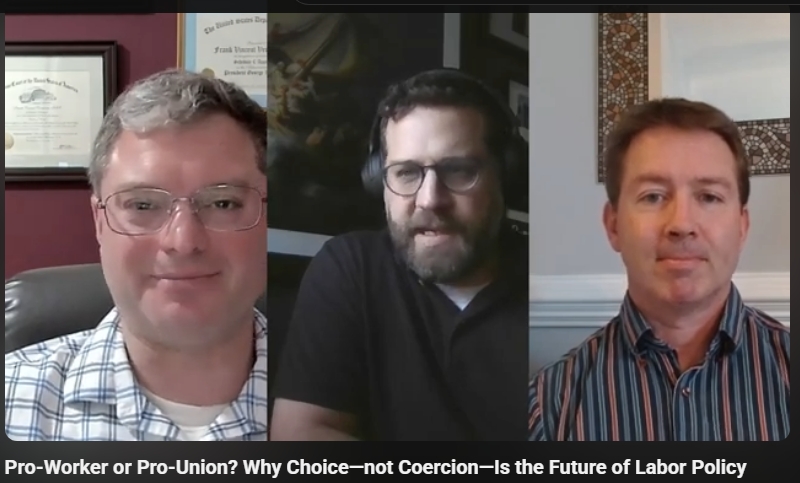
Pro-Worker or Pro-Union? Why Choice—not Coercion—Is the Future of Labor Policy, Disunion: The Government Union Report; Commonwealth Foundation
December 18, 2025 // This week on Disunion, host David Osborne is joined by Austen Bannan of Americans for Prosperity and Vincent Vernuccio, president of the Institute for the American Worker, to break down a sweeping new report: How to Empower Workers: Embracing a Pro-Worker Agenda Built on Choice. With Congress rolling out a flurry of labor bills—from right-to-work reforms and secret ballot protections to proposals backed by unions and even some Republicans—this episode cuts through the noise. The panel explains why many so-called “pro-worker” policies actually empower union bosses and government regulators, not workers themselves.
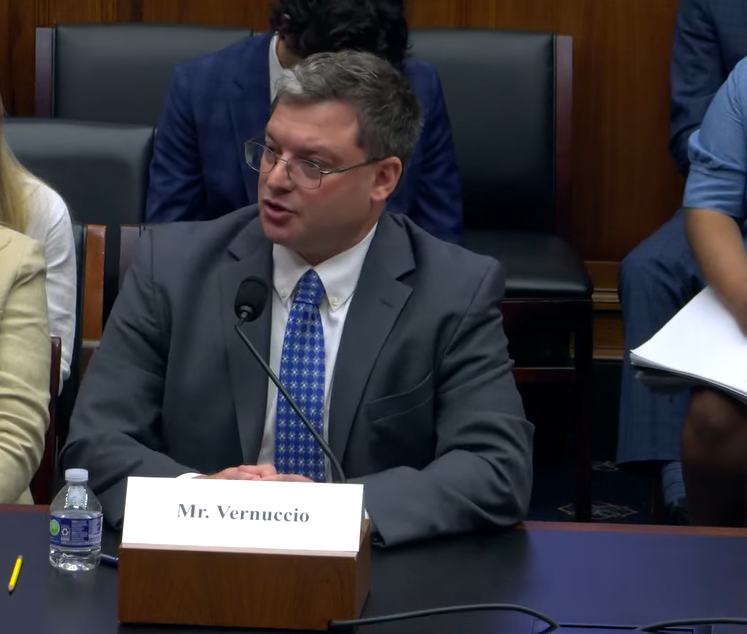
U.S. Senate Committee on Health, Employment, Labor and Pensions titled “Labor Law Reform Part 2: New Solutions for Finding a Pro-Worker Way Forward.”
October 20, 2025 // Wednesday, Oct. 22, I4AW's Vinnie Vernuccio will testify at a labor hearing held by the U.S. Senate Committee on Health, Employment, Labor and Pensions titled "Labor Law Reform Part 2: New Solutions for Finding a Pro-Worker Way Forward."

One Big Beautiful Law on American Radio Journal
July 7, 2025 // This week on American Radio Journal: Lowman Henry talks with Vincent Vernuccio from the Institute for the American Worker about the proposed Employee Rights Act of 2025;
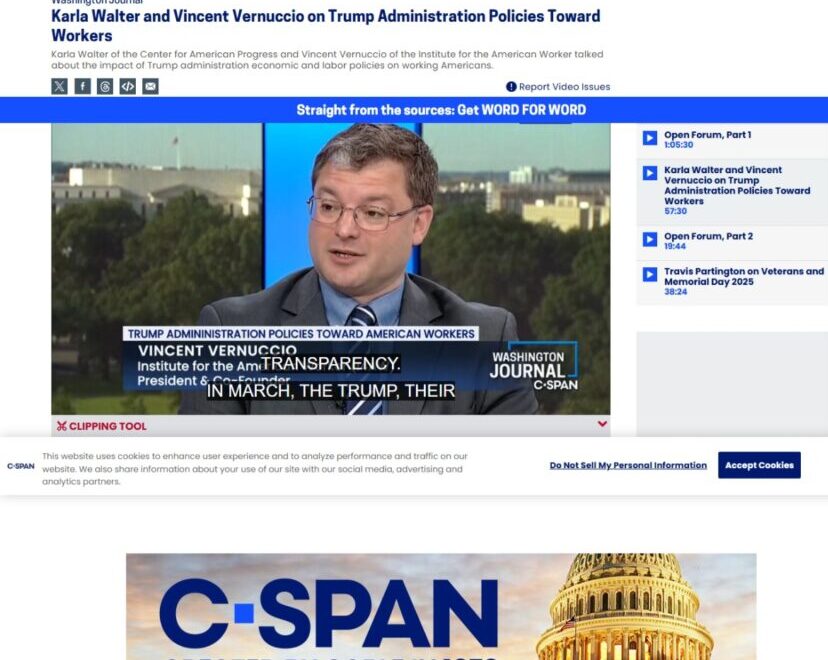
Karla Walter and Vincent Vernuccio on Trump Administration Policies Toward Workers
May 27, 2025 // Karla Walter of the Center for American Progress and Vincent Vernuccio of the Institute for the American Worker talked about the impact of Trump administration economic and labor policies on working Americans.
New Trump civil-service reform rule nearer to going into effect
May 7, 2025 // According to former Department of Labor official Vincent Vernuccio, who is now president of the labor nonprofit Institute for the American Worker, OPM may amend the rule or issue it as it’s proposed, which could happen within the next few weeks or months. “So, you’re talking about 50,000 federal employees—about 2% of the workforce who will become ‘at will’,” Mr. Vernuccio said. “These are still career employees,” he said. “They still have protections. They’re not changing that. It’s just that if they are in a policy-influencing position, they’re ‘at will’, and they can be removed if they’re throwing sand in gears of policy.” He added, “And if they simply don’t want to do their jobs and they don’t want to implement the policies that the people’s duly elected representatives have implemented, they can be removed.”

Podcast Newt Gingrich, Vinnie Vernuccio; Episode 837: Protecting the American Worker
May 5, 2025 // Newt’s guest is Vincent Vernuccio, president and co-founder of the Institute for the American Worker. They discuss the significant labor policy developments and legislative efforts aimed at increasing transparency and accountability in both public and private sectors. Their conversation covers the introduction of the Start Applying Labor Transparency (SALT) Act, which seeks to amend the Labor Management Reporting and Disclosure Act of 1959 to ensure greater transparency in financial transactions between unions and labor consultants. Vernuccio also explains the implications of President Trump's executive action, Schedule F, which aims to make certain federal employees at-will to enhance accountability. They also discuss the challenges posed by public sector unions and the potential impact of Senator Josh Hawley's Faster Labor Contracts Act, which could impose arbitration on private sector union negotiations. Vernuccio emphasizes the need for modernizing union models to align with today's workforce demands for flexibility and merit-based advancement.

Free-Market Groups Back Bill to Protect Taxpayers from Union Abuse
September 18, 2024 // H.R. 9594 was introduced by Congressman Scott Perry (R-Pa.) and swiftly referred to the House Oversight Committee. The bill would allow federal agencies to charge public-sector labor unions for the employee hours and agency resources which are used on activities that serve those unions. Currently, federal employees who are union members can spend their on-the-clock hours working for a union instead of doing their jobs, while still being paid their taxpayer-funded salaries. The unions also use government facilities and resources to conduct their work at taxpayer expense. H.R. 9594 would recover these wasted taxpayer funds
The Union Members Who Never Voted for Their Union
September 10, 2024 // Reform federal labor law to require a secret-ballot election for unionization, as the Employee Rights Act would do. A 2022 survey showed that 70 percent of Americans — and 76 percent of union households — support this concept. At present, unions can succeed without support from a majority of its workforce when only a tiny portion of eligible employees vote in the election. For example, the NLRB is considering certifying an election in California in which just three employees out of 24 voted to unionize. A fourth voted against the union, and the rest did not vote. Federal labor law should require a quorum — such as two-thirds of all eligible voters — in order for an election result to be upheld. Such a requirement is popular: Eighty-four percent of Americans support this idea.