
Posts tagged Alabama
The Rise of Portable Benefits
March 19, 2026 // States like Alabama, Tennessee, Utah, West Virginia, and Wyoming have already enacted voluntary portable benefits frameworks. Others—including Pennsylvania, Maryland, and Georgia—have launched pilot programs. And a growing number of states—from Connecticut to Kansas to Hawaii—are actively considering legislation.
Is AEA in compliance with state payroll deduction law? National non-profit Freedom Foundation has doubts
March 5, 2026 // Over the last several weeks, representatives from the group whose mission is to “liberate public employees from political exploitation” have been in Alabama to introduce themselves to lawmakers and like-minded groups. One of the problems they’re ready to address is what they describe as a loophole or problem with the way the AEA uses money collected through payroll deductions for political purposes. “The loophole is the fact that paycheck protection, payroll deduction ban, whatever you want to call it, relies on the Alabama Education Association certifying that they do not take any portion of that money, dues, and use it for political fights. That is absolutely false,” Freedom Foundation's Rusty Brown told 1819 News in a phone interview.
Op-ed: When taxpayers incentivize jobs, the state should protect workers’ privacy in union votes
February 26, 2026 // Now, Rankin County Republican State Sen. Josh Harkins, who chairs the Senate Finance Committee, has introduced legislation to protect the investments of state and local taxpayers in economic development projects that rely on taxpayer incentives. The bill ensures that Mississippi workers are entitled to a private ballot for any unionization vote. In a recent op-ed, Harkins explained: “Senate Bill 2202 is straightforward: for companies that choose to accept future state economic development incentives, any decision about union representation should be made through a private, secret-ballot election. The bill does not prohibit employees from organizing. It does not outlaw unions. It does not interfere with an employee’s right to choose union representation if a majority wants it. It simply sets an expectation that the decision is made in a way that protects (worker) privacy.”
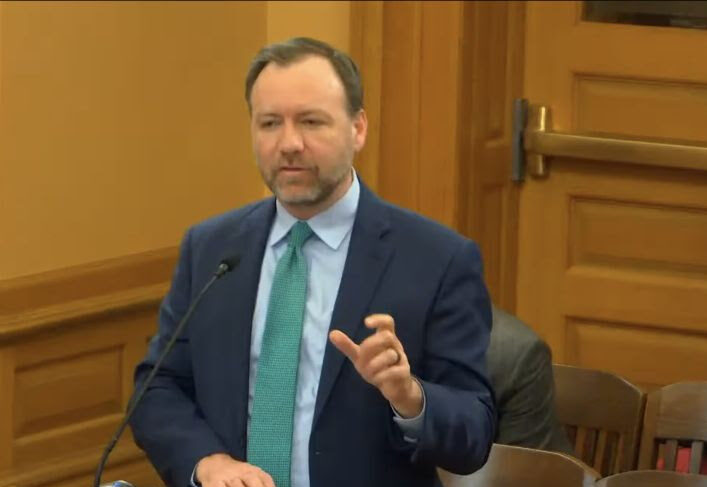
WATCH: I4AW’s Jonathan Wolfson Testifies Again: Portable Benefits Bill Considered in Kansas House of Representatives
February 11, 2026 // Visiting Fellow Jonathan Wolfson testified before the Kansas House of Representatives to offer expert analysis on HB 2602, a state bill that would allow businesses that hire independent workers to pay for benefits like retirement accounts or insurance without risking being punished by the government for "misclassifying" the freelancer as an independent worker instead of an employee.
Hearst Magazines Union stages walkout after WGA East contract expires
February 3, 2026 // Members of the Writers Guild of America East at Hearst Magazines staged a half-day walkout Tuesday after negotiations with management failed to produce a second collective bargaining agreement before their contract expired. The action affects roughly 400 union members whose first contract expired Saturday, Jan. 31, 2026. Workers held walkouts and rallies at Hearst Tower in Manhattan as well as at Hearst offices in Los Angeles; Easton, Pennsylvania; Ann Arbor, Michigan; and Birmingham, Alabama.
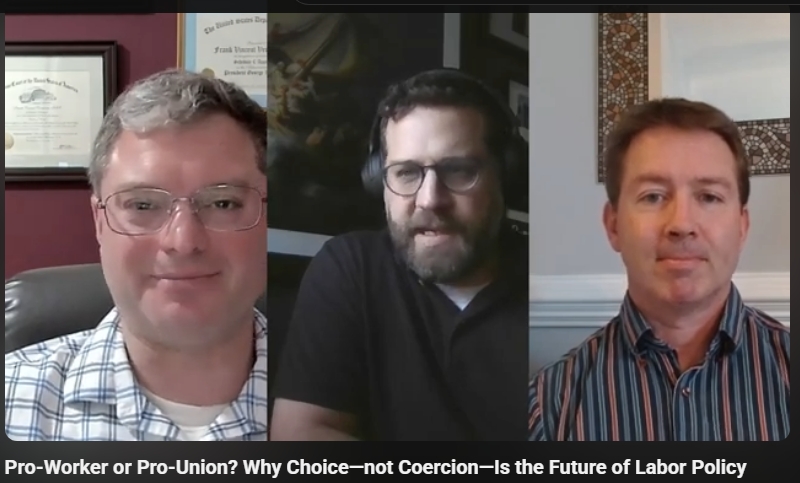
Pro-Worker or Pro-Union? Why Choice—not Coercion—Is the Future of Labor Policy, Disunion: The Government Union Report; Commonwealth Foundation
December 18, 2025 // This week on Disunion, host David Osborne is joined by Austen Bannan of Americans for Prosperity and Vincent Vernuccio, president of the Institute for the American Worker, to break down a sweeping new report: How to Empower Workers: Embracing a Pro-Worker Agenda Built on Choice. With Congress rolling out a flurry of labor bills—from right-to-work reforms and secret ballot protections to proposals backed by unions and even some Republicans—this episode cuts through the noise. The panel explains why many so-called “pro-worker” policies actually empower union bosses and government regulators, not workers themselves.
Get on the Job and Organize with Inside Organizer School
November 23, 2025 // On November 6, a panel of labor organizers local to the Twin Cities gathered with the IOS at the East Side Freedom Library in St. Paul, Minn. The conversation centered on Brisack’s book, Get on the Job and Organize: Standing up for a Better Workplace and a Better World, which was released in April. Packed with labor history, the book is about Brisack’s experience salting at Starbucks, but also about their experience as an external organizer for union campaigns at Nissan and Tesla. The conversation was not limited to salting. During the event, panelists connected wisdom from the book to their own experiences organizing different industries in Minnesota, and shared tips and stories with audience members about organizing in general.
RADIO: Vincent Vernuccio- Pro-Worker Labor Legislation That Promotes Worker Freedom
November 17, 2025 // Senator Bill Cassidy announced a swath of pro-worker labor legislation that promotes worker freedom and curbs undue influence and abuse by unions

America Doesn’t Have Enough Weapons for a Major Conflict. These Workers Know Why.
October 28, 2025 // Historically, in the fight against their bosses, unions have had only one real weapon to wield: their numbers. The primary goal of a labor strike is to blockade production and inflict pain on the company so that it will negotiate better terms. But in Orlando, it was hard for the union to enlist enough workers for the fight. Florida is a “right to work” state, meaning that union membership is optional. Workers in an organized factory are free to return to their stations and get back to work, leaving everyone else on the picket line to fight for a contract that would eventually apply to everyone.
Op-Ed: Instead of subsidy fights, Georgia should allow ‘portable’ benefits
October 20, 2025 // Meanwhile, other states have taken the lead on the matter. Utah, Tennessee and Alabama have all formally recognized portable benefits as a form of independent contractor compensation. Georgia can be next by passing a safe harbor portable benefits model, which will cost the state and federal government zero taxpayer dollars. It simply clarifies that companies can contribute to portable benefits accounts if they want and doing so is not evidence of an employee/employer relationship.