Posts tagged Congress
GOP’s populists flex muscles with wins on Capitol Hill
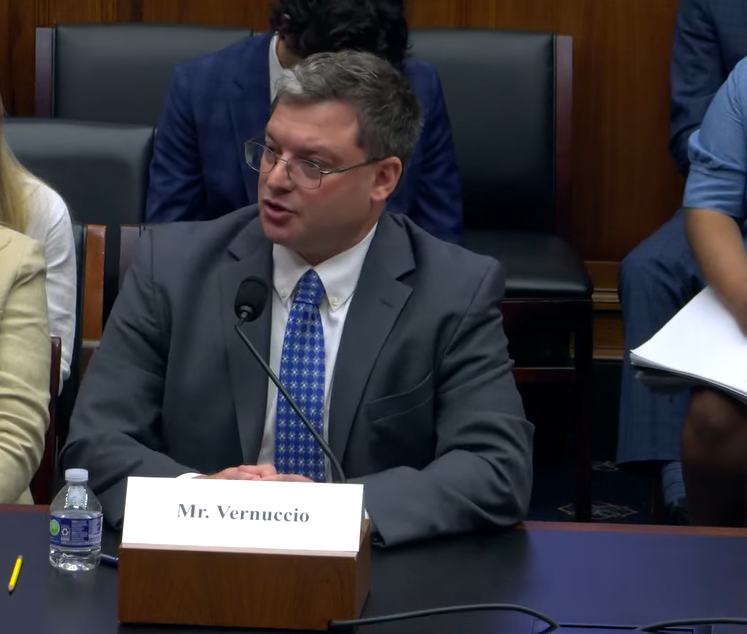
May 29, 2026 // F. Vincent Vernuccio, president of the Institute for the American Worker think tank, which has argued against the bill, pointed to hesitation that one union official expressed about that format in a Senate hearing last year, calling it undemocratic. “It takes away the whole point of a union because it takes away the vote from workers, and that’s exactly what the Faster Labor Contracts Act would do,” Vernuccio told The Hill. “If the union and the employer can’t come to an agreement within 120 days, this arbitration panel that’s appointed by government bureaucrats would write everything in that contract.”

Op-ed: The New Big Labor GOP
May 26, 2026 // The FLCA is a plank in the Big Labor PRO Act that failed to pass Congress in the Biden years. The bill is now likely to pass the House. The GOP Senate could kill it, but Josh Hawley (R., Mo.) is sponsoring the corresponding legislation there. The pro-union Republicans fancy themselves as tribunes for the common man, but they’re really rubber stamps for labor bosses who are allies of the Democratic Party.
CTDOL Finally Enforces the Union Transparency Law It Tried to Kill
May 24, 2026 // Frank Ricci, Yankee Institute’s labor fellow, argued that CTDOL’s reversal came only after outside pressure and legislative scrutiny. “Laws are worthless if the powerful can simply ignore them,” he said. “This statute exists to deter the misuse of funds and stamp out corruption — yet it was treated as optional by those sworn to uphold it.” That is the real story here. Connecticut’s public-sector unions enjoy enormous privileges under state law. Government employers collect dues on their behalf. Union contracts shape public budgets. Union leaders exercise political influence at the Capitol. At minimum, members should be able to see how their own money is being used. Transparency is not anti-union. It is pro-worker. Honest union leaders should have no fear of showing members the books. Members who pay dues should not have to hire lawyers, contact legislators, or embarrass a state agency into action simply to obtain records the law already guarantees.
Railway Safety Act in the balance
May 21, 2026 // Today, the House Transportation and Infrastructure (T&I) Committee is marking up the BUILD America Act — the surface transportation reauthorization bill. Among the amendments under consideration is the Railway Safety Act (RSA), a pro-union measure that has consistently failed to advance as a standalone bill but has suddenly gained new life with President Trump’s endorsement. The RSA purports to be aimed at ensuring an accident like the East Palestine, Ohio disaster does not happen again. Indeed, that is the president’s stated rationale for supporting the measure. However, as so often happens after a disaster, on hearing a cry that “something must be done,” opportunistic forces advance a policy wish list saying, “this is something, so let’s do this.” That is certainly the case with the RSA, which advances a long-held rail union position that two-person crews are necessary for safety. This is untrue. Research has shown that modern trains can operate safely with one-person crews. As T&I Committee Chairman Sam Graves (R-MO) said opposing the amendment,
Big Labor’s Rise to Power, or Big Labor Never Lets a Tragedy Go to Waste
May 21, 2026 // It contrasts Samuel Gompers’ early emphasis on voluntarism (“No lasting gain has ever come from compulsion”) with later leaders, such as Owen Bieber, who embraced “the persuasion of power.” Compulsory unionism—forced membership or dues as a condition of keeping or having a job—began in the private sector in 1935, and with the federal government’s help, it spread like a “cancer” to government workers, and it has eroded worker rights, public services, and democratic processes while enriching labor union treasuries and many union officers.
Op-ed: This LIRR Strike Should Be the Last
May 20, 2026 // Public employees in New York do not have the right to strike. The RLA, however, supersedes state law, effectively granting the railroad’s workers this right. Much has changed over a century, and this exception should no longer apply. In 1966, the Metropolitan Transportation Authority absorbed the LIRR, making the railroad a public employer. In 1980, federal courts rejected an attempt to enforce New York’s strike prohibition, in part because the LIRR was still hauling freight at that time. It no longer does. Nonetheless, the federal exemption has proved a powerful tool for the LIRR’s unions. Each time their labor contracts come up for negotiation, these groups threaten LIRR riders, and New York governors, with stoppages. They’ve carried out the threat before, most recently in 1987 and 1994.
DOL gets flexible on overtime
May 18, 2026 // The Fair Labor Standards Act (FLSA) requires that workers be paid time-and-a-half once a work week exceeds 40 hours. However, employers may exempt workers classified as managerial who meet a salary threshold. In 2023, The Biden administration raised the income threshold from $35,500 to $44,000, and planned to increase it again to $59,000 annually by 2025. This was intended to expand the number of people receiving overtime. The administration’s union allies and labor-sympathetic lawmakers have long argued that companies abuse the exception by designating regular employees as managerial to get out of having to pay them overtime. Raising the threshold was meant to prevent this. This one-size-fits-all approach did not necessarily benefit all workers.
Commentary: Josh Hawley’s Pro-Union Bill Would Let Washington Write Your Contract
May 16, 2026 // A Hawley-backed bill, known as the Faster Labor Contracts Act (FLCA), seems to be picking up steam and may soon pass the House of Representatives. Unfortunately, the FLCA is a trifecta of bad public policy: It suffers from constitutional infirmities, revives a corrupt government agency, and takes away the voice of both businesses and workers. Earlier this Congress, Hawley introduced the FLCA in the Senate, alongside one other Republican senator and three Democratic senators; he has since picked up another Republican and 10 more Democrats. Companion legislation in the House has 99 cosponsors, 17 of which are Republican.

Congress Should Reject the “Faster Labor Contracts Act”
May 15, 2026 // “What would happen if workers lost that ability to ratify a contract?” Cassidy asked. “That would be removing democracy from the workplace,” replied the Democrats’ witness, himself a union organizer. Despite this, the Faster Labor Contracts Act has since gained more cosponsors, which are almost entirely Democrats. In the House, Democrats are pushing for the passage of a discharge petition to force the bill through Congress. Union bosses such as Teamsters President Sean O’Brien are running an aggressive campaign to push for the bill’s passage, including attempts to fool Republicans into signing on.
MLB, players’ union meet to begin labor talks, sources say
May 14, 2026 // MLB intends to pursue a salary cap system, a financial structure that players staunchly oppose. The current deal, which came after a 99-day lockout by the league that threatened the beginning of the 2022 season, expires Dec. 1. If there is no agreement by the time the deal lapses, MLB is expected to again lock out the players, causing a work stoppage that could jeopardize games in the 2027 season. During the opening presentations, sources said, the sides outlined their views on the game, noting challenges they see and opportunities to use labor negotiations as a tool to move it forward.