Posts tagged Public Sector

Wisconsin saw steepest decline in union membership over 40-year period, report finds
March 30, 2026 // . “The only thing they could bargain on was their pay, and that was limited by law to never exceed the rate of inflation.” All of that, paired with a new requirement for every union to hold a recertification vote every year, means “many, many public-sector unions simply vanished,” Heywood said.
New group of Alexandria City workers vote to unionize
March 25, 2026 // As new negotiations gear up in Alexandria, public workers and unions around the state are waiting to see what Spanberger does with the public-sector collective bargaining bill that the General Assembly passed. The bill would remove the collective bargaining ban on local government, school board, and state employees. Currently, local government and school board employees only have the right to collective bargaining if their employers pass resolutions allowing them to do so. The bill would also extend collective bargaining rights to home care providers and service workers at public universities. The bill excludes university full-time professors, adjuncts, and librarians. These workers are waiting to see if Spanberger adds them back to the bill or makes other changes.
Modeling the Impact of Sectoral Bargaining for U.S. Workers
March 5, 2026 // New statistical modeling suggests that sectoral bargaining could more than double collective bargaining coverage in the United States and generate big gains in union density.

Opinion Public unions’ stealthy scheme will siphon $100B from NY taxpayers
March 1, 2026 // In fact, many union leaders say their members shouldn’t have to pay anything toward their pensions. And it’s a matter of “equity” and “dignity,” they say, for teachers and office workers at state agencies to be able to retire with full pensions (plus taxpayer-funded retiree health insurance) at age 55. The unions want to “fix” these supposed injustices.

Op-ed: Trump restores America’s control over Washington
February 12, 2026 // President Trump is all too familiar with this injustice. In his first term, senior bureaucrats repeatedly used their power to prevent his priorities from becoming policy. They slow-walked reforms at the Department of Education, refused to prosecute civil rights cases, and circumvented a federal hiring freeze—to name just a few examples. At the start of the second Trump administration, a poll found that 75 percent of federal managers who voted for Kamala Harris planned to disobey instructions they don’t like. But public servants are supposed to serve the public, even if they disagree with the party the public elected. In the private sector, workers could be fired for not doing their job. But until now, presidential administrations couldn’t hold senior bureaucrats accountable because federal rules made them effectively untouchable. While Democrats outnumber Republicans two to one at federal agencies, conservative career officials could also refuse to implement a liberal president’s agenda.
Labor standoff at LA’s Loyola Marymount University a battle over Catholic teaching
February 1, 2026 // On the pages LMU published profiling the dispute, the institution defends its action by stating “invocation of the religious exemption is lawful, grounded in the U.S. Constitution, and consistent with Supreme Court and NLRB precedent. This right cannot be waived and may be exercised at any point.” “The Board reached this decision to protect LMU’s Catholic mission, its students, and its long-term sustainability,” Griff McNerney, LMU’s senior director of media and public relations, told OSV News in an e-mailed statement. “After months of discernment, trustees concluded that direct partnership with faculty — without SEIU’s involvement — would enable faster, more mission-aligned progress toward shared goals.” McNerney noted, “From December 2024 to Summer 2025, LMU reviewed 39 proposals and made counterproposals, none of which were accepted by the union.”
Union Membership Stagnated in 2025 (report from Center for Economic and Policy Research)
January 28, 2026 // The share of US employees who are union members and the share who are covered by a union contract have both declined substantially over the past four decades (Figure 1). In 1983, 20.1 percent of workers were union members, and 23.3 percent were covered by a union contract. By 2010, union membership and coverage had fallen to 11.9 percent and 13.1 percent, respectively. In recent years, both measures reached historic lows. Membership declined to 9.9 percent in 2024 before ticking up to 10.0 percent in 2025, while coverage fell to 11.1 percent in 2024 and edged up to 11.2 percent in 2025. Throughout the entire period, the persistent gap between coverage and membership reflects the share of workers who benefit from union contracts without being union members.
Op-Ed Aaron Withe: Public-Sector Unions Have a Transparency Problem
December 18, 2025 // California takes it a step further. State law actually prohibits public employers from informing workers of their constitutional right to opt out. The Freedom Foundation is challenging these “gag rules” in court on behalf of Shasta County. The government actively prevents workers from learning the truth because it serves union financial interests. If unions provided valuable services that members wanted, they wouldn’t need to ensnare people through intimidation and bureaucratic obstacles.
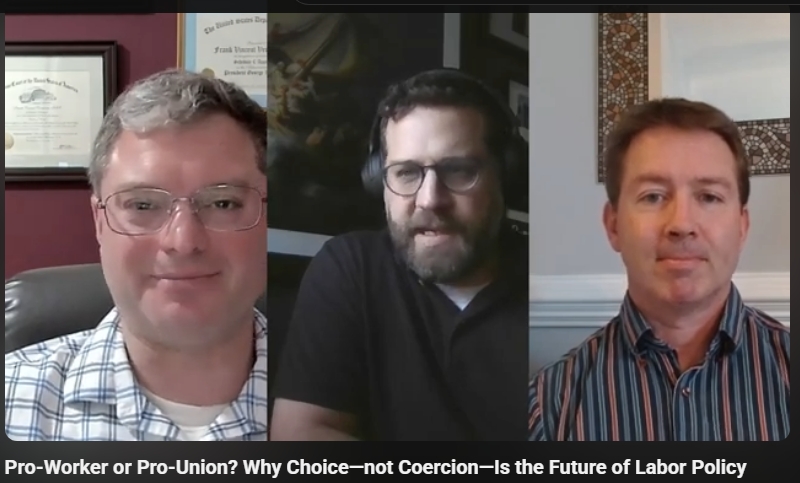
Pro-Worker or Pro-Union? Why Choice—not Coercion—Is the Future of Labor Policy, Disunion: The Government Union Report; Commonwealth Foundation
December 18, 2025 // This week on Disunion, host David Osborne is joined by Austen Bannan of Americans for Prosperity and Vincent Vernuccio, president of the Institute for the American Worker, to break down a sweeping new report: How to Empower Workers: Embracing a Pro-Worker Agenda Built on Choice. With Congress rolling out a flurry of labor bills—from right-to-work reforms and secret ballot protections to proposals backed by unions and even some Republicans—this episode cuts through the noise. The panel explains why many so-called “pro-worker” policies actually empower union bosses and government regulators, not workers themselves.
Unionization Wave Hits Nonprofit Sector
December 17, 2025 // ASeveral key economic factors are driving this current union organizing trend, including inflation and job security. In this environment, employees are motivated to seek the protections that higher pay and increased benefits offer. However, about one-third of nonprofit museums and cultural institutions are also struggling to confront the loss of government grants or contracts. More than half of museums reported fewer 2025 visitors than in 2019, according to a Novemberreport by the American Alliance of Museums. In spite of these conflicting economic difficulties, employees are continuing to push back, feeling that they have been taken for granted for many years. Bottom line: unions continue to seek out new groups of workers to organize as their traditional targets, such as manufacturing and production jobs, wane or move overseas. Nonprofit employers would be well advised to stay engaged with their employees, keep an eye on employee morale, and look for ways to reward employees' hard work even when funds are scarce.