Posts tagged NLRA
States’ substitutes for NLRB falter in court
January 5, 2026 // Troy Nunley, the chief judge in the Eastern District of California, ruled that the bulk of the state statute is in conflict with the National Labor Relations Act and therefore is preempted by federal law. “In some respect, the Board’s inability to fully function due to the lack of quorum shows the NLRA is operating as intended,” wrote Nunley, an Obama appointee. “The Court thus cannot conclude the loss of quorum equates to the NLRB ceding its jurisdiction over any particular matter.”
A new California law gives the state more power over workplaces. Trump is suing to block it
January 1, 2026 // With the NLRB unable to fulfill its duties, states are trying to fill the gap in enforcing the National Labor Relations Act, which Congress passed in 1935. But labor experts contacted by CalMatters do not have high hopes for the California law, which is similar to a law passed in New York this year. They said courts, including the Supreme Court, have ruled that states cannot decide matters pertaining to federal labor law because of preemption, the doctrine that a higher authority of law overrides a lower authority.
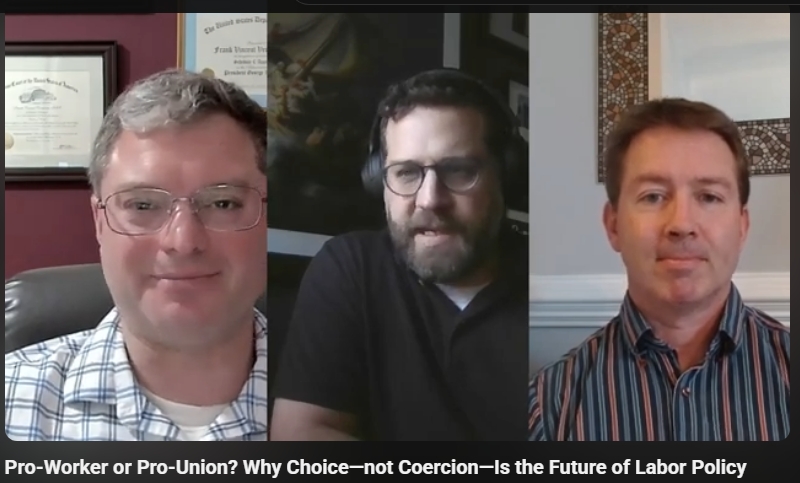
Pro-Worker or Pro-Union? Why Choice—not Coercion—Is the Future of Labor Policy, Disunion: The Government Union Report; Commonwealth Foundation
December 18, 2025 // This week on Disunion, host David Osborne is joined by Austen Bannan of Americans for Prosperity and Vincent Vernuccio, president of the Institute for the American Worker, to break down a sweeping new report: How to Empower Workers: Embracing a Pro-Worker Agenda Built on Choice. With Congress rolling out a flurry of labor bills—from right-to-work reforms and secret ballot protections to proposals backed by unions and even some Republicans—this episode cuts through the noise. The panel explains why many so-called “pro-worker” policies actually empower union bosses and government regulators, not workers themselves.
Halted: Federal Judge Stops Enforcement of New York’s ‘NLRB Trigger Bill’
December 5, 2025 // New York federal judge granted Amazon’s bid for a preliminary injunction barring the enforcement of recent amendments to the Empire State’s State Employment Relations Act (“SERA”) that would have subjected most private-sector employers within the state to the jurisdiction of the Public Employment Relations Board (“PERB”). Prior to passage of the “NLRB Trigger Bill” that amended SERA, PERB, which enforces state labor law, mainly oversaw public-sector employers in New York, though it also regulates labor relations for private-sector employers where federal laws – such as the National Labor Relations Act (“NLRA”) – do not apply, such as for agricultural workers. SERA, generally, applies more employee-friendly standards than the NLRA.
Viking Corporation Employee Slams Steelworkers Union With Federal Charges for “Closed Shop” Firing Threats
December 4, 2025 // When Dickinson emailed a Viking HR representative for clarification on her obligations, the HR rep claimed that “Per the new Michigan [Right to Work repeal] law and the Contract…those employees who do not sign the check-off authorization card, will not be allowed to work at Viking.” Dickinson’s charges include a charge against Viking management for repeating the misrepresentations of union officials. Dickinson’s charges also maintain that Steelworkers union bosses “violated the NLRA because [they] demanded that Charging Party, and all similarly situated nonmember discriminatees, opt-out of paying for political and ideological activities, instead of opting-in to make such political and ideological payments.” Supreme Court precedent, including the Foundation-won Knox v. SEIU case, establish the principle that union officials cannot assume that workers have waived their right to abstain from funding union politics.
Judge Grants Amazon Request to Block New York Labor Board Law
December 1, 2025 // Amazon won a court order temporarily blocking enforcement of New York’s statute attempting to claim jurisdiction over private-sector union disputes, which the retailer argues is preempted by federal labor law. The state law likely runs afoul of the National Labor Relations Act and should be enjoined while the legal challenge against it proceeds, the US District Court for the Eastern District of New York found.
Get on the Job and Organize with Inside Organizer School
November 23, 2025 // On November 6, a panel of labor organizers local to the Twin Cities gathered with the IOS at the East Side Freedom Library in St. Paul, Minn. The conversation centered on Brisack’s book, Get on the Job and Organize: Standing up for a Better Workplace and a Better World, which was released in April. Packed with labor history, the book is about Brisack’s experience salting at Starbucks, but also about their experience as an external organizer for union campaigns at Nissan and Tesla. The conversation was not limited to salting. During the event, panelists connected wisdom from the book to their own experiences organizing different industries in Minnesota, and shared tips and stories with audience members about organizing in general.

MAXFORD NELSEN: The Other Education Choice: Freeing Teachers from Monopolistic Unions
November 17, 2025 // Public-sector collective bargaining tends to crowd out the interests of students, families, and taxpayers in education policymaking, but teachers unions’ power comes from subjecting teachers to a monopoly system of workplace restrictions. While individual educators now have the legal right to forgo union membership, state policymakers have many opportunities to improve educators’ ability to exercise that right. To level the playing field and increase teachers unions’ accountability to the public and their own members, policymakers should consider reforming or replacing collective bargaining in public education.
After Year-Long Effort, McDowell County Commission on Aging Employees Free Themselves From SEIU Union Bosses
November 16, 2025 // Majority of employees signed petition demanding Commission stop bargaining with SEIU; success follows months of union stonewalling
8th Circuit Backs Home Depot in “BLM Apron” Case
November 16, 2025 // The Eighth Circuit disagreed, holding that Home Depot had “special circumstances” justifying enforcement of its dress-code policy. The store was near the site of civil unrest following George Floyd’s death, and the Court accepted that Home Depot could lawfully restrict potentially divisive messaging to protect employee safety, maintain order, and preserve its public image based on a “reasonable belief” as opposed to direct evidence. The case was sent back to the NLRB for further review under that standard.