
Posts tagged independent contracting

Vernuccio, Institute For The American Worker on The William Wallis for America Show
March 10, 2026 // Vernuccio, Institute For The American Worker on The William Wallis for America Show Vinny Vernuccio is the President of The Institute For The American Worker. In this interview at The Pelican Institutes Solutions Summit he talks about legislative ideas he is working on in DC to help the average American Worker.
2026 Independent Contracting- DOL Rulemaking
March 5, 2026 // The proposed rule would revise federal standards for classifying workers under the Fair Labor Standards Act (FLSA). It would also rescind the 2024 independent contractor regulation and largely restore the January 2021 framework, with clarifications and updates. The proposal returns to a traditional “economic reality” analysis focused on whether a worker is in business for themselves or economically dependent on an employer. In particular, it restores emphasis on two core factors: The degree of control exercised by the company The worker’s opportunity for profit or loss

Déjà vu all over again as Trump administration move to protect freelancing
March 2, 2026 // Congress should take up legislation to codify a sensible standard that protects gig economy workers and settles the issue for good. Legislation to that effect, the Employee Rights Act, has been introduced and deserves congressional consideration.
Freelance Busting: ‘Absolute Stalemate’
February 20, 2026 // The nearly two-thirds of Americans who would prefer to be our own bosses need protection from this encroachment on our freedom to choose self-employment. So do the vast majority of us who are already independent contractors and wish to remain so. It’s beyond frustrating that the help we need may be a long time coming, especially at the federal level. Experts recently gathered to discuss the reality of the situation in Congress during an hourlong Federalist Society panel, where they minced no words about why the challenges in Washington, D.C., persist.
Webinar with The Federalist Society: Labor Law Reform on Capitol Hill: Opening Offer or Impasse?
February 17, 2026 // Last session saw no shortage of proposals in Congress for labor-law reform. In the Senate, lawmakers introduced proposals ranging from mandatory interest arbitration to bans on organizing undocumented workers. In the House, representatives proposed a range of union-democracy reforms, including a requirement for unions to poll their members before endorsing a candidate for president. And in between, scholars and practitioners offered their own ideas, including a proposal to transform the National Labor Relations Board into an article I court.

Empowering Workers in a Changing Economy with Vinnie Vernuccio | Let People Prosper Ep. 184
February 6, 2026 // Too many labor policies today assume workers need protection from choice. But the evidence shows the opposite. When workers can choose how they work, who represents them, and how they negotiate, they’re better off—economically and personally. Vinnie Vernuccio’s work reminds us that labor policy should serve workers as individuals, not institutions with political clout. If we want a labor market that adapts, innovates, and actually lifts people up, we need reforms rooted in freedom—not nostalgia.

Testimony: Jonathan Wolfson: NH House of Representatives Committee, House Labor, Industrial and Rehabilitative Services
January 20, 2026 // And what this bill really does at says if a worker and the business that they're working with want to enter into an agreement where a portion of that pay, whether that is the pay, the base pay they agree on or some sort of supplemental pay, wants to go into some sort of account. Maybe that business offers health savings accounts to their employees and they say to that independent worker, would you like us to put some of the dollars that we would otherwise pay you into that health savings account which allow you to have some tax benefits for the dollars going in there instead of going to you directly? This allows them to do that without taking the risk that in the status quo they have. And that risk is that by simply paying those dollars into a benefited account, that business is at risk that that person could be considered misclassified under New Hampshire law. whether that is workers compensation, unemployment insurance, state labor law, or state tax law.

Watson Commentary: Making the AFL-CIO great again: labor policy in 2026
January 20, 2026 // The biggest labor issue of all might be the changing composition of what remains of the union movement. Goodbye, manual-labor men; hello purple-haired they/them grad students.

PODCAST: Empowering Workers with a Prosperous Future with Austen Bannan | Let People Prosper
January 15, 2026 // America’s labor policies are stuck in the past—designed for a 1930s economy that no longer exists. Meanwhile, workers have moved on. They want flexibility. They want choice. They want opportunity. And increasingly, government is standing in the way. My guest is Austen Bannan, Workforce Policy Fellow at Americans for Prosperity and one of the sharpest voices making the case for worker freedom over bureaucratic control. Austen works at the intersection of labor policy, occupational licensing, and education reform—where outdated rules quietly crush opportunity for millions of Americans.
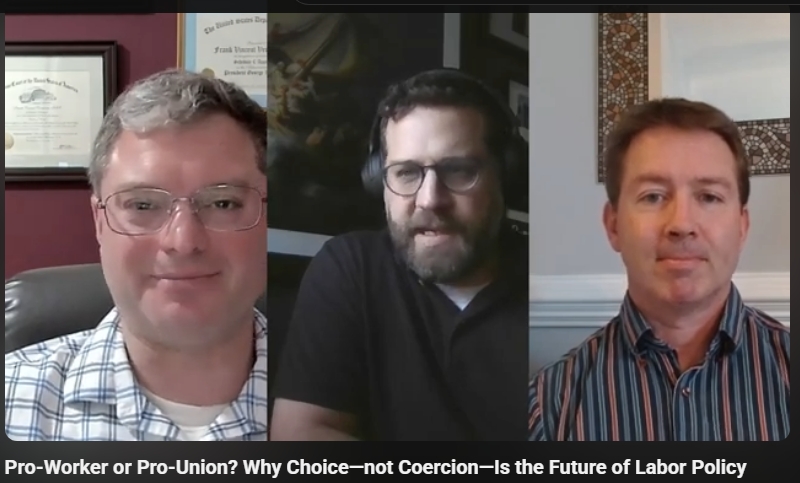
Pro-Worker or Pro-Union? Why Choice—not Coercion—Is the Future of Labor Policy, Disunion: The Government Union Report; Commonwealth Foundation
December 18, 2025 // This week on Disunion, host David Osborne is joined by Austen Bannan of Americans for Prosperity and Vincent Vernuccio, president of the Institute for the American Worker, to break down a sweeping new report: How to Empower Workers: Embracing a Pro-Worker Agenda Built on Choice. With Congress rolling out a flurry of labor bills—from right-to-work reforms and secret ballot protections to proposals backed by unions and even some Republicans—this episode cuts through the noise. The panel explains why many so-called “pro-worker” policies actually empower union bosses and government regulators, not workers themselves.