
Posts tagged Faster Labor Contracts Act

Commentary: Congress is about to undo DOGE’s biggest win
April 13, 2026 // That corrupt flow of campaign cash into Congress’s coffers is ultimately why, instead of being eliminated by DOGE, the FMCS is on track to be given a whole new set of powers. New Jersey Democrat Donald Norcross recently filed a discharge petition on the Faster Labor Contracts Act. The petition will force the House to vote on the bill once it reaches 218 signatures. The bill can easily hit that target if all 214 House Democrats sign the petition, along with any four of the bill’s 17 Republican cosponsors. Understanding a politician’s real priorities often requires zooming into these quiet battles over little-known agencies.
Op-ed: A bipartisan bill that would hurt employers and unions
April 12, 2026 // The bill would mandate that workers sometimes be subjected to labor contracts that they never vote for. The idea is to reduce the amount of time it takes between a union being recognized as the collective bargaining agent in a workplace and the enactment of an agreement. The National Labor Relations Act requires recognized unions and employers to negotiate in good faith, but it does not say how long that negotiating may last. In some cases, it can last years.
Webinar with The Federalist Society: Labor Law Reform on Capitol Hill: Opening Offer or Impasse?
February 17, 2026 // Last session saw no shortage of proposals in Congress for labor-law reform. In the Senate, lawmakers introduced proposals ranging from mandatory interest arbitration to bans on organizing undocumented workers. In the House, representatives proposed a range of union-democracy reforms, including a requirement for unions to poll their members before endorsing a candidate for president. And in between, scholars and practitioners offered their own ideas, including a proposal to transform the National Labor Relations Board into an article I court.
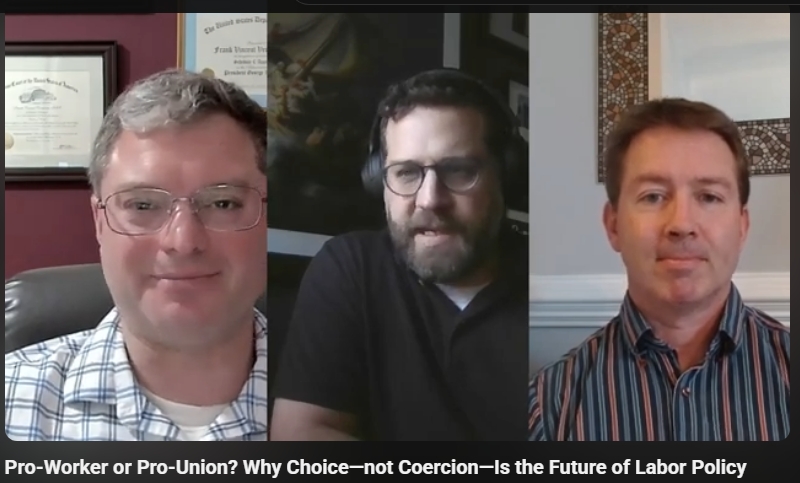
Pro-Worker or Pro-Union? Why Choice—not Coercion—Is the Future of Labor Policy, Disunion: The Government Union Report; Commonwealth Foundation
December 18, 2025 // This week on Disunion, host David Osborne is joined by Austen Bannan of Americans for Prosperity and Vincent Vernuccio, president of the Institute for the American Worker, to break down a sweeping new report: How to Empower Workers: Embracing a Pro-Worker Agenda Built on Choice. With Congress rolling out a flurry of labor bills—from right-to-work reforms and secret ballot protections to proposals backed by unions and even some Republicans—this episode cuts through the noise. The panel explains why many so-called “pro-worker” policies actually empower union bosses and government regulators, not workers themselves.
Labor Unions Are Chipping Away at Worker Freedoms One Bill at a Time
October 14, 2025 // The so-called Faster Labor Contracts Act is one of the first steps in this new tactical departure. The legislation would force employers to begin bargaining with a new union in just ten days. If the two parties don’t reach an agreement in 90 days, the government forces mediation. One month after that, the matter goes to binding arbitration, meaning an outside arbitrator will dictate wages, benefits, and workplace rules for years to come. That’s not worker freedom. It’s top-down federal control. Americans recognize proposals like this for what they are: a Washington power grab. A U.S. Chamber of Commerce survey released just two weeks ago found that 90% of voters oppose government-mandated union contracts without worker approval.

Testimony: Rachel Greszler: Labor Law Reform Part 1: Diagnosing the Issues, Exploring Current Proposals
October 10, 2025 // SummaryToday’s challenges—from the rise of artificial intelligence to the expansion of independent work and the growing demand for flexibility, autonomy, and new skills—necessitate modernized labor laws that are pro-worker and pro-employer, regardless of the type of workplace. Heavy-handed government interventions and attempts to bring back the 1950s’ ways of work are not the answers. American labor laws should preserve the freedom, dignity, and opportunity that make American work exceptional.
Op-ed: Democrats and Republicans agree: The clocks are ticking on union contracts
September 29, 2025 // Despite these clear benefits, the process of reaching a first contract can often drag on for well over a year. Unions are met with delay and silence while trying to negotiate. According to Bloomberg Law, it takes an average of 458 days for workers and employers to reach a contract after a union is formed. And that’s after workers have already won a union election — a process that is too often met with stiff resistance or outright union-busting.

Op-ed: A GOP-Teamsters Alliance Makes No Sense
August 24, 2025 // Republicans getting on board with these ideas aren’t just awkward—they’re incoherent. There’s little evidence that endorsements from Teamsters executives move the needle in general elections, for parties or for candidates. Can Republicans credibly argue that filling the Teamsters’ coffers (and campaign-donation kitty) will result in the sort of political realignment some hope for, or even a lasting political windfall? The only guaranteed outcome is more power for the Teamsters and other unions over U.S. labor relations. If these overtures to the Teamsters backfire, Republicans can’t say they weren’t warned. As one GOP politician running for Missouri attorney general tweeted in 2015, after labor-aligned Republicans derailed state right-to-work legislation, “time for an end to union-backed candidates in GOP.”

Podcast Newt Gingrich, Vinnie Vernuccio; Episode 837: Protecting the American Worker
May 5, 2025 // Newt’s guest is Vincent Vernuccio, president and co-founder of the Institute for the American Worker. They discuss the significant labor policy developments and legislative efforts aimed at increasing transparency and accountability in both public and private sectors. Their conversation covers the introduction of the Start Applying Labor Transparency (SALT) Act, which seeks to amend the Labor Management Reporting and Disclosure Act of 1959 to ensure greater transparency in financial transactions between unions and labor consultants. Vernuccio also explains the implications of President Trump's executive action, Schedule F, which aims to make certain federal employees at-will to enhance accountability. They also discuss the challenges posed by public sector unions and the potential impact of Senator Josh Hawley's Faster Labor Contracts Act, which could impose arbitration on private sector union negotiations. Vernuccio emphasizes the need for modernizing union models to align with today's workforce demands for flexibility and merit-based advancement.
Free the Economy podcast with Vinnie Vernuccio of the Institute for the American Worker
March 27, 2025 // Our interview for Episode 116 of the Free the Economy podcast is with Vinnie Vernuccio of the Institute for the American Worker. We talk about labor unions, independent contractors, right-to-work laws, port automation, and the future of the American workforce. Free the Economy is hosted by Richard Morrison. Our co-producer and editor is Destry Edwards. Keep up with new episodes by following us on Twitter at @freethe_economy and read our episode summaries, with links to the stories we cover, at cei.org/blog.